Rhode Island’s community health centers are bracing for a new round of financial and operational challenges as changes to Medicaid eligibility, new work requirements and uncertainty surrounding a federal drug discount program threaten to put additional pressure on organizations already struggling to recruit providers and balance their budgets.
For the state’s nine federally qualified health centers, the stakes are significant.
They serve hundreds of thousands of patients, including many who rely on Medicaid or have limited access to other sources of care. Now, health center leaders are trying to figure out how to absorb potentially lower revenues and higher administrative demands without reducing services for the patients who depend on them.
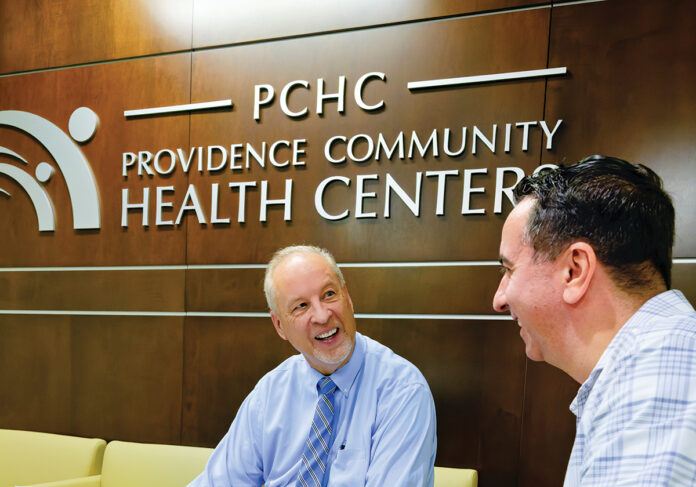
“We have had to make cuts over the last three years to get to a balanced budget due to cuts in the Medicaid program,” said Merrill Thomas, who spoke to Providence Business News before he retired in October after 25 years as CEO and president of Providence Community Health Centers.
Thomas said PCHC has already closed clinics and combined another site because of financial pressures.
“I got a lot of grief. There was negative stuff about us because we had to do that. It was a financial reality,” Thomas said
Now, health center leaders are trying to prepare for what could come next.
“The main thing is, since January we have seen a 30% increase in self-pay because of the loss of the Affordable Care Act subsidy,” Thomas said. “And that is before anything happens next year with the [One Big Beautiful Bill Act].”
The challenges are not limited to PCHC.

At Wood River Health, CEO and President Alison Croke said a shortage of primary care providers is creating gaps in the organization’s ability to care for patients. Wood River Health has lost three or four primary care providers to Connecticut, she said.
“It also adds to the burden of the remaining staff of primary care providers because we have the same number of patients we are trying to care for with less people to care for them,” Croke said.
At the same time, the health centers are watching changes to Medicaid eligibility and a legal challenge by pharmaceutical makers and the federal government to Rhode Island’s 2025 law protecting the 340B drug discount program.
The program, created by Congress in 1992, requires drug manufacturers to provide outpatient medications at steep discounts to safety-net healthcare providers.
Wood River Health, which serves residents in Rhode Island’s Washington County and southeastern Connecticut, mostly in rural areas, benefited from the 340B legislation, Croke said.
“That legislation and our ability to draw down that rebate is a big part of the reason why we ended the year in the black last year,” Croke said.
She said the organization has a $13 million operating budget and described the impact of 340B as a million-dollar swing from year to year.
Croke said 340B helps close the gap created by inadequate reimbursement rates and has become Wood River Health’s second-largest revenue stream.
“Threats to our ability to draw down that rebate could potentially be very impactful,” Croke said.
Chuck Jones, CEO and president at Thundermist Health Center, said he is hopeful that Rhode Island’s law protecting 340B for community health centers will withstand the pharmaceutical companies’ lawsuits.
“It is absolutely critical for our ability to provide low-cost drugs to our patients, especially our uninsured patients,” Jones said.
Another major concern for Rhode Island’s federally qualified health centers is the changing Medicaid landscape.
Jones said that beginning in 2027, Rhode Island Medicaid expansion adults will have to meet community engagement or work requirements to maintain eligibility, unless they qualify for an exemption.
“I believe Rhode Island has chosen to permit self-attestation on meeting those requirements or qualifying for exemptions,” Jones said.
“The ability to self-attest will hopefully mitigate the eligibility losses among eligible individuals in 2027,” he said. “In 2028 the ability to self-attest goes away, and some part of that increased admin burden will be placed on our clinical staff who will be asked to provide certifications for exemptions.”
At Wood River Health, about 40% of medical billing is Medicaid-related.
Croke said the number of people who could lose coverage is difficult to predict.
“The projections … could be 10, 20, 30,000 people in Rhode Island, and without insurance, there is not a lot of places you can go, but you can go to a community health center,” Croke said.
While health center officials are not necessarily worried that they’ll have to close their doors because of the current financial and staffing challenges, they are concerned about what could happen if more patients lose coverage.
“We had to close clinics, and we had to combine one of our other sites,” Thomas said. “I don’t think I am going to have to close something else right now. But in a year or two if 50,000 people lose insurance, potentially we would have to scale back some things.”
Thomas said the potential effects are particularly challenging because Rhode Island health centers provide care for about 200,000 people, which he said represents 1 out of 5 Rhode Islanders.
Croke said it’s possible Wood River Health will have to scale back when services are offered.
“What is more likely for us is a potential change in hours,” Croke said. “Some other health centers have made changes to their hours of operation as well. That is more of a realistic change than a closure for us,” Croke said.
Rhode Island’s health centers are dealing with many of the same challenges while continuing to work together on ways to respond.
The leaders meet monthly for board and operational meetings “so we can strategize,” Croke said. “What is our legislative agenda for next year, how do we position ourselves so that we are prepared for what is going to happen at the federal level?”
With more financial challenges looming, the search for ways to remain financially sustainable is more urgent.
“We are looking into opportunities regarding value-based care,” Jones said. “If we can find ways to create savings in the healthcare system, we have arrangements that share some of those savings with us that can be a source of additional revenue for us.”
Jones also said technology could offer opportunities to improve efficiency.
“There are a lot of administrative functions: something as simple as drafting provider contracts – we have developed a simplified and consistent AI [artificial intelligence] tool to do that; better customer service, including coach and train AI to assist us in that area,” he said.
PCHC is also looking at technology solutions aimed at making billing, call center and scheduling more efficient.
The goal, Thomas said, is to do things “better, faster and cheaper.”
For now, however, the health centers are still trying to determine exactly what the coming changes will mean for their patients and their own finances.
“We are trying to forecast the future as best we can. But right now it is kind of dire. We are expecting cuts in Medicaid … and we are trying to figure out how to respond,” Thomas said.
“I don’t have any cuts planned right now; we are trying to get our hand on what do we think the Medicaid enrollment is going to be and see what that does to our revenues,” he said.
Mary Benvenuto has been named CEO and president of PCHC and started in the role on Oct. 13.