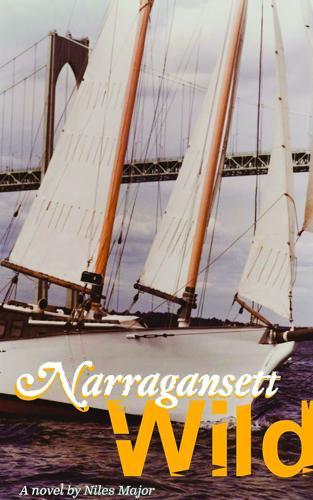
Some stories refuse to disappear. They linger in the back corners of a state’s memory, half legend and half truth, waiting for someone who lived close enough to tell it. For the self-published debut novel “Narragansett Wild,” that person is Niles Major, an author with a very personal connection to the events he chronicles. What he produced is a vivid, unflinching, and sometimes uncomfortable record of one of the most audacious criminal enterprises in Rhode Island history, told through the eyes of someone who grew up in its shadow.
“Narragansett Wild” was published in January 2026 and centers on the Dorchester case, a massive drug-smuggling operation that played out in and around Narragansett and the broader South County region during the late 1960s and throughout the 1970s.
The operation, conducted by a charismatic and daring figure the author names Jimmy Chin, attracted hundreds — possibly thousands — of participants. It made front-page news in the Providence Journal-Bulletin for years, ultimately ending in acquittals and mistrials that left law enforcement powerless. Major describes it as the largest criminal story in Rhode Island history, and the research he put behind that claim is substantial.
Jimmy Chin, the novel’s mastermind, and his wife Cecile are Major’s parents. Major, whose given first name is Teddy, grew up in Narragansett as the son of an international drug trafficker whose face appeared regularly on the local news and whose name filled newspaper columns for years. He attended school while that coverage unfolded, navigated the awkward and painful social consequences, spending decades sitting with a collection of stories he knew would eventually demand to be told.
The book took 15 years to write. Major spent four of those years in the microfiche stacks at the University of Rhode Island, pulling front-page articles from the Providence Journal-Bulletin that documented the case in real time. The result is a novel that blends documentary detail with narrative prose, a combination that occasionally strains against itself but more often propels the reader to learn more.
The opening chapters, which work hard to establish the atmosphere of a seedy, electrified Narragansett before the operation takes shape, ask the reader for patience. Once the criminal machinery is in motion, the storytelling finds its footing.
From the Narragansett coastline, the story moves through the Florida underworld, into the Caribbean Islands, up to the forests of Maine, and eventually out to Hawaii, where Jimmy Chin was born and ultimately retreats as a fugitive.
Along the way, the novel brushes against the edges of organized crime at its most expansive, with figures modeled on real-world players including Meyer Lansky’s Jewish Mafia and the Rhode Island mob.
The settings are rendered with a writer’s eye for texture, and readers with roots in South County will find the geographical detail to be among the book’s greatest pleasures. Major is especially sharp on what Narragansett felt like at its most untamed, when the town had, as he describes it, a seedy and honky-tonk undercurrent that a tourist-friendly vibe has since replaced.
That richness of local lore is one of the book’s genuine strengths. For readers who know the history of Narragansett, South County, and Rhode Island, the novel is a guided tour of a place that no longer exists. The author changed names throughout to protect players who are still alive, some of them connected to prominent South County families, but those familiar with the era will likely recognize the landscape immediately.
It should be noted that the sex, drug use, and criminal conduct described in the novel are not presented sparingly. Major makes no apologies for his material, and his authorial sympathy for the men at the story’s center is explicit and unwavering.
Readers who approach the material on its own terms will find a genuinely compelling story. Those looking for moral reckonings will find the novel frustrating by design.
Major recently held a signing at Wakefield Books, where he was met by readers who remembered the real events and came bearing stories of their own. He will also deliver an author talk on June 27 from 1-2 p.m. at the Maury Loontjens Memorial Library, 25 Pier Marketplace, Narragansett.
Major sat down to discuss the novel, the Dorchester case, and what it meant to finally put the story into print.
Q: Where are you in this novel? What is your connection to the story?
A: “So, how I’m connected to the book, Jimmy Chin and Cecile are my parents. So they’re real people. I just changed their names. I’m basically a vessel. I have a myriad of stories, and I didn’t know what to do with them. I had heard these stories for the past 56 years about all these things that had taken place, whether it be from Scarborough lifeguards to all the drug smuggling. I grew up with it. I grew up with the whole Dorchester case. I knew exactly what was going on. I was a smart little kid. So I had to live with that. I had to go to school with that. My dad was in the papers. He was on TV at night. I had to deal with that with teachers. I had to fight kids at school. There was a lot to unpack.”
Q: What drove you to write this book after so many years?
A: “It was just going to turn to folklore. Even though it’s a true story and it happened, and it’s based on real people and events, I didn’t want that to happen. So that’s really what drove me to write the book. Anyone who reads the book will immediately know who I’m talking about, because these people were icons at the time. They were revolutionaries. They were men who lived way out on the edge, and they were well known around town.”
Q: Why did you choose the novel form rather than nonfiction?
A: “I chose a novel format because I thought it was going to be more interesting to the audience. I went the novel route because I wanted to really spin a good yarn. I wanted something readable, something that would stand the test of time. And when I had my book signing, interestingly enough, I had people thanking me for writing the book, people I had never met before, saying, ‘I can’t believe you wrote this. This is amazing.’”