Photo: Michael Derr
South County, summers aren’t just measured in weeks — they’re measured in the rhythms of the tide, the hours spent offshore, and the race to get out on the water before the season inevitably fades. The good news? You don’t need to own a yacht or know the difference between a bowline and a cleat hitch to join in the fun.
The experts — marina owners, charter captains, sailing instructors, and surf coaches — agree on the golden rule for a great boating season: ensure that everyone gets home safely and looking forward to the next trip.
Slip Into Something Comfortable
For boaters who own their own vessels, finding a place to keep them is always the first order of business. North Kingstown’s Darren Jodoin dove headfirst into marina ownership when he purchased Greenwich Cove Marina in East Greenwich last year.
A power boater for 25 years and a fisherman at heart who is “still chasing the big dream of catching a gigantic tuna,” Jodoin runs a boutique operation with 18 slips that can handle anything from a small skiff to a 50-foot boat. The marina is fully booked, with a waiting list, and this season features brand-new docks.
Greenwich Cove is distinguished by its supportive culture. The marina lends life jackets as a courtesy, keeps extra lines and fenders on hand, and actively helps boaters at the docks.
“Safety actually enhances the experience of boating, in my opinion. It doesn’t take away from it,” Jodoin said. “When everybody’s prepared out in the water, you can definitely relax and just fully enjoy your time out there.”
Still, even experienced boaters make mistakes.
“The number one mistake everybody makes when they’re on a boat is just complacency,” Jodoin said. “People get comfortable.”
In busy Greenwich Bay, with its high traffic and ever-growing number of new boaters, conditions can change quickly, and respecting the water — and fellow boaters — during each trip is key.
Jodoin’s safety-first philosophy is a family affair. His two daughters, ages 20 and 17, have also grown to love boating.
“Since they were born, they have been on the water, and we have just been always showing them the ropes,” he said.
They are both skippers, and his youngest recently earned her boater’s license.
Let Someone Else Take the Helm
Of course, not everyone has a boat or slip, but that is no reason to stay ashore. SeaEscape Charters, based in Point Judith, is the perfect entry point for anyone looking for a low-commitment way to test the waters.
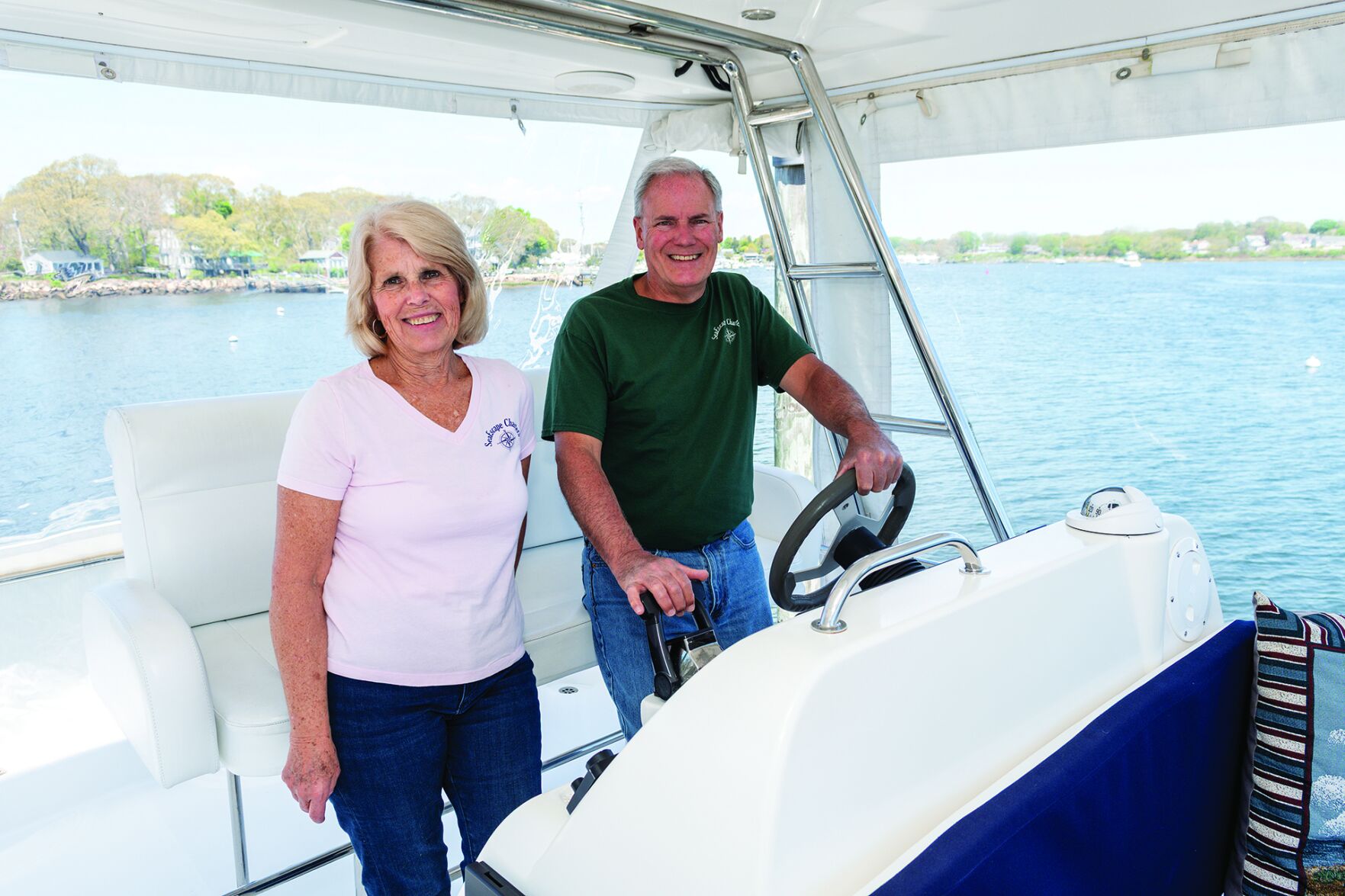
Owner Lesli Kelleter and her husband, Captain Donald, a Coast Guard licensed captain, have been running charters for more than 30 years. Their private cruises carry up to six passengers on two- and three-hour trips that wind through Point Judith Pond, past the working waterfront of Galilee, and out toward the Harbor of Refuge and Point Judith Lighthouse. Guests bring their own food and drinks, and the boat comes equipped with a cooler, bottled water, and comfortable bow seating.
The trips are fully customizable, and the couple has hosted a variety of occasions ranging from birthday parties to memorial ash scatterings.
Before every departure, the crew conducts a thorough safety briefing.
“We talk about where the life jackets are, all the trip hazards on the boat, and how to travel back and forth from the back of the boat to the bow,” Kelleter said.
What keeps people coming back is the shift in perspective they experience on the water.
“What everyone says to us is that ‘I see South County, I see Galilee in a whole different light’ when you’re looking at it from the water,” Kelleter said.
She tells all of their guests to keep an eye out for Bighead, a resident seal who pops up during most of their charters.
Paddle Your Own Course
A chartered cruise is one way to ease into life on the water, but for those who prefer to journey at their own pace, kayaks or paddleboards allow explorers to choose their own adventures. Since 1995, The Kayak Centre in Wickford has been the premier destination for paddlesports. With its convenient waterfront launch, Wickford Harbor offers kayakers and paddleboarders their own personal recreational area.
Brad Kinckner, who handles retail and marketing, says the business prides itself on leading with safety and teaching proper technique.
“We’re really about getting people on the water,” he said. “We have classes specifically just to get people comfortable and understanding kayak strokes. A big thing that we see is people using the wrong muscles or doing things not exactly the right way.”
Single kayak rentals are an affordable way to explore the Bay, with doubles, standup paddleboards, and pedalboards available as well. For beginners, the Just Strokes class, a half-day morning session, runs multiple sessions each summer. The Kayak Centre also offers guided tours, including moonlight paddles and sunset excursions. For groups looking to make a splash, there is the Fiesta, a four-person pedal-powered raft.
“It’s literally a party,” Kinckner said.
Children under 13 are typically paired with a parent/guardian in a tandem kayak, based on staff assessment of their size, experience, and the weather. Life jackets are required by Rhode Island law for all kayakers and paddleboarders, and the Kayak Centre reviews safety protocols with every renter before launch.
Surf’s Up (Eventually)
From harbor paddling, it is a very short leap into the open ocean. Narragansett Surf and Skate, located at 74 Narragansett Avenue, teaches year-round and serves roughly 20 students a day at the peak of the summer season. Camps run for kids ages 7 through 15, and private and group lessons welcome all ages.
Options include private lessons, lessons for two, and group lessons for three or more participants. Board rentals are also available for the day. Saturday surf lessons run from 11 a.m. to 1 p.m. three weekends a month during the spring and on Wednesday evenings.
Manager Tricia Pan said every first lesson begins the same way.
“All of our first lessons start with the safety,” she said. “Simple things like where to keep your surfboard, how to cover your head, where to stay in the lineup to be out of the way.”
One important note for parents: life preservers are not safe for surfing.
“There’s times in surfing where you do have to be able to get under the water, and if you’re staying afloat, it’s going to make it hard,” Pan explained.
Wetsuits, which the shop also rents to learners, offer both warmth and sun protection.
Pan acknowledged that Mother Nature does not always cooperate, but is hoping she will this season. Last summer’s waves were the flattest in recent memory. Her father told her it was the worst surf since 1963.
“It can only go up from there,” she said with a laugh.
A Woman’s Place Is at the Helm
From surfboards to 45-foot sailboats, a clear theme emerged: the growing presence of women on the water is fundamentally improving boating culture.
Kristin Walcott is a pioneer in the boating world. A licensed U.S. Coast Guard commercial captain and American Sailing Association instructor, Walcott came to sailing 15 years ago when her then-husband, a Rhode Islander, introduced her to racing. When he suffered a stroke and became limited physically, she realized she had to take on a bigger role.
Learning at the Narragansett Sailing School under the guidance of owner Mary Goff proved to be a life-changing experience.
“Being taught by another woman and her wonderful, positive attitude just hooked me,” Walcott said.
She now specializes in private sailing lessons on Narragansett Bay, focusing on assisting new boat owners. Her instruction covers handling the vessel, understanding its systems, and docking. She is a member of Edgewood Yacht Club, where women currently hold the commodore and vice commodore positions, and this season she and a fellow female captain will take turns driving the launch.
Walcott believes women bring natural strengths to boating.
“We tend to plan and think ahead,” she said. “Before heading into the marina, we’re already taking into account where the wind’s coming from, what’s the traffic like, who’s going to be doing what.”
Her advice for couples who boat together? Both partners need to be competent.
“You never know when you’re not going to have that other person to rely on,” Walcott said. It is both a safety issue and an empowerment one.
Walcott does not mince words about the broader culture on the water.
“There’s a dangerous combination of arrogance and ignorance that seems to be pervasive right now,” she said. “When it comes to boating, that can be life or death.” She urged boaters to take time to educate themselves, to understand they do not know everything, and to behave respectfully on the water.
Walcott would urge any woman who has ever felt the pull of the ocean but felt intimidated to just go for it.
“You already have what it takes,” she said.
Safe Harbor: Keeping Everyone Afloat
No organization embodies the spirit of preparation more fully than the Better Bay Alliance (dba Safe Boating RI), a nonprofit founded in 2019 after tragedy struck. Dave Lussier, the group’s president and a retired software engineering executive, lost a dear friend, Sandra Tartellino, when a powerboat struck her 20-foot sailboat on a clear, sunny day.
“It was just irresponsible piloting by the powerboat, basically,” Lussier said.
After a period of grief, a dedicated volunteer board of eight members developed two important free resources. One of these is LiveChart, an interactive Google Map available at betterbayalliance.org, which features over 400 Narragansett Bay events each boating season. Users can select any date and four-hour time window to view color-coded polygons showing exactly where races, festivals, swim events, Navy testing, and fireworks are taking place. New this year, LiveChart integrates the DEM aquaculture farm database, flagging oyster and scallop farms that can ruin an unsuspecting boater’s day.
“On any day of the entire boating season, you can call this product up and see what’s going on in Narragansett Bay,” Lussier said. The tool logged around 2,000 users last year and has earned buy-in from the Coast Guard and DEM, both of which now share data with the Alliance.
The group’s second offering is its free, two-hour safety seminars, held at marinas and yacht clubs throughout Rhode Island. The sessions cover rules of the road, navigation aids, and bay-specific hazards. These seminars reached roughly 200 boaters last year.
Lussier uses a dramatic drone video of a near-collision between racing sailboats and a powerboat to drive home the point that right-of-way does not mean the right to ignore danger.
“Clearly these sailors thought, ‘I’ve got right of way because I’m a sailboat,’ and they didn’t even try to avoid the power,” Lussier said. “The bottom line is everybody was wrong.”
The seminars also address the post-pandemic surge in paddle craft, a category the Coast Guard has not specifically addressed since 1976. For anyone who began using a kayak during COVID, the free class is time well spent.
Cast Off
All professionals interviewed, from licensed captains to surfers, stressed that the water is for everyone and getting out on it need not be intimidating. The boating season in Rhode Island is short. Check the weather, share your plan, wear your life jacket, and enjoy your favorite corner of the Bay.
For more information, visit betterbayalliance.org, seaescapecharters.com, kayakcentre.com, and narragansettsurfandskate.com.