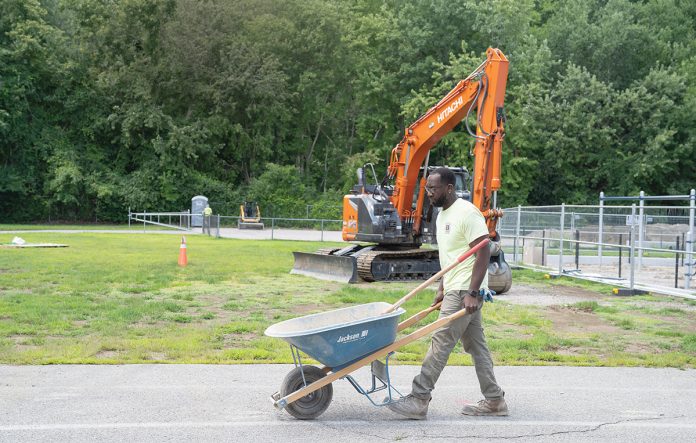
Rhode Island’s construction trades gained 400 jobs in July, a positive sign for an industry that nonetheless is facing a workforce reckoning: Thousands of experienced workers are nearing retirement, while the state expects 26,556 job openings in the trades by 2032.
Replacing those workers will depend in part on strengthening an apprenticeship system that trains the next generation of electricians, plumbers, carpenters and other skilled tradespeople. Industry leaders say that system is working, but not fast enough to ease concerns about the labor pipeline.
“The No. 1 concern is the shortage of skilled labor,” said Andrew Cortés, CEO and president of Providence-based Building Futures, which runs a pre-apprenticeship program that teaches general skills and exposes participants to different trades. “A really high percentage of people [in a recent survey] consider a shortage of workers to be an existential challenge.”
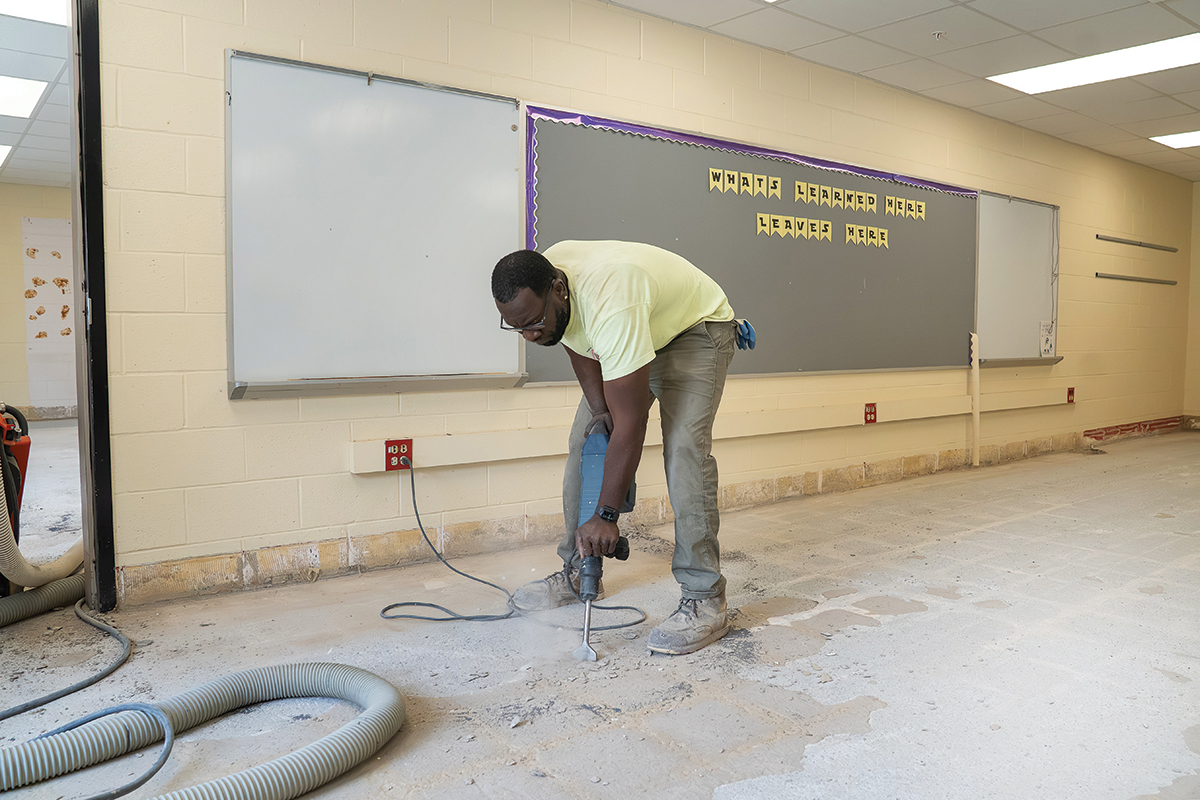
Apprenticeships help prepare the next generation of workers, and for some, including Thomas Fallah, can be life-changing. A member of Carpenters Local 330, Fallah, 39, is in his second year as an apprentice flooring installer and works for Ruggieri Brothers Commercial Flooring, based in Cranston.
Fallah found training, union membership and apprentice employment with the help of Building Futures. He first heard of the organization’s pre-apprenticeship program while he was in prison. He signed up and his training began in a workshop on the prison grounds.
He says it can be very hard to get into a union, but Building Futures functioned as a kind of “uncle” or “big brother” to ease his entry into union membership and training.
“I love this work,” Fallah said. “I would advise anybody with a kid coming out of high school that the trades are the way to go.”
But there remains a shortage of people entering the apprenticeship system, and it can be challenging for those that do to get placed on job sites for required training.
FOOT IN THE DOOR
Apprentices are hired voluntarily by contractors and paid from Day 1, at a lower wage than a more advanced journeyman. Employers, sometimes in connection with trade unions, create a classroom training program. Where a union is not a partner, instruction may be provided by a third-party institution.
Training varies across industries, typically lasting three to five years and requiring 6,000 to 8,000 hours on the job. Building Futures says a first-year apprentice earns an average of $42,000. It says total earnings over a four-year apprenticeship are $218,000 in wages.
Joseph Degnan, assistant director at the R.I. Department of Labor and Training, says the state now has 2,336 apprentices and 642 registered sponsors, meaning employers using them.
Joe Lopes is CEO and president of the state chapter of Associated Builders and Contractors, an organization representing nonunion shops. He says problems in the apprenticeship system include “access” for people starting their careers and “scale,” meaning a shortage of job openings for apprentices.
Regarding access, Lopes says people interested in a career in the trades can have trouble getting a foot in the first door. A person with no contacts in the industry has to find a contractor and persuade the contractor to hire them. That can be difficult.
He says he would support a system where people could begin their classroom training and then go to contractors to ask for work. This demonstration of due diligence “opens the door for a conversation with an employer,” Lopes said.
The number of apprenticeship opportunities on job sites is also constrained by required ratios of journeymen to apprentices. State and federal law require a minimum number of journeymen on the job for each apprentice. Depending on the trade, a job site must employ from one to five journeymen for each apprentice, limiting the number of apprenticeship positions available.
Mark Massa, an electrical contractor who founded Exeter-based Stony Lane Electric Inc. in 1997, says his staff consists of himself and one journeyman, so he can never employ more than two apprentices, even though he would like to do so. He says the limit is not necessary for training or for safety.
Cortés sees another problem. He says some contractors are “reluctant” to hire apprentices, preferring to hire journeymen because they don’t want other workers on the job to be distracted by coaching an apprentice. He says this reluctance is a mistake because “an apprentice provides value from Day 1.”
EXPANDING OPPORTUNITY
Efforts are underway to expand apprenticeship opportunities and reduce the cost to contractors of hiring apprentices.
The Apprenticeship Utilization Program aims for at least 15% of the total labor hours on a project to be performed by apprentices. This is existing policy for Brown University, the city of Providence and state contracts valued at $1 million or higher.
Building Futures and Brown are collaborating on a three-year Contractor Incentive Program for graduates of the nonprofit workforce trainer, funded by Brown. The program pays participating contractors 50% of the wage for the first 400 hours of employment of an apprentice. The idea, Cortés said, is to “de-risk” the use of apprentices.
Ruggieri Brothers in Cranston is taking part in the contractor incentive program. David Ruggieri, president, says the company has used apprentices for years, bringing three to five apprentices on board every year, with good results. The incentive program has a financial benefit, but more important, Ruggieri says, is the work by Building Futures to recruit and prepare candidates for apprenticeships. “They are doing the front-end work for us,” he said.
“Apprenticeships are very effective; they help us with our labor shortage,” Ruggieri added. “When we get a quality candidate, we can train them as we want to train them.” Ruggieri says his company has had gaps in the availability of apprentices over the past decade, and he would like schools to make more young people aware of opportunities in the trades.
Lopes said the industry’s shared objective is clear: “We are all working to build a workforce of skilled and motivated apprentices.”