
We get it — politics doesn't always inspire excitement, people have lives and jobs, and sometimes it can feel like one thing America is good at is running interminable elections. Well, don't worry, The Messenger politics team has you covered, with sharp insights from our reporting on the ground and in conversations with newsmakers from both major parties to reveal the eight things we learned in 2023 that could have a major impact in 2024. Without further ado:
Biden Needs the Israel-Hamas War to End — ASAP
While the politics around Israel and the Middle East has been thorny since time immemorial, it’s been pretty clear for months now that President Joe Biden needs the Israel-Hamas war to not just wind down, but really, come to an end. The reason being the clear generational divide found in national polling since the October 7 terrorist attack that has shown that while older Americans strongly support Israel, young voters who were a part of Biden’s winning coalition in 2020, are more likely to say they support Palestinians.
That support from young people, who describe themselves as pro-ceasefire and anti-genocide, has been part of the reason Biden’s approval rating has tumbled this fall. What’s more, a New York Times/Siena College national survey released December 19 found that for the first time, Donald Trump led among 18 to 29-year-olds, 49% to 43%.
“Usually, it’s not worth dwelling too much on a sub-sample from a single poll,” the NYT’s Nate Cohn wrote, “but this basic story about young voters is present in nearly every major survey at this point.”
More bad news on that front? The generational divide extends to politically important Latino voters, too.
While the administration began by supporting Israel’s right to defend itself and publicly batted down ceasefire calls from its left flank, the White House has increasingly been pushing Israel to end its large-scale ground war, while POLITICO Europe said the administration had “given Israel until the end of the year to wrap up its war on Hamas.”
So what do Democrats hope happens politically should the war end? The idea is that Biden’s numbers with young people will improve once the war is months in the rear-view mirror, say spring or summer, as they are confronted with the realities of a second Trump term. Democrats believe at that point young people will be reminded that their politics aligns much more with Biden than it does with Trump. — Adrian Carrasquillo
Trump Is Still Who He Says He Is
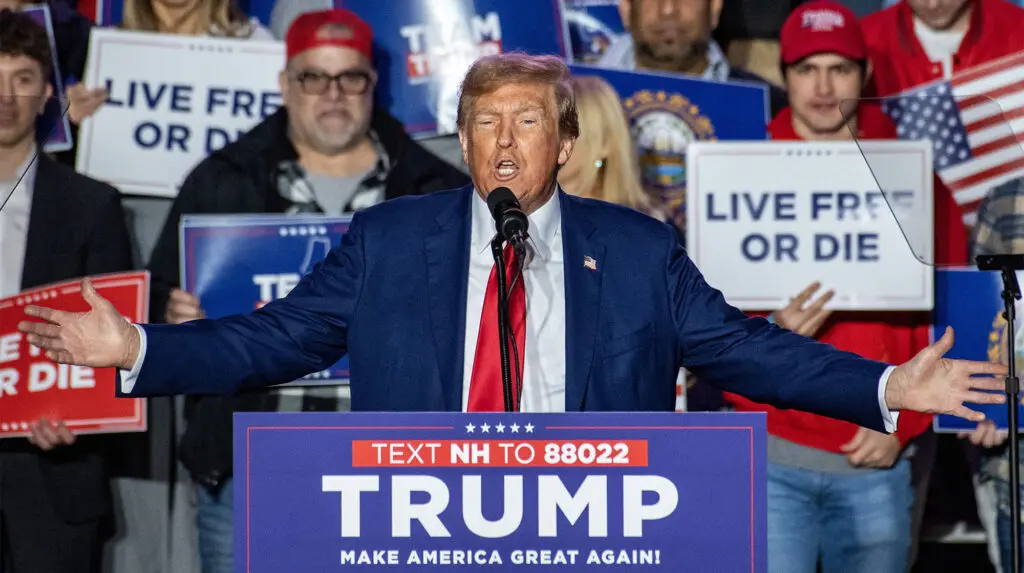
One of the easiest political predictions for 2024 is what happens in the partisan primaries. President Joe Biden is certain to be renominated against token opposition, and former President Donald Trump isn’t far behind as he faces slightly more difficult opponents.
One of the hardest predictions in all of politics is WWTD: What Will Trump Do?
Answer: whatever he wants.
Since 2016, Trump has built a brand on basically saying whatever comes into his head and on Twitter. But that was before he was banned from it after the Jan. 6 U.S. Capitol riot, before Twitter was rebranded X and before Trump founded his own Truth Social media platform to continue saying whatever he wanted.
But Truth Social doesn’t have the user base that X does, so Trump’s incendiary, extreme, wild, offensive and even funny commentary doesn’t make news the way it used to. So Trump is making news the old fashioned way – by speaking at rallies and on television – “joking” he wants to be dictator (but only for a day, and only for more oil drilling and immigration crackdown) and by saying undocumented immigrants are “poisoning the blood of our country” (but he insists it’s not a Mein Kampf reference, and his surrogates claim he’s really talking about the damage from cross-border fentanyl.)
Expect more of the same in 2024. Trump is not a candidate who will be fully reined in, despite running a more disciplined campaign team so far. Trump will continue saying what he wants and, if he’s accused of being racist or sexist so that the criticisms reach a fever pitch, expect more of it because he likes the fever pitch.
Trump also lashes out more if he’s under more pressure. And Trump is facing more of a crucible than any major candidate ever as he fights a New York civil fraud trial to dissolve his family business and four separate criminal cases. In the civil case and the Jan. 6 federal criminal case, Trump has been gagged by the judges for his attacks on personnel and prosecutors, orders that have resulted in thousands of dollars of fines and appeals from Trump.
That’s right, even judges are struggling to gag him.
The criminal cases could go to trial while he’s on the campaign trail. What happens if he’s convicted is anyone’s guess.
Polls show Trump is nursing an inside-the-error-margin lead over Biden, so in Trump’s mind, all the criticism is just noise. And with polls showing that a majority of Americans don’t want a Trump-Biden rematch, it increases the likelihood of an election that revolves around turning out the base.
To Trump, that likely means more cowbell.
So get ready for more “dictator for a day” jokes, more “poisoning the blood of our country” moments, more courtroom drama and maybe some more gag orders he ignores. — Marc Caputo
GOP With Their Heads in the Sand on Abortion
Republicans endured a string of anti-abortion losses this year, highlighting how the GOP has yet to contend with the central reality that most voters support reproductive rights.
Since the fall of Roe v. Wade in 2022, abortion has appeared on the ballot in 8 states–both red and blue–and has won each time. In November, Ohio voters resoundingly approved Issue 1, a constitutional amendment to enshrine abortion rights into the state constitution. And despite the fact that the amendment passed with 56% support, some Republicans chalked up the loss to anti-abortion political disadvantages— ignoring the simple fact that abortion rights are popular.
Jessie Hill, a professor at Case Western University previously told The Messenger after the approval of Issue 1: “They [Republicans] do not seem to realize how out of touch they are with the voters. Republicans have gerrymandered themselves into power and have been there for so long, and they've been living in this echo-chamber for so long that I think they just kind of can't accept this defeat.”
Abortion was also a winning issue in Kentucky and Virginia, where voters rejected anti-abortion candidates. The election served as a testing ground to determine how much of a driving force abortion is for Democrats. The Republican losses in both states only affirmed that abortion continues to be a major driving force for Democrats and that Republicans are on the losing side of the abortion debate. — Khaya Himmelman
The House Is Up For Grabs and It Could Come Down To Redistricting
The House majority is already almost entirely up for grabs solely due to the slim margin Republicans hold. Democrats only need to net five additional seats to flip the lower chamber, but they have their sights set on more than just a handful of competitive swing districts.
Over the past year, several legal battles have played out across the country over congressional lines — including one case that made its way to the U.S. Supreme Court. Since the Supreme Court’s ruling earlier this year upholding a major tenet of the Voting Rights Act, a number of lower courts have weighed in on whether districts in places like Alabama and Florida should redraw their Congressional maps ahead of next year’s election.
Courts are largely deciding whether states have been upholding Section 2 of the Voting Rights Act in drawing their congressional lines, which “prohibits voting practices or procedures that discriminate on the basis of race, color, or membership in one of the language minority groups,” according to the Justice Department.
But a number of other cases have also been playing out, including in New York, another state that will have to redraw its maps ahead of next year. The case in New York was not about the Voting Rights Act, but instead about the way the maps were drawn for the last election.
With the House majority coming down to so few seats, every district matters, including ones that have yet to be drawn.
Both Republicans and Democrats have seen redistricting wins, but there are still a number of outstanding maps and cases that are expected in the new year. Depending on how these are drawn, it could ultimately determine who wins the lower chamber next year. — Sophie Tatum
Americans Really Don’t Want the Rematch They’ll Probably Get
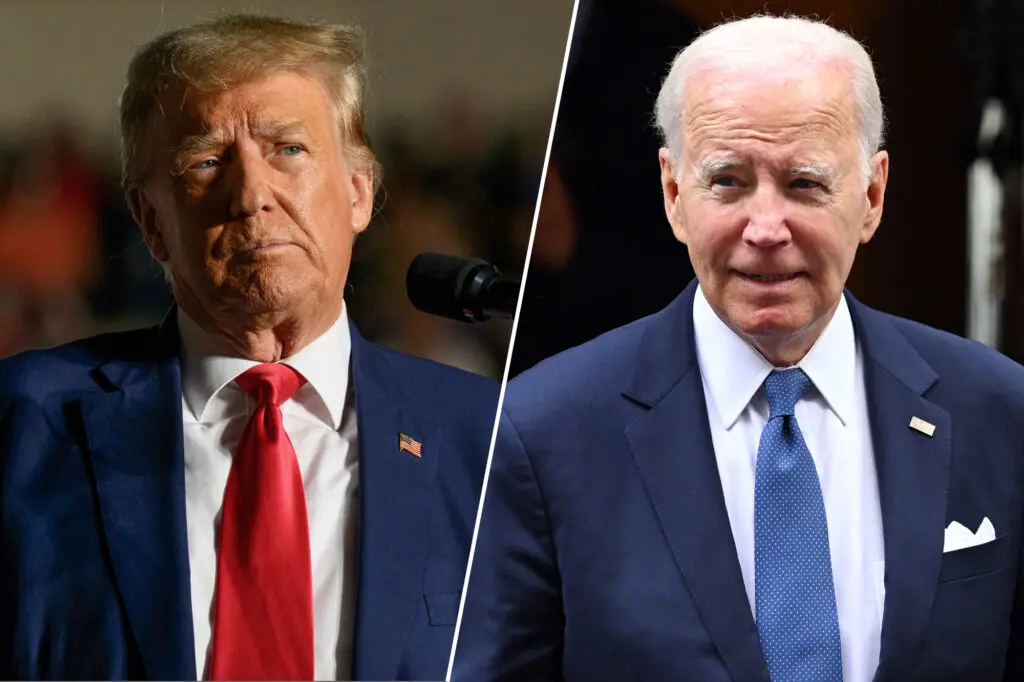
In poll after poll, Americans have made it clear that they do not want a Biden vs. Trump rematch in 2024.
Both parties are marching toward that reality anyway.
Trump is dominating the Republican presidential race in the essential early states, while Biden’s longshot primary challenger has failed to generate any momentum in New Hampshire, where the unpopular president is not even on the ballot. Of course, things could change – no votes have been cast in the 2024 primary. But right now, it seems unlikely that either party will replace its leader. This unpopularity means no one knows the role third-party candidates could play.
Voters are apprehensive about Biden’s age and his handling of the economy and foreign affairs, and Trump is facing 91 criminal charges, some tied to his alleged role in trying to overturn the 2020 election, all while his recent comments have inspired comparisons to some of history’s most infamous dictators. — Stephanie Murray
Biden’s Poll Numbers Aren’t Holding Democrats Down
Biden is leaving 2023 with some of the lowest approval ratings numbers of his entire presidency, saddled with doubts about his handling of the economy, trustworthiness, and ability to beat Trump in November.
Those polls, however, are having little impact on Democrats running in Biden’s image. The party had a strong year, winning a string of special elections, riding anger about abortion to ballot measure victories in key states, and clawing back power from Republicans like Virginia Gov. Glenn Youngkin. In nearly all these cases, Democrats ran on the same issues Biden has championed in the White House, partly validating the Democratic argument that their agenda and message are strong when presented to voters.
The question headed into 2024 is whether that decoupling between Democratic success and Biden’s flagging approval rating will continue. Biden’s top aides are confident it will, viewing victories in these states as proof they are on the right track. It’s a risky bet to make, however: Few presidents who went on to win reelection headed into an election year with the kind of dismal numbers Biden is currently feeling. — Dan Merica
The Senate Map Is Tough For Democrats, But Republicans Could Be Their Own Worst Enemies — Again
With West Virginia Sen. Joe Manchin deciding against reelection, the margin of error is slim for Senate Democrats in 2024. Holding onto a 51-49 majority, if President Biden loses reelection, Republicans will have to pick up just one seat to take back control of the upper chamber. Democrats are defending two red state Senators — Montana Sen. Jon Tester and Ohio Sen. Sherrod Brown. Both will have to run ahead of Biden in their respective states, as Montana and Ohio are not expected to be competitive on the presidential level. On top of those two races which are expected to be heavily contested, Democrats will have to defend seats in battleground states like Arizona, Michigan, Nevada, Pennsylvania, and Wisconsin.
With the amount of defense Democrats need to play, Republicans believe they have a good chance of victory next year — if they can stay out of their own way. In 2022, messy primaries across the country hindered their candidates, leaving them down on cash and bruised from vicious attacks before the general election even started. The National Republican Senatorial Committee has been more active in candidate recruitment this cycle, and so far it looks like they’ve avoided contentious primaries in West Virginia and Pennsylvania, while their pick in Nevada, Army Captain Sam Brown, looks more formidable than his primary opponents.
But nasty primaries are looming. In Montana, where retired Navy SEAL Tim Sheehy, the NRSC’s pick, looks like he’ll be challenged by Rep. Matt Rosendale – although Rosendale hasn’t made any decision official. In Ohio, a three-way primary is set to be an expensive affair between one statewide office holder and two wealthy candidates. In Michigan, the NRSC did not clear the field for their pick, former Rep. Mike Rogers, who has three primary challengers. And in Wisconsin, Republicans are confident that businessman Eric Hovde will eventually enter the race against Democratic Sen. Tammy Baldwin, but so far no Republican has stepped up to run.
Democrats believe the same dynamics that befuddled Republicans in 2022 will strike again. But they are under no illusions that holding their majority will be easy. — Matt Holt
Latino Voters Could Very Well Decide the 2024 Election
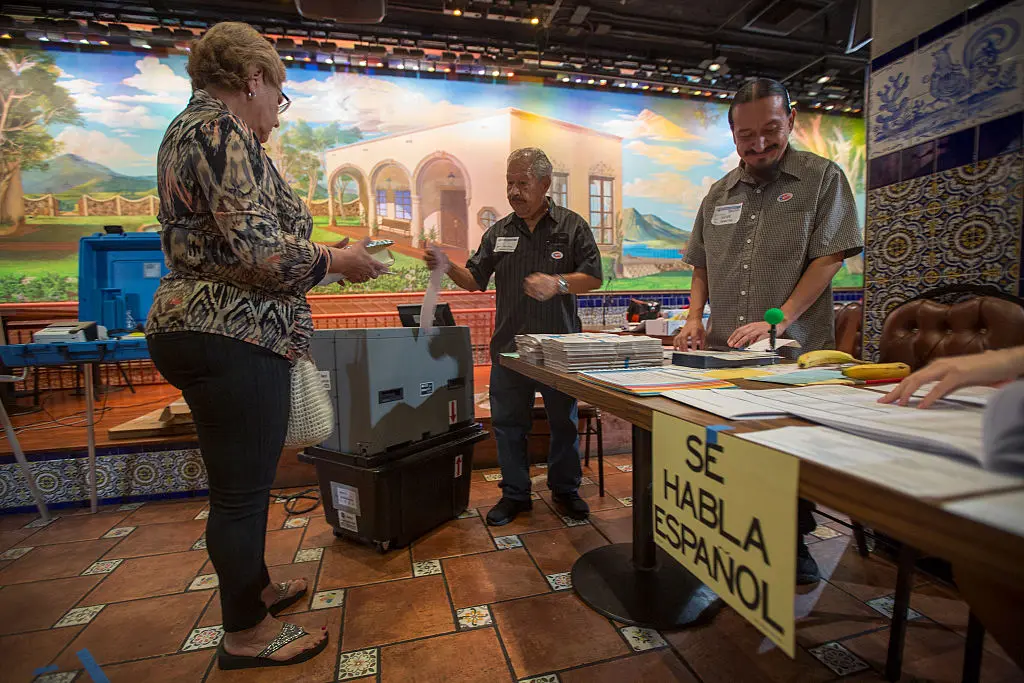
A tried and true thing happens when a battleground state goes in a candidate’s column, vaulting them to the presidency. With Arizona in 2020, which hadn’t turned blue since 1996, the jockeying for groups to take credit on the win began instantaneously. Some said it was Cindy McCain’s endorsement mobilizing moderate Republicans and independents who were still on the fence. While others gave credit to the state’s sizable Latino population. When the margin is a razor-thin 11,000 votes, everyone is right, it turns out.
Ahead of 2024, it looks like Hispanic voters will again be critical to who wins in Arizona and Nevada, where polls show the tightest of races.
This topic frustrates some Latino Democrats. Close to half of Hispanics live in blue California or red Texas, which means they aren’t often sought after electorally. But the southwest has emerged as a key barometer and bellwether for the Latino vote, particularly with one-third of residents being Hispanic, in Arizona and Nevada, respectively.
For Democrats it has often been part of a blue wall (one top Democratic strategist Chuck Rocha calls it part of a “brown wall” for his party) but that has changed, particularly in a state like Nevada where Donald Trump lost by just 2.4 points in 2020. Since then, Republicans knocked off an incumbent Democratic governor and nearly toppled Sen. Catherine Cortez Masto, who won by less than 8,000 votes last year. If Trump wins Nevada, that wall would crumble like when the Night King took down the wall in Game of Thrones, and with it, possibly Joe Biden’s presidency as well. — Adrian Carrasquillo