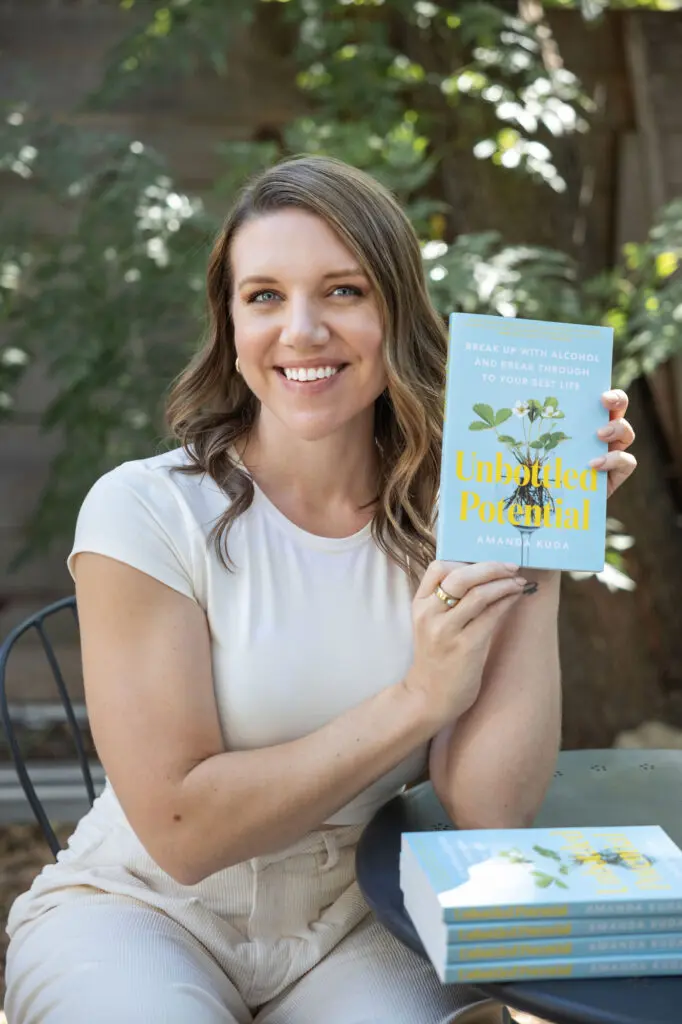
Amanda Kuda, author of Unbottled Potential, helps people change their relationship to alcohol
Sobriety began to change shape in 2018 with the release of Sober Curious by Ruby Warrington, who had started the alcohol-free event series Club Soda NYC a few years prior. Around that time, beautiful new mocktail recipes appeared online alongside #sobercurious social media groups, and people started to realize they didn’t need to be alcoholic or anonymous to question their relationship to booze.
The movement generated more ways to meet the ongoing challenge of alcohol. Of course there’s Dry January and Sober October, as well as apps that help users cut-back such as Reframe, and cocktail bars that offer low-proof or no-proof options.
For people wanting a more personal approach, there’s also sober coaching: a one-on-one relationship that provides accountability and support for those who want to examine their relationship to drinking, but either don’t need or don’t want to go to a traditional rehabilitation center or 12-step program.
Amanda Kuda, sober coach and author of the podcast and book Unbottled Potential spoke to The Messenger about how sober coaching works, how much it costs — and who should still go to rehab.
First off, who should go to a traditional rehabilitation program and not rely on sober coaching?
Someone who knows they have a physical addiction, and they don't know how to quit by themselves. A person who needs help and support through withdrawal and other symptoms of alcohol use disorder is going to be a good fit for the traditional recovery approach.
Have you ever referred a potential client to a rehab program?
- Wegovy Effective Against Alcohol Abuse: Study
- Non-Alcoholic Beer Is the New Beer
- Brain Surgery Cures Alcohol Abuse in Gene Therapy Study
- How to Finish Dry January, According to an Alcohol-Free Expert
- Tom Holland Opens up About ‘Really, Really Struggling,’ ‘Being Addicted’ to Alcohol
- Jelly Roll on Alcohol and Cocaine Use: ‘I Thought Drinking Was to Make Us Not Feel Like Drug Addicts’
Oh, absolutely. Several times. Other coaches might handle it differently, but I ask a lot of questions in the process of deciding if I'm a good fit to work with someone in order to get down to what their relationship with alcohol is and what their needs are.
It's not serving someone to say, “Yeah, let's get together” if I know that they need a different type of help. I'm not a therapist, so I am really diligent about asking questions to get to the bottom of what's going on in their lives, and knowing if I am best equipped to support them, because that's really important to me.
Who is a good fit for sober coaching?
People who are pursuing a coaching approach don't resonate with the language of traditional recovery.They know they don't have an addiction, but they drink more than they like, and they want to change that. And they know because of the social stigma around alcohol that it's going to be more difficult than just not drinking.
They want to learn how to navigate the world alcohol-free. They want to learn about the underlying causes of why they're drinking, and so they're looking for that supportive network or that supportive relationship that a coaching program or engagement can provide.
Do most of your clients want to quit alcohol completely, or do they just want to drink less?
I personally only work in my one-on-one programs with people who aspire to not drink at all. I think that there are a lot of times when people come into my network, and there is that fantasy, which I certainly had, that they might become a moderate drinker, an every now-and-again drinker. But the approach that I use is designed to help my clients create a life that they don't want to escape from.
My ultimate goal is that the client has put these building blocks into place where they understand why they drink. They now have the skills and the confidence to overcome some of the areas where alcohol has stunted their growth.
In the method that I teach, I say, ‘Let's not ever put the word ‘forever’ on our tongue, because that can be really intimidating.’ But ultimately they want to have a relationship where alcohol is irrelevant in their lives.
It sounds like ‘moderation’ with alcohol is different from alcohol being ‘irrelevant’?
I think that there's a difference between people who want to moderate, because alcohol is still taking up your brain space. You're still thinking about when you're going to drink, how much and sometimes beating yourself up if you go overboard.
When alcohol becomes irrelevant in your life, you don't need it. You don't really desire it. And from that place, I think it's really easy to make the decision that you don't want to drink at all. It's no different than if you break up with a romantic partner, and for a while you kind of want them back, but after a while, you get over them. And it's not that you hate them necessarily, it's just that you no longer have that desire and that need for them in your life. You've maybe done some personal healing work, and that relationship is now not necessary for you.
What questions should someone ask themselves if they are considering sober coaching?
Do you feel like alcohol is altering your ability to live the life that you truly desire?
You're not at a rock bottom. Most of the people I work with are incredibly successful. I’ve worked with Tony Award winners, I've worked with national TV hosts. I've worked with people who, on the outside it looks like they're checking all the boxes, but they know that their relationship with alcohol is frequent enough and consistent enough that, even though they're not addicted, they don't qualify for rehab and recovery, that it's holding them back in some way.
They don't really have empirical proof. It's just a gut instinct or an intuition that they have something bigger they're supposed to be doing in life, or that they could be happier or more connected or more fulfilled, and that alcohol is keeping them stuck. So it's having this intuitive sense that they want something more, and that alcohol is very likely the thing that's keeping them from getting it.
How should someone find a coach?
You can find coaches online, and get on sober Instagram. Your algorithm will readjust to put you on the sober side of Instagram.
You really need to pick someone whom you resonate with, how they speak, how they show up, how they teach. We all have different styles, different demographics that we tend to speak to, and it's really important that you do a little due diligence to make sure you really feel the, for lack of a better word, really feel the ‘vibe’ of the person who you choose to work with because you're creating a partnership with them.
I think the most important thing is that you really trust and respect them and their approach, because you are entrusting them with a really vulnerable part of your life.
Should you look for certain qualifications? And can you ask for a free intro session?
The coaching industry is just completely unregulated, and I don't think that you have to have any specific certifications to be a great coach, but there are some different coaching programs that people might have gone through.
I think it’s important to ask yourself, ‘What kind of support do I need and who offers that kind of support?’ Because if you just need some light encouragement, maybe a group program or a challenge will be helpful for you. But if you want a little more integrative one-on-one, then get some one-on-one time with them to make sure you two are a match. I do a free 45 minute call.
How often are coaching sessions, and how much do they cost?
Depending upon the program, some people are weekly, and some people meet one-on-one every two or three weeks, and then as a group once every week or so. It really depends upon the support level that they need. With my coaching, there's always an ability to get in touch with me directly pretty much every day.
My fees vary, but in the sober coaching industry as a whole, I'm seeing anywhere from $100 to $300 for a one-hour session, depending upon that person's level of expertise.
Group programs are less expensive, I have a Dry January challenge that's under $100.
But if I were going to invest in a health journey and I were someone who was drinking more than I wanted, I would cut out alcohol.There's all of these optimal habits that you can put into your life to make your life better, but if you have one incredibly ineffective habit, it's going to unevenly weigh the scales, it's going to hold you back, it's going to tether you to a stuck point.
For many people, alcohol is a silent stuck point, and because it's so socially acceptable, they do not realize that it could be holding them back, and it would be really beneficial to have someone help and support them in removing that really ineffective habit.