Women have reported symptoms for decades, when will the research catch up?
At least 300,000 people get breast implants each year — for cosmetic reasons, as a part of gender-affirming surgery or because of breast reconstruction after a mastectomy.
And each year at least 30,000 people have breast implants removed due to complications, including breast implant illness (BII).
Although women have been speaking publicly about BII since the 1990s, it is largely considered folklore by the broader healthcare system, as there is no diagnostic test or official medical diagnosis. And there’s a constellation of symptoms, making BII difficult to recognize — joint pain, rashes, hair loss, extreme fatigue, memory loss, gastrointestinal issues, and heart arrhythmias are some of the most common.
Despite women consistently reporting these symptoms, many plastic surgeons and scientists question the legitimacy of BII. There is a lack of data and research, and the studies that exist tend to be streaked with bias against the women with the illness. For example a 2002 study said women who get breast implants may be more likely to have “poor self esteem, interpersonal and psychological problems.” The researchers based this assumption on a previous study that theorized breast implant illness to be “mass somatisation” or a group psychological illness.
The tendency for some doctors and researchers to decide “it’s all in their heads” when there isn’t yet a clear scientific explanation is a reflection of the larger gender bias in medicine. This bias is seen in published data that shows more frequent misdiagnosis of women than men.
“Most of the doctors that I talk to about this either don't know about it, or if they do, they think it's not real,” Kevin Brenner, M.D., a board certified plastic surgeon with a background in general surgery tells The Messenger.
“A lot of people think it's a psychosomatic phenomenon,” Dr. Brenner says, speaking of a psychological condition that leads to physical symptoms.
“That just doesn't make sense to me at all. It's not like these patients have any true secondary gain other than feeling better,” he says.
At his practice in Beverly Hills, Dr. Brenner has been performing explants — the removal of breast implants — for women with BII for ten years. Many patients come to him after years of seeing other specialists for their symptoms with little or no resolution.
“It's hard to argue with the hundreds and hundreds of patients that I see who get better after we take out their implants,” says Dr. Brenner, who has become so familiar with BII that he’s stopped performing breast augmentations altogether.
“There's just so many issues. There's complications that happen with breast implants besides breast implant illness [like ruptures]. I just didn't see a reason to be putting them in anymore,” he says.
FDA Response
In 2021, the Food and Drug Administration (FDA) put its boxed warning (its most strict) on breast implants and recognized BII as a set of symptoms with causes that “are poorly understood.” The action also warned of breast implant-associated anaplastic large cell lymphoma, which is a type of non-Hodgkins lymphoma that can develop following breast implants. The FDA encourages any woman experiencing symptoms of BII to report it to help gather data and better understand its impact.
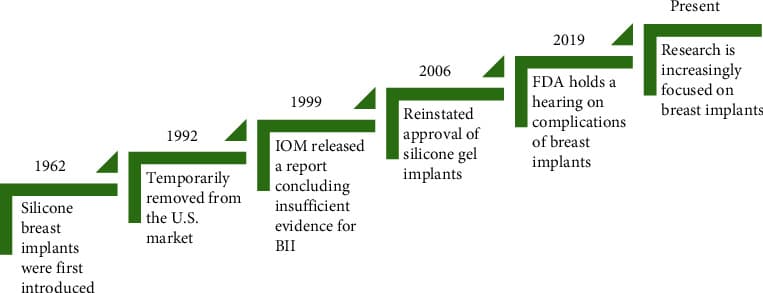
In April, a peer-reviewed study concluded that “breast implant illness is a true clinical entity that affects an extensive population of patients who have undergone breast augmentation.” But researchers don’t yet understand the cause of BII.
Many experts point to the body’s immune system as a starting point for more study. Dr. Brenner agrees the immunologic response could be the key to understanding the reported symptoms.
“Every person that has a breast implant, the body grows what's called a ‘capsule’ around the breast implant and it's a specialized form of scar tissue to wall off the implant, which is a foreign body and your immune system is protecting you from it,” explains Dr. Brenner. “Most of the time that capsule is very thin and pliable and doesn't create a problem. But the point is that your immune system is responding to having an implant.”
There are other types of medical implants that can cause the same symptoms that characterize BII. A 2022 study details data on patients with hip, knee and other orthopedic implants who developed autoimmune inflammatory disorders also seen in patients with breast implants.
While it’s possible BII is one example of a more general implant illness, the lack of any definitive diagnosis has mental health ramifications for women in particular.
“This continues to be such a problem for women because they aren't listened to, they aren't being believed,” Amanda Savage Brown, Ph.D., a licensed psychotherapist and former scientist at the Centers for Disease Control tells The Messenger. “This to me is reminiscent of when postpartum depression was first being recognized, and initially women who experienced postpartum depression were dismissed and they were seen as a problem.”
Mental Health Effects of BII
Dr. Brown says that the psychological concerns around BII are many: “There is all of this pressure and idealization around breasts that can lead us onto the implant table. But when it inevitably comes time to replace or remove them, it can affect the way that we see ourselves.”
In her private practice and her book Busting Free, Dr. Brown examines specific anxiety, depression, relationship distress and partner abandonment related to explant surgery.
“There's a lot of focus on the surgical considerations, and that makes sense, but as a former public health scientist, I was aghast at the lack of support for the rest of the journey because breasts are these icons of femininity, and when implants don't work out for you, you're kind of left to white knuckle through the mental, emotional and social aspect of it,” she says.
Further, women who have endured breast cancer say “they feel they’ve been put on a conveyor belt that takes them directly to implant-based reconstruction,” Dr. Brown says.
“A lot of them tell me, ‘I didn't feel like I had a choice, and it was a given that I was going to reconstruct with implants,’” she says. “Some women don't actually want to reconstruct, they're fine to go flat. But implant-based reconstruction reflects that this body part has been so objectified.”
The current medical doctrine is that reconstruction with breast implants is less complicated and requires less recovery, a practice Dr. Brown says is “unfortunate, because breast implant reconstruction patients can also get breast implant illness.”
But due to its unproven status, most women who have breast reconstruction are not warned of the possibility of BII.
Many women have survived breast cancer after painful treatment and then they experience illness from their implants that often gets “misdiagnosed as the after-effects of chemo,” Dr. Brown says.