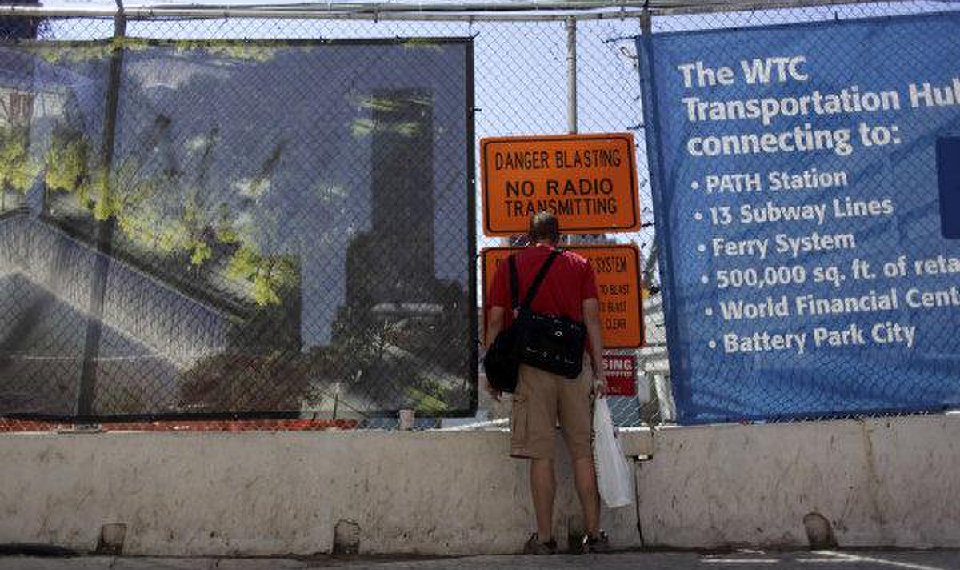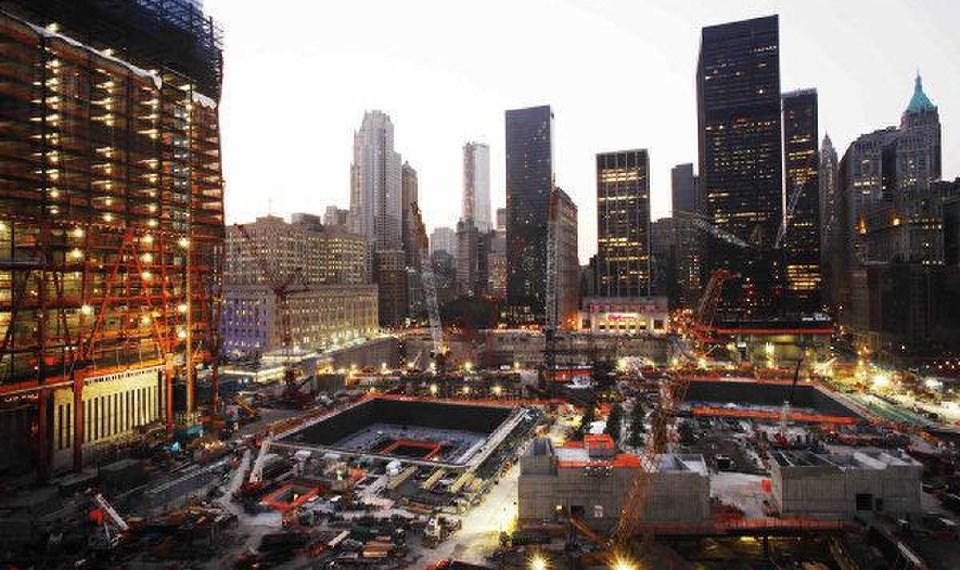
NEW YORK — It is a place of sacrifice. A place of mourning. A place people pass on their way to grab lunch. It's a place where tourists crane their necks to snatch a glimpse around barriers walling off an enormous construction site, which is also what it is.
Ground zero.
Depending on whom you talk to, it's a scar on this city where horror lingers, a bustling hive symbolizing the resilience of a nation, or simply, for those who live and work nearby, a place where life goes on.
In recent weeks, as debate has raged over the placement of a planned Islamic cultural center and mosque a couple of blocks from where the World Trade Center once stood, Americans have been reminded of just how many people lay claim to this place, the focal point for all those who have a stake in the legacy of 9/11.
Almost everyone has a stake.
Gesturing at the land he helped clear in the weeks after terrorists rammed planes into the twin towers of the World Trade Center on Sept. 11, 2001, Louis Pabon believes he knows who owns it: "This is mine."
Today he is wearing his hard hat again, standing at the gates of St. Paul's Chapel, hawking the photos he took of the wreckage. Tourists stop in the sun to look at the images of smoky desolation.
Take a walk around ground zero, and you can get lost in the throngs. Among the tourist crowds at St. Paul's, a block away, a woman sipping a strawberry smoothie walks past an altar covered with photos of the dead. Outside, beneath cranes that glint red in the sun, construction workers cluster.
This place was once a giant plaza filled with businesspeople and tourists and shoppers and commuters rushing to the subway. Then, on one sunny September Tuesday in 2001, it became suddenly a place of history and loss. Within 24 hours, someone had dubbed it ground zero, and it was never the same.
After 9/11, there were weeks and months of coming to grips. Everyone had lost something: A child. An acquaintance. A skyline. A sense of safety. A center of business. A solid stock portfolio. A feeling that we knew where everything was heading.
Many of the city's Muslims lost a willingness to speak out. They had enjoyed a kind of anonymity — a knowledge that they were just another ingredient in the hearty stew of New York. But since Sept. 11, they have felt an unwanted spotlight. Some have been afraid.
"Now no one can talk about Islam ... because Islam became like equal to violence," said Noureddine Elberhoumi, a cabdriver who says that after Sept. 11 he stopped volunteering information about his religious affiliation. "In their mind, Islam is always going back to Iraq, Afghanistan, 9/11 — that's it."
In the days after the attacks, the nation was in a wrenching, gripping catharsis. We were mourning our dead. We were on a new, uncertain course.
Before the week was out, the pastor at St. Paul's began calling the site of the devastation "sacred ground." On Sept. 20, Katie Couric told TV viewers it "should be hallowed." For the family members of more than 1,100 of the victims whose remains were never recovered, it is the only grave site they have.
"This pit of evil and doom," Sally Regenhard calls it now, her voice shaking nine years after the death here of her firefighter son, Christian.
"My son's beautiful remains are forever scattered," she said. "Ground zero is a burial ground."
Battles over land, legacy
Since that awful day, the story of the site has been through what seem like endless chapters.
There were battles over the land — over the prolonged search for victims' remains that kept turning up more tiny body parts in the soil five years later. The developer and insurance companies fought over payouts. The state and the developer haggled over financing and how many towers would be rebuilt.
Some families successfully challenged the creation of a freedom museum at the site, and some questioned whether a planned performing arts center there is appropriate. How best to pay respect to the dead?
Now, almost everyone is staking out a position on the planned Islamic cultural center, to include a mosque, auditorium and other facilities about two blocks from the construction barriers. Some say the location should be moved out of sensitivity, because the Sept. 11 hijackers claimed to act in the name of Islam. Others say that moving the mosque would be bowing to intolerance and curtailing religious freedom.
Through all of this conflict, ground zero has been shuttered. Few have walked on its soil, except for the workers who cleared the site and those who are rebuilding it. Family members and others invited to the yearly memorial ceremonies have been allowed in, as was the pope on his 2008 pilgrimage.
But most have been unable to enter. At first, some people walked up to the barricades to post pictures of the missing, others to keep watch on the dead. More came. Out-of-towners started filling the sidewalks at the edge of the construction, holding up maps and asking passers-by: What's the best spot to see ground zero? With so few allowed in, everyone who journeyed to this untouchable space could make of it what they would.
So, what happens after the planned memorial opening Sept. 11, 2011, when the public is allowed inside the walled-off space?
Sacred or no, in many ways this space will belong to the American people — those who come to mourn the most personal of losses, those who come for all the other reasons, and even those who don't come at all but know this place is now no longer just a hole in the ground.
The memorial was always intended to become a vibrant space again — to "be stitched back into the grid of lower Manhattan," said professor James E. Young, a member of the panel that selected the memorial design.
"Short of turning the whole thing into a cemetery with fences and saying this is somehow inviolable ... we knew that even sacred spaces live in public use," he said.
Some proposals had called for the footprints of the twin towers to be cordoned off, with only family members of the victims allowed there.
But that "suggests that only the families of victims own it," Young said. "What about those who were injured? What about those who escaped? What about the rest of the city, which also felt surely violated and even victimized by the attacks?"
Many across the nation — even around the world — felt that they had been hit, too.
Sacred amid life
How much reverence will be given to this open space in the city's maze, which still carries for many the memories of screams and dust and panic? Can it stay sacred?
That question was answered long ago, said a family member.
"The memorial museum is selling souvenirs, for God's sake," said Diane Horning, who lost her son, Matthew. "You can't stand in ground zero without seeing Century 21's big banners advertising whatever their special is. ... This hasn't been sacred space since the day they put the first rivets in something. It's office buildings; it's places to eat; it's everything but sacred space."
There's even a strip club three blocks from the construction site. At New York Dolls Gentlemen's Club, a woman in a red sequined G-string takes a break from platform dancing and leans over to rub her calves. Outside, where William Dean is handing out fliers promoting the dancers, he says he's used to people yelling at him about the unseemly proximity to ground zero. His answer: "We're making a buck like anyone else."
Just one block closer to ground zero, it's still uncertain whether the cultural center and mosque known as Park51 will be built. But this would-be neighbor has aroused a reaction unlike any of the other disputes over this land.
The mosque furor has brought 9/11 back to the fore of America's consciousness. It had been quiet for a long time, bogged down in the bureaucracy of what would be built, for how much and when.
Amid all the disputes and all the compromise, the World Trade Center site had lost some of its hold on the public's imagination.
The plan for the memorial pools set in the footprints of the towers, though, remains.
At the 9/11 Memorial Preview Site at ground zero, a mob of visitors is snapping pictures, clustering in around a small-scale model of what this place is supposed to become.
There are the footprints, with lines standing in for what are to be the largest man-made waterfalls in the nation. There are tall, elegant buildings. There are tiny trees, each miniature trunk no thicker than a pushpin.
It looks peaceful. And it looks ready to come to life.
CONTRIBUTING: Associated Press Writer Amy Westfeldt and AP researcher Monika Mathur