Forbes contributors publish independent expert analyses and insights.
A lifetime in the car business, first engineering, now communicating
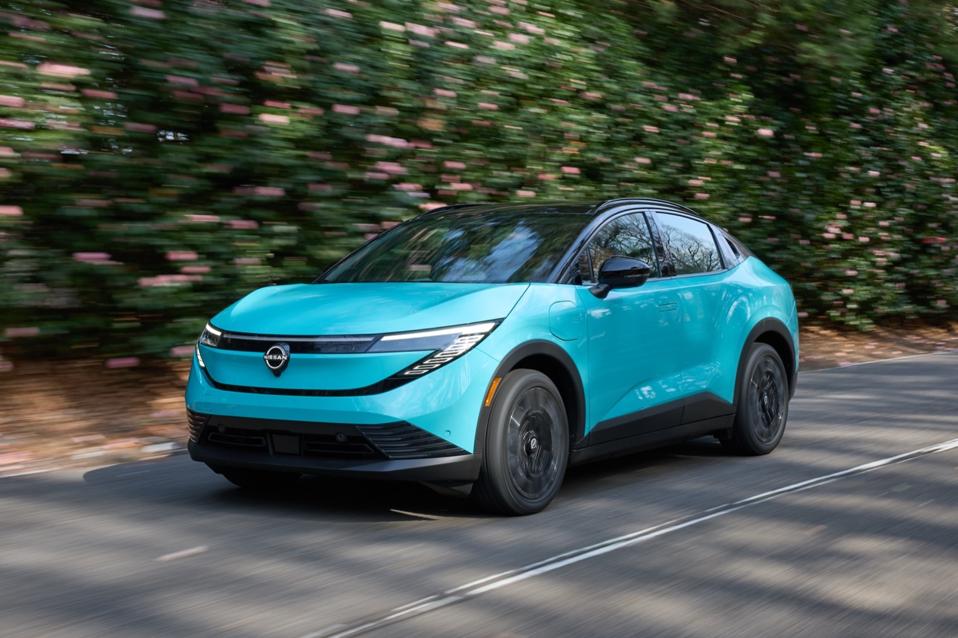
In late-2010, Nissan introduced what could reasonably be called the first mainstream electric vehicle, the Leaf. Until production of the Tesla Model 3 really ramped up in 2018, it would remain the best selling BEV globally. Ever since then, its sales have been in steady decline despite a major update in 2016. But now for model year 2026, the Leaf has been completely rethought in hopes that it can regain and build on its early success.
2026 Nissan Leaf
NissanThe first step in that process is changing the Leaf’s form factor from compact hatchback car to something more akin to a crossover. The first two generations of the Leaf were based on the same platform and overall structure. The original had what could best be described as unusual styling that has often been referred to as “alien-like.”
The second-generation was essentially the same car, retaining the doors, glass and rear hatch, but swapping the rest of the external bodywork for something a bit more conventional looking. The same could be said of the interior with a more traditional control layout except for the gear selector that was carried over.
2026 Nissan Leaf
NissanWhile the working bits of the Leaf definitely evolved over the last 15 years, the overall concept remained the same. Every Leaf built to date has had a single motor driving the front wheels and an air-cooled lithium ion battery. That battery proved to be the Leaf’s Achille’s heel, especially in the early years, but I’ll come back to that. While the Leaf has never been an outright performance vehicle, even in its early years, the instant torque delivery made its acceleration adequate if not exciting.
The original goal of the Leaf was to make a practical electric car that was accessible to the masses. In order to keep the cost down (the original MSRP was under $33,000 before the $7,500 federal tax credit) Nissan opted to use an air cooled battery pack with modest capacity of 24-kWh. That gave it an EPA rated range of 73 miles. As a daily commuter it was okay if you had somewhere to plug it in nightly.
2026 Nissan Leaf
NissanThe problem was the air cooling system wasn’t up to the task of protecting the battery if you live in hot climates like Arizona or southern California. Early Leaf owners were finding that the battery would rapidly degrade when it was used in hot weather. Nissan made improvements over the years including increasing the battery capacity so that current models get either 150 or 212 miles on a charge, used Leafs still tend to have a lot more range loss than other EVs with liquid cooled batteries.
For 2026, Nissan has addressed both of those major issues along with others like charging. The most obvious is the look of the Leaf which is now a compact crossover since Americans in particular don’t seem to want to buy cars anymore. The fastback profile and a lot of the details of the new Leaf will be instantly familiar to anyone that has seen Nissan’s other EV, the Ariya. The 2026 Leaf looks basically like a ¾ scale Ariya which isn’t a bad thing. Car buyers will probably be a lot more inclined to see this and want to learn more about it.
2026 Nissan Leaf
NissanContrary to the broader industry trend, the Leaf has not grown larger with this redesign. In fact, it’s 3-inches shorter overall and has a 0.4-inch shorter wheelbase. It is 0.8-inches wider and about 300-lbs heavier which can likely be attributed to the larger battery. The overall profile is very similar to the Ariya but the headlamps include the vertically stacked elements now found on a number of other recent Nissans including the Kicks. Across the top of the side glass there is a contrasting molding that is supposed to echo a curved katana blade but is also carried over from the Ariya and Z.
2026 Nissan Leaf
NissanNissan designers have incorporated an interesting detail as an easter egg in a number of places on the new Leaf but it’s most noticeable on the rear end. They created a bit of iconography that consists of two stacked horizontal rectangles next to three vertical rectangles. The horizontal rectangles are reminiscent of the taillamps on the Z, but here the combination refers to “2-3 or two-three” which is pronounced at “ni-san” in Japanese.
2026 Nissan Leaf
NissanAs is often the case on newer EVs, Nissan is trying to keep aerodynamic drag to a minimum so the front doors have retracting handles that will probably get stuck in cold weather and recessed handles hidden in the rear door glass frame. These details and the overall shape contribute to an impressive drag coefficient of just 0.26 and with its modest size, overall drag should be quite good.
2026 Nissan Leaf
NissanThe scaled-down Ariya theme continues in the cabin with a similar two-spoke steering wheel and large single piece screen with two-displays. All trims get a 12.3 driver instrument display with the S and S+ getting a similar sized infotainment touchscreen. The SV+ and Platinum+ get a larger 14.3-inch touchscreen that includes an Android infotainment system with Google Services. The smaller screens just get an updated version of Nissan’s standard infotainment software but all have support for wireless Apple Carplay and Android Auto projection.
2026 Nissan Leaf
NissanJust below the touchscreen is a touch panel for the climate controls, but it’s not clear if these are haptic as they are on the Ariya. The funky shift controller is now replaced by pushbuttons below the center vents. One detail that’s nice to see at least on the photos of the Platinum+ is a complete absence of the piano black plastic that often populates the inside of Nissan vehicles. The Platinum+ also has an electrochromic glass roof that can be adjusted from transparent to nearly opaque at the touch of a button.
2026 Nissan Leaf
NissanBesides the form factor, probably the most important part of the new Leaf is the aforementioned battery. The battery is now liquid cooled and features a heating system to improve cold weather charging. The S+, SV+ and Platinum+ launch trims all get a larger 75-kWh battery with cells supplied by LG Energy Solution. Some time after launch, Nissan will add a base S trim with a 52-kWh battery.
That battery is paired with a more powerful 214-hp, three in one drive unit on the front axle. The three-in-one refers to the integration of the motor, power electronics unit and reduction gear which makes it more compact and lighter. The excess heat generated by the motor and power electronics is used to heat the battery to the optimal temperature for charging. The resin cover for the battery pack also helps insulate it during cold temperature use. The smaller battery S trim will be limited to 174-hp which is still plenty in an EV this size.
2026 Nissan Leaf
NissanThanks in part to these changes, the Leaf is now capable of DC fast charging at up to 150-kW, three times the power of all Leafs up to now. While it’s not as fast as what Hyundai Motor Group EVs can manage, it will get from 10-80% charge in about 35 minutes, about half of what the old Leaf SV Plus could manage.
One other design change is that the charging ports are no longer on the front fascia of the Leaf. Until now, the Leaf always had two charge ports, a J1772 port for AC charging and the Japanese standard CHAdeMO for DC charging and they were side by side under one cover. The new Leaf still has two ports, but they are separated. One the left front fender is the same J1772 port currently used to support AC charging for public chargers as well as compatible home chargers. The J1772 will also support vehicle to load capability with up to 1.5-kW output through an available adapter.
2026 Nissan Leaf
NissanOn the right front is an SAE J3400 or NACS port. This will enable support for charging at Tesla Superchargers and the increasing number of other locations with this connector. Just as Toyota did with the refreshed 2026 bZ, putting this port on the right front will allow access to the short Supercharger cables without having to park in the wrong stall at Tesla stations.
Unfortunately, Nissan has opted not to connect the J3400 port to the on-board AC charger so it only supports DC fast charging. That means Leaf drivers won’t be able to utilize the more than 14,000 Tesla AC destination chargers at 5,500 locations or use an existing Tesla wall box at home without an adapter to convert from J3400 to J1772. Nissan will offer a CCS to J3400 adapter for charging on other DC equipment with a CCS cable and a number of third-party J3400 to J1772 adapters are available.
According to Nissan, there was a short timeline between when the decision was made to adopt J3400 and production freeze for the Leaf. As a result, the engineering to connect the J3400 port to the AC charger couldn’t be completed and validated in time. Expect future model years to have updates to allow AC charging from both ports.
The Leaf will be the first Nissan that also includes Plug&Charge support so it can be charged from compatible DC chargers (including Tesla, Electrify America, Ionna and others) without having to use an app or card. Just set up a payment method in the Nissan account and then when the car is plugged in, it will start charging and bill your card.
The Leaf S+ is expected to have a range of 303 miles, with the SV+ and Platinum+ at 288 and 259 miles respectively thanks in part to the larger tires. Nissan hasn’t given a range estimate for the base S yet, but with about ⅔ of the battery capacity and lower weight (again due to the smaller battery, it should get at least 200 miles, not far off the 212 miles of the current SV+.
2026 Nissan Leaf
NissanAll 2026 Leafs will get ProPilot Assist as standard equipment. This is a hands-on lane centering and adaptive cruise control system that has been on the Leaf for several years already. Automatic emergency braking with pedestrian detection, blindspot monitoring and rear cross traffic alert along with other driver assist features are also standard. A new feature called secondary collision mitigation braking that applies the brakes when the airbags have been deployed to reduce the risk or severity of any secondary impacts during a crash situation.
Nissan isn’t discussing pricing until closer to launch in early fall, but so far, it looks like most of the issues with the first two generations have been addressed and the new Leaf should be a much more appealing option. It would be nice if they could keep the prices close to the current model, but since it won’t be produced in Tennessee as the current one is, it will probably be subject to onerous tariffs. There’s also a strong chance that the federal tax credits will go away which means that the super cheap lease deals will also vanish. That’s a shame, because this looks like a vastly better vehicle than the outgoing model in pretty much every way.