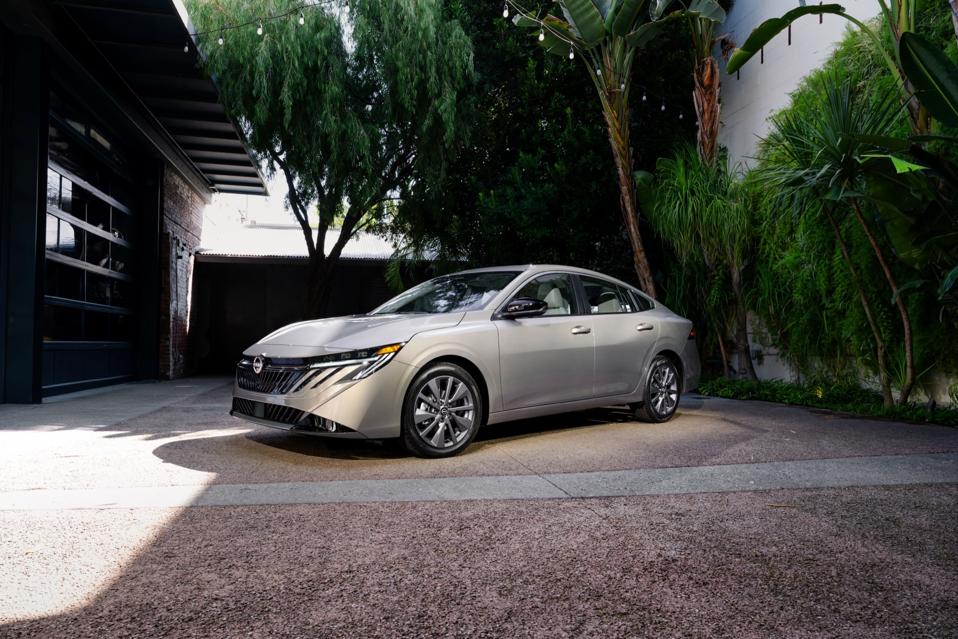
Over the past decade, Detroit-based automakers, GM, Ford and Stellantis have all slashed the traditional sedans from their lineups to instead focus their energies on crossovers and SUVs. But while sedans have certainly given up a lot of market share to taller form factors, not all automakers have discontinued their offerings. Notably, the Japanese and Korean brands have hung in there along with Volkswagen. Among those is Nissan which is about to launch a redesigned version of its compact Sentra sedan for 2026.
The first drives of the new Sentra are still a few weeks away, but based on the specifications and details released so far it appears that this model is riding on essentially the same platform as the current model which launched in 2019. That shouldn’t be a problem though. While the Sentra is certainly not a sports sedan, it is pleasant enough to drive and delivers on what buyers are generally going to expect at this price point.
The 2026 Sentra rides on a 106.5-inch wheelbase and is 183.3-inches long overall. That’s essentially the same size as the 2025 and its remaining competitors, the Honda Civic, Toyota Corolla, Hyundai Elantra, Kia K4 and VW Jetta. The powertrain of the Sentra is carried over, a 2.0-liter four-cylinder engine generating 149-hp and 146 lb-ft of torque. It remains paired with one of Nissan’s X-Tronic continuously variable transmissions. It’s not an exciting setup, but it gets the job done and provides enough thrust to easily merge onto highway traffic and handle daily commutes.
Notably, unlike the Civic, Corolla and Elantra, Nissan still doesn’t offer a hybrid power unit in the Sentra (or anything else it sells in North America). It’s not going to match the approximately 45-50 mpg of the hybrids, but should still provide a respectable 33-34 mpg combined.
The front suspension remains a MacPherson strut setup as you’ll find on almost all smaller transverse-engined vehicles. The Sentra also retains the rear multi-link setup that provides a bit better ride quality and handling than the torsion beam layout of the smaller Versa. There are also vented disk brakes at all four corners. The S and SV trims ride on 16-inch wheels and tires in steel or aluminum respectively. The nominally sportier SR gets 18-inch alloy wheels while the top SL steps back to 17-inch wheels with a bit more tire sidewall and ride compliance.
The basic profile of the Sentra remains unchanged, but all of the exterior surfaces are new. The face has a completely different take on Nissan’s “V-Motion” grille that looks much more modern and thankfully doesn’t have a comically oversized grille. LED headlights are standard and the SR and SL trims add LED signature lights. LED lighting is also standard at the rear with the two top trims getting a full-width light bar.
Inside, Nissan has adopted the increasingly industry-wide trend of two LCD displays behind a common panel of glass propped on top of the dashboard. Both the instrument display and the infotainment touchscreen measure 12.3-inches across the diagonal. Unlike the entry-level Kicks that debuted last year, the Sentra doesn’t offer an Android infotainment system with Google Services. Instead, you’ll find the standard Nissan system that has been updated in recent years and offers all the basic functionality that’s needed including Apple CarPlay and Android Auto.
On the base S trim, you’ll have to plug in a phone through one of the three USB-C ports to project the phone interface to the big screen. On the SV, SR or SL this can all be done wirelessly. There’s only a couple of patches of piano black plastic, for the four buttons that surround the volume knob in the center of the dashboard and the panel surrounding the shift lever.
Overall, the interior looks much more modern and premium, at least on the SR and SL trims that Nissan has released images of. There are probably some hard plastic surfaces, but assuming this is priced comparably to the 2025 model, that’s to be expected. At least all of the surfaces look nicely textured.
All 2026 Sentras get radar adaptive cruise control as standard equipment while Nissan’s hands-on ProPilot assist system is standard on the SL and optional on SR. Also standard are forward collision alert, automatic emergency braking, lane departure prevention and blindspot monitoring with rear cross-traffic alert. Lane keeping assist with pedestrian detection are also standard on SL and optional on SR.
We don’t yet have pricing information on the new 2026 model yet, but for 2025, the Sentra remains one of the most affordable new vehicles available to purchase in the US at $22,785 including destination charge. We expect that affordability to continue to be true for 2026 although tariffs and added features might force prices up a bit for the new model year. The 2026 Sentra should arrive in Nissan dealers before the end of the year.