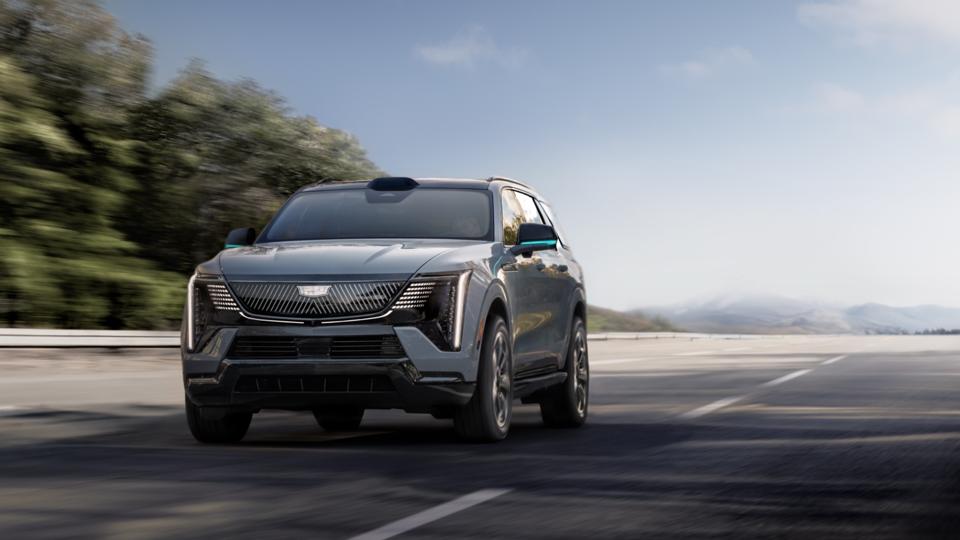
General Motors has some big plans for rolling out new technologies over the next several years that involve AI, automated driving, robotics and expanding bidirectional charging deployment for electric vehicle owners. In advance of an event in New York, Dave Richardson, GM senior vice president for software and services provided a preview of what is coming.
The first of the new technologies scheduled to arrive in 2026 is the rollout of Google’s Gemini AI in GM vehicles that use the Android Automotive operating system for infotainment. All but a few of GM’s entry level models are now equipped with Android systems that included Google Automotive Services (GAS) that features Google Maps, the Play Store for app downloads and Assistant. Google has already begun replacing Assistant with Gemini in its other platforms including smartphones, tablets and smart home devices.
Drivers that use Android Auto smartphone projection systems in their vehicles have already begun a similar transition as their phones get updated with Gemini. GM is expected to be among the first automakers to add the update directly to their vehicles. Gemini will be the new default voice recognition system on these vehicles and it should provide more robust natural language capabilities. Assistant can already be used to control features like climate control with voice commands.
However, given the probabilistic nature of generative AI chat bots, it remains to be seen how reliably Gemini will actually work on the road and whether it can consistently adjust cabin temperature rather than moving the seats around.
GM has had a long and sometimes troubled history with automated driving systems (ADS). Some of the earliest proposals date back to the 1950s, but the efforts at GM R&D really took off in the 1990s when the automaker participated in a test program in California that had vehicles driving on a highway and following beacons embedded in the roadway. In the mid-2000s, GM engineers supported the efforts of the team from Carnegie Mellon University that took part in the DARPA Grand Challenge. The CMU entry, a Chevrolet Tahoe called Boss, ultimately won the urban challenge in 2007.
Many of the members of the CMU team along with the rest of the DARPA competitors went on to be key members of programs at Google, Zoox, Motional, Aurora, May Mobility, Cruise and others in the automated driving ecosystem. GM acquired Cruise in 2016 and made it responsible for its automated driving programs including developing a robotaxi service. Following a 2023 incident where a pedestrian in San Francisco was struck and dragged under a Cruise car, the program was paused and ultimately Cruise was shut down entirely early this year. However, GM hired many of the Cruise engineers and brought them in-house to develop automated driving technology for future consumer vehicles.
At the same time, through the 2010s, GM developed its hands-off/eyes-on Super Cruise system that debuted in 2017 and is now offered on 23 GM models. That system allows drivers to get hands-off on nearly 700,000 miles of roads in North America while it manages speed and keeps the vehicle in the lane. However, it requires constant supervision by the driver. The next-stage in the evolution of this system is scheduled to debut in 2028 with the driver being able to go eyes-off under certain conditions.
This next generation system is being developed by a combination of the existing GM assisted driving team and former Cruise engineers. These hands-off/eyes-off systems fall under what SAE International defines as a level 3 (L3) conditional automation system. So far Honda, Mercedes-Benz and BMW have launched L3 systems but they are very limited in their capability. The Honda system was only sold on a small number of cars in Japan, while the German systems only operate at speeds up to 37 mph on highways in Germany, with the Mercedes system also available in California and Nevada.
Other companies are developing L3 systems including a new system from Honda in the next couple of years as well as a Mobileye system coming to some VW Group models in 2027. The GM system is the first that we know of that will be able to be used across North America. GM hasn’t yet provided details on how it plans to overcome the legal approvals to use the system more broadly than other current systems.
While most details of the GM L3 system (which still doesn’t have an official brand name) are limited so far, we do have some information. The system is developed entirely in-house at GM and will be the first product from the automaker to move over to an Nvidia compute platform. Last March at Nvidia GTC, GM announced it would be transitioning to the new chips and away from the Qualcomm Snapdragon Ride chips being used on current Super Cruise systems.
The system will debut on the Cadillac Escalade IQ and that will also be the first vehicle from GM to incorporate a new centralized compute electronic architecture rather than the domain controller setup used on current vehicles. This will simplify the architecture, reduce wiring needs and make it easier to do over-the-air software updates. The L3 system will rely on a mix of cameras, radar and lidar for sensing.
While it will initially be limited to highways as Super Cruise was at launch, the goal is to expand the operational domain to urban and then eventually level 4 autonomy. For an L3 system, the driver is required to remain awake and at the wheel so that they can take over when the system reaches the limits of its capability. They can read, text or watch a movie, but can’t take a nap or get out of the driver seat. If and when the system reaches L4 capability, the driver can take a nap.
The new electronic architecture will enable fully capable software defined vehicles (SDV) that can add new capabilities over the life of the vehicle. While it will debut on an EV, it will also be incorporated into internal combustion and hybrid vehicles in the future. In addition to developing all of the software platform in-house, GM is designing all of the electronic components as well. The automaker will just use suppliers for build-to-print of the electronics.
As with most industrial companies, GM is also expanding its work in robotics including a new autonomous robotics lab at its Warren, Mich. tech center. However, GM is not pursuing humanoid robots. GM, like most automakers has been utilizing industrial robots for decades to handle tasks like welding and painting. These large machines are generally not designed to operate in close proximity with human workers and are typically installed in cages to keep people from being injured. While humanoid robots can theoretically do most of the tasks of people, they are still relatively slow and cumbersome.
Instead, GM is using so-called “cobots” or collaborative robots. Cobots are similar to traditional industrial robots although they are generally much smaller and they are typically permanently mounted like the industrial units. However, they have additional sensing and are constructed in such a way that they can detect the presence of a person or any other obstacle and will automatically back off to prevent injury. They are also typically padded. These can be used in places where they have an ergonomic advantage over people while the humans can work alongside and take advantage of their dexterity and adaptability.
GM’s final announcement was related to its Energy unit which is responsible for both home and commercial charging solutions. GM already offers a range of vehicle-to-home solutions that enable integration with solar, stationary batteries and current GM EVs. These can be used for backup power in the event of an outage as well as storing solar energy during the day for use at other times. All of the current generation GM EVs have bidirectional power capability so they can be used as a power source for home while GM also makes and sells home batteries.
These kits range in price from $6,300 to $13,600 plus the cost of installation which can be several thousand dollars more. With a vehicle like the Silverado or Sierra EVs with the largest battery pack, these can keep a typical home powered up for up to 3 weeks. GM Energy is launching a new leasing program for its home solutions that should make it considerably more affordable to get started. The GM Energy leasing program will also launch in 2026 with pricing to be announced later.