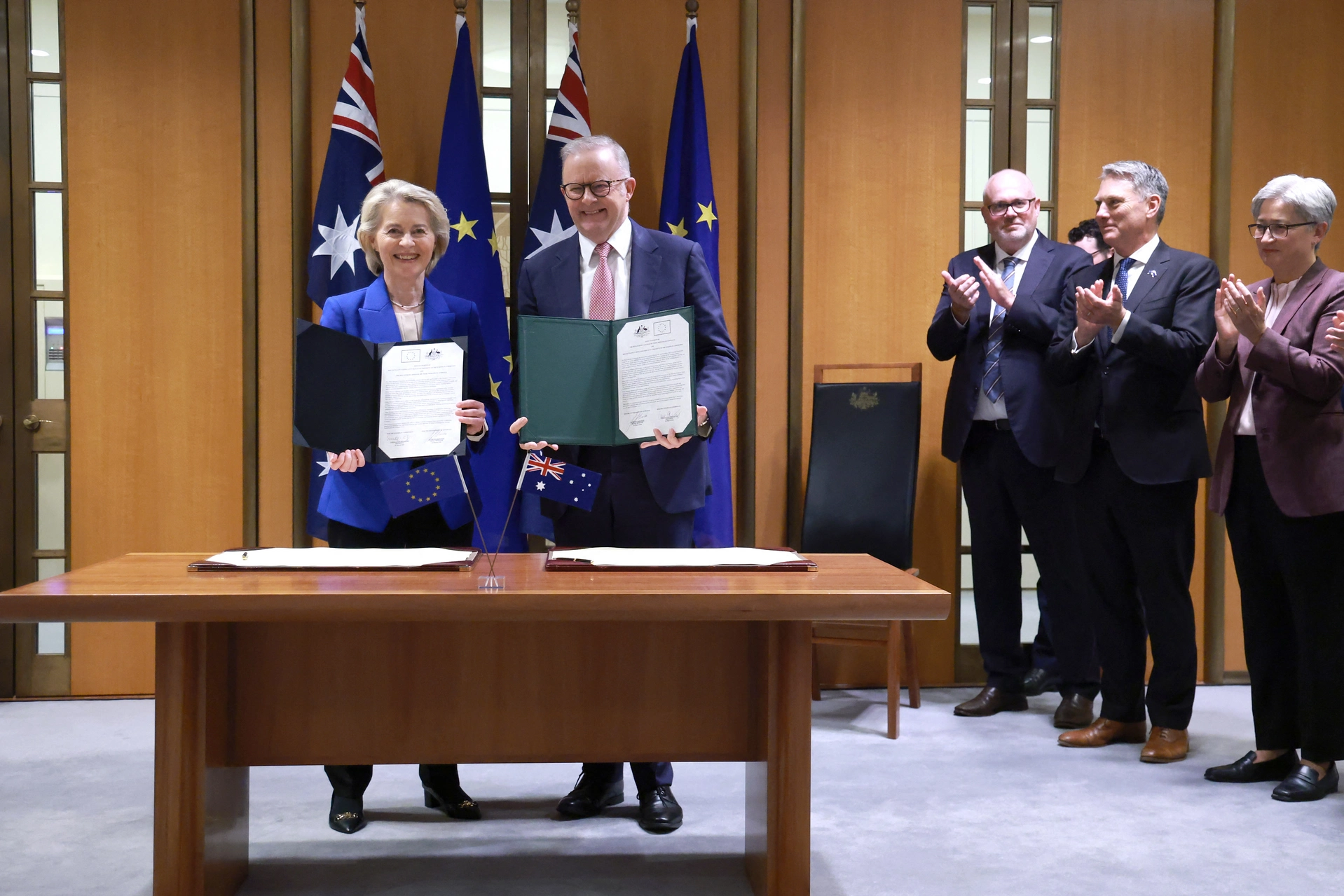
The EU says its trade deal with Australia is settled. Australia's Shadow Treasurer Tim Wilson says ministers must make a better case for the deal.
CANBERRA — The European Commission has ruled out reopening its free trade agreement with Australia, putting it on a collision course with Australia’s Coalition opposition that is threatening to block the deal in the Senate.
“The EU has the world’s largest network of free trade agreements. We invest years in getting these deals right, ensuring they are balanced, ambitious and offer benefits for both us and our partners,” Commission trade spokesperson Olof Gill told POLITICO. “Once negotiations are done, they are done.”
Gill was asked whether Brussels would return to the table if the deal could not get the backing it needs in the Australian Senate. He said the Commission aims to propose the agreement for signature and conclusion in early 2027.
He also dismissed Coalition concerns that the deal would tie Australia’s hands on future energy and climate policy: “The agreement is balanced and has been agreed by both sides.”
Shadow Treasurer Tim Wilson, one of the Coalition MPs who went public with concerns about the deal last week, said the opposition had not taken a “formal” position.
“We haven’t committed to opposing it in a formal sense,” Wilson said in an interview with POLITICO’s Canberra Playbook podcast. “We haven’t even seen the legislation, the enabling legislation for it, and it still has to go through the joint standing committee on treaties.”
When told the Commission had ruled out further negotiations, Wilson said: “There’s always a component of compromise in trade agreements and we completely understand that. But the problem is I don’t really see how we massively win out of this trade agreement right now.”
“I’m happy for it to be proven to the Parliament. I’m happy to see that through public conversation, but we aren’t really seeing that at the moment.”
Sovereignty and climate concerns
Wilson said the deal does too little to open markets, especially for agriculture and primary producers. “Australia is a country that has largely unilaterally liberalized its trade,” he said. “Most of the advantage we get is when other countries remove their barriers. This agreement doesn’t do that much of that.”
Instead, he argued, the deal tries to export European regulation to Australia. “That raises issues around sovereignty and us being in control of our own destiny,” he said. On climate the deal “actually tries to impose European standards on Australia,” in Wilson’s view.
Wilson also questioned the government’s main selling point, critical minerals. These “primarily come from two countries: us and China,” he said. Because the Commission president has made clear Europe would rather buy from Australia than China, it ought to do more than remove tariffs on the minerals it admits it needs.
A looming risk for Trade Minister Don Farrell is that Wilson believes the deal has not substantially improved since Farrell walked out of talks in 2023, in a preview of the complaints now made by the Coalition.
A Coalition without a position
When shadow trade minister and Nationals leader Matt Canavan wrote in The Australian, Oct. 16, that “the Liberals and Nationals oppose the EU free-trade” deal, the issue had been discussed in the shadow cabinet, but no decision had been made.
Talking points sent to MPs at the same time, seen by POLITICO, were more cautious: “We’re opposed to the deal as it stands, subject to the proper parliamentary and Coalition processes.”
Pro-deal Liberals, including Zoe McKenzie, want the Joint Standing Committee on Treaties to be the main forum for the Coalition to express its concerns.
Former Prime Minister Malcolm Turnbull told POLITICO the party “should stick to its free trade principles and support an FTA, the negotiation of which was a Liberal government initiative.” Former trade minister Simon Birmingham told the ABC the deal would not be easy to renegotiate.
Liberals have never voted against a trade deal.
Australian Greens trade spokesperson Sarah Hanson-Young weighed in for the first time Tuesday, saying the deal “could be a positive step” for the climate, adding she would be “kicking the tires on the Agreement’s climate and environmental commitments to see what they actually deliver. Commitments are one thing, how they are implemented is what really matters.”
Hanson-Young criticized the Coalition as “all over the shop” on the deal. Though the Greens themselves have had little internal debate on the deal, she said the Coalition litigating the deal in the media was “not a serious way to approach an agreement with one of Australia’s major economic partners.”
Under the deal, the share of Australian goods entering the EU tariff-free would rise from 37% to 98% upon implementation, and to 99% over time. A contentious quota for Australian beef would grow to eight times its current size, and Australia would be committed to the Paris Climate Agreement, or risk voiding the deal.
The Senate numbers
If both the Coalition and the Greens oppose the deal, with no defections, Labor would need all nine of the remaining senators to back the deal.
While a handful of Liberal and Greens senators could cross the floor, finding the remaining votes would be difficult for Labor, given that One Nation, with four senators, is also skeptical of the deal.
Preliminary research into a possible “safeguard mechanism” to win over the Coalition, either as an addendum or as a complementary law, is underway.
Wilson said the opposition does not want to “make the perfect the enemy of the good,” but that its job is to defend Australia’s national interest “and not just to give the government a blank check.”