If you’ve been forwarded this newsletter, you can sign up forfree.
You can now listen to our podcast too.
All our articles are free to those who register on politico.com and our mobile app.
ESSENTIALS
— Why David Shoebridge is the party leader most excited by the U.S. midterms
— Buck your party, and other lessons from the U.S. election
— Troy Bramston exits The Australian
DRIVING THE DAY
EV SALES SURGE AS TAX BREAK BECOMES BUDGET SAVINGS TARGET
Will Anthony Albanese and Jim Chalmers accelerate the end of the EV tax break? Car buyers aren’t waiting to find out.
The Australian Automobile Association EV Index shows 52% of Q3 new cars sales were electric or hybrid. Among those were 76,947 battery electric vehicles, which made up 24% of car sales. That’s up from 21% in Q2, and 12% in Q1.
EVs worth less than $91,387 purchased via a novated lease are exempt from fringe benefits tax. In the 2026 budget Labor left open that generous tax break for 12 months before a gradual phase-down to save the budget $1.7 billion over the next five years.
Read more in Canberra Meets World about Sen. Deb O’Neill’s surveillance fears from Chinese EVs.
CHALMERS PRODUCTIVITY SCRAMBLE: Chalmers has “made a fresh request to Treasury in the past week to develop new productivity policies that can be included in his mid-year budget update next month, as he responds to the Reserve Bank’s bleak downgrade of its key standard-of-living measure,” reports Matthew Cranston.
THE PLAYBOOK INTERVIEW
IS DAVID SHOEBRIDGE THE PARTY LEADER HAPPIEST ABOUT THE MIDTERMS?
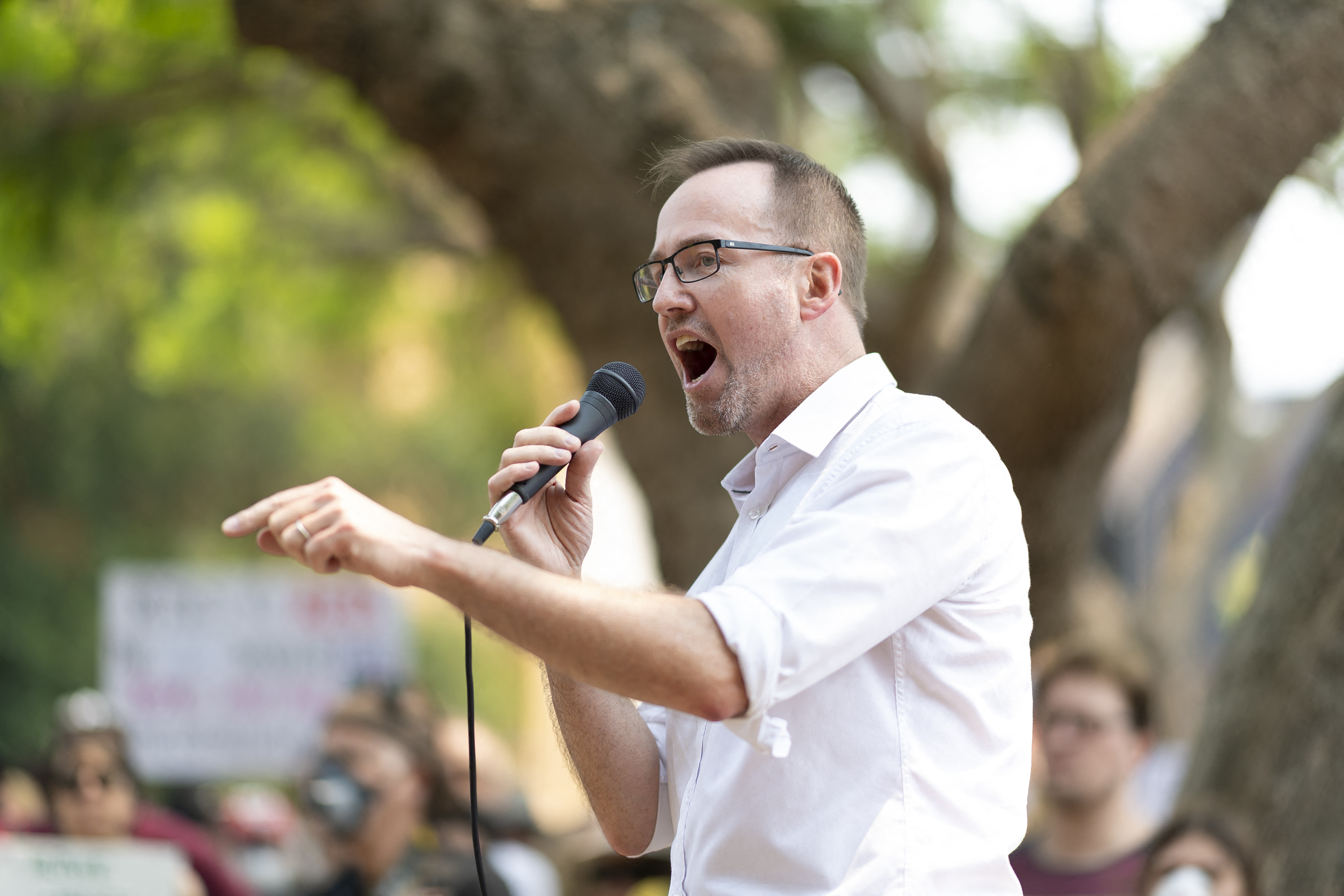
In the wake of the U.S. midterm elections, Australian Greens Leader David Shoebridge is ready to apply the progressive Democratic playbook to build a left-wing resurgence in Australia. He spoke with Amanda Copp and says building a mass movement is about making people realize the things they have in common rather than stoking division.
This interview has been edited for length and clarity.
What can the Greens learn from the U.S. midterms?
The 1% is stealing a greater and greater share of our global wealth in the United States, in Europe, in the U.K., in Australia, and people are feeling that same disaffection with politics. Progressive politics needs to say, well, let’s stop with the hate and the division. Let’s recognize how much we have in common, and let’s fight for those material gains.
The Greens conference starts on Saturday, what’s your message to the members on how you bring that momentum to Australia?
We’ve had this surge in membership, double-digit growth since Steph Hodgins-May and I took on the leadership. What our supporter base and the public has needed to hear is there’s a political party here that’s going to have a red-hot fight to fix things, a red hot fight to say better days are ahead. We’re not just going to have managed decline.
What have the Greens got wrong in the past?
Your politics is crafted with what’s in front of you. I think many of us thought we could be a kind of social conscience, environmental conscience to drag Labor back to the left. Well, that has not worked, and it will not work. Our job isn’t to make Labor better. Our job is actually to replace them and fill this huge void in the left of politics.
Anthony Albanese is from Labor’s left faction. Are there any similarities between what he wanted to do 20 years ago that you’re looking to do now?
I don’t recognize the left faction in the Labor Party. I’m an external observer, but left or right, they seem more like vehicles for internal careerism, rather than any kind of coherent ideological position. What he seems to be aiming to do with his prime ministership is remain as prime minister. That seems to be the goal. His goal in politics was to get there, and now his goal is to stay there.
Have the Greens focused too much on culture war issues and alienated a portion of the population?
I think you need to be true to all your value statements. We are absolutely going to stand up for marginalized people. If we’re going to make this left resurgence happen, if we’re going to fill that void, we need to weave together these political movements more in a mosaic. As you start tying them together, you make people realize how much we all have in common. That’s when you build political power.
Why is One Nation’s vote surging, and the Greens is not?
One Nation is getting significant corporate funding. I think they’re being given the platform by corporate media and by corporate investment. They then use that platform to put out a very nasty, divisive, and simplistic message. We can’t allow a nasty, hard right, divisive anti-immigrant party to be the only party that’s connecting with people’s economic pain right now.
Read Amanda’s report on Shoebridge.
MIDTERM MADNESS
AMERICANS TURNED AGAINST DATA CENTERS IN DROVES — AUSTRALIA COULD BE NEXT
Americans voted against data centers in 40 out of 41 local referendums across 10 states. The vote ran roughly 3 to 1 against data centers and, in one instance, the officials promoting a data center were recalled — in other words, fired by voters.
Around 40% of proposed new data center capacity in the U.S. face new hurdles, including from Texas Gov.-elect Gina Hinojosa, who has pledged to impose a moratorium on new data center approvals until the Legislature passes protections for water, electricity costs and air quality.
A new hurdle for the Albanese government arrived Thursday from an under-the-radar NSW cross-party parliamentary inquiry which criticized current rules for looking at individual data centers in isolation “despite many impacts being cumulative in nature.” Even Liberals Jacqui Munro and Scott Farlow, who dissented from one of the recommendations, were brutal in warning of “social fracturing and cautious investment” because of “woefully inadequate” public communication about both AI’s benefits and “the physical constraints of construction and operations” of data centers.
7 MIDTERMS LESSONS FOR AUSTRALIAN STRATEGISTS
The U.S. midterms were not only expensive but provided monthslong laboratories for testing what works in campaigns from messages to tactics to technologies. Here’s what counts and scales to Australia — full report from Ryan Heath.
It’s still the economy, stupid: Winning campaigns communicated through household expense examples, including food, health care, housing and fuel, rather than citing economywide statistics such as inflation figures or interest rates.
Treat AI with extreme caution: As we noted, U.S. voters overwhelmingly voted against data centers in dozens of local initiatives.
But use AI to build relationships and reduce costs: Conversational AI systems collect better voter data. People ask AI chatbots how to vote, so you need to optimize your presence in them. AI-generated or enhanced material is being normalized, even as it generates backlash.
Buck your party, it’s the vibe: Caucus solidarity is so yesterday. (OK, that’s not going to land here.) But there’s a lesson in Democrats being, saying and doing things that would have had them canceled by their own party colleagues two or four years ago. It worked.
Campaign everywhere: Democrats in states such as Texas, Kansas, South Carolina and Ohio did not rely on turnout in heavily Democratic urban areas alone; they campaigned everywhere. That will matter more than it used to in Australian elections with more three- and four-way contests.
Use an unpopular leader — but stars talk about tomorrow: Democrats mentioned Trump far more than Republicans did, per an Associated Press investigation. The Australia translation: One Nation, Coalition and Greens would be on solid ground focusing on Albanese and Chalmers in their advertising efforts.
But the biggest midterms stars moved beyond using Trump-bashing as a campaign crutch. Jon Ossoff, James Talarico, Adam Hamilton focused on their own values. The most surprising Democratic Senate victory this week — Annie Andrews in South Carolina — made it a policy to not even talk about Trump.
Candidate selection can shift races: Pick loyalists, get bad results. Run excellent people against the cronies — win in unexpected places.
BEST OF POLITICO’S COVERAGE
WATCH OUR IMPROMPTU PHONE INTERVIEW WITH TRUMP, thanks to Dasha Burns.
In 2016 Bernie Sanders lost the fight. A decade later, he won the war, by Will Steakin.
How the Republicans blew up their 2028 map: Democrats now run states holding around 400 of the country’s 538 electoral votes. That makes everything harder for the GOP in 2028, writes Jonathan Martin.
Trump’s whole theory of power is in ruins, writes Alex Burns.
The forces Trump unleashed are now working against him: Movements built on grievance can flip. John Harris explains how.
The Trump era of judicial nominees has ended, write Josh Gerstein and Kyle Cheney.
“EXTINCTION LEVEL EVENT”: That’s how potential Liberal frontbencher Andrew Hastie described the midterms for his conservative colleagues in the U.S. “People feel worse off after tariffs and after the war in Iran, and Donald Trump has said a few times now that he doesn’t really care,” Hastie told 2GB.
Hastie’s “three C’s” for leadership: Competence, character, conviction.
WHERE NOW ON IRAN? As inflation bites, the Albanese government is desperate for an end to the Iran War (despite giving Trump its backing at the outset). Trump is still equivocating. “We’re going to take a look, and if we see any opportunity to do one thing or another, we’re gonna do what’s best for this country,” Trump told POLITICO.
Are nuclear weapons on the table?: “I don’t need it. We’ve knocked them out already, 90%,” Trump said.
“A Democratic Congress will be certain to bring more scrutiny and oversight of the Iran war,” Charles Edel, Australia chair of the Center for Strategic and International Studies, told Playbook.
STATE OF THE NATION
PAUL KARP’S FRIDAY COLUMN — SHARING AI GAINS AND BUDGET PAINS
Tuesday’s Reserve Bank interest rate rise has renewed the Albanese government’s search for budget savings so fiscal policy can do more of the heavy lifting. But with the opposition parties adopting a Not In My Budget Backyard mindset, this means a focus on savings that don’t require approval of the Senate in December’s mid-year economic and fiscal update.
In his weekly column, Paul Karp looks at the concept of gainsharing, the idea that measures to boost productivity work best when “everybody feels as though they can share in the additional prosperity,” as NSW Treasurer Daniel Mookhey put it in April.
If governments around Australia think that adopting artificial intelligence can increase productivity and reduce labor-intensive drudge work, then the gains must be shared: in the form of higher wages for public sector unions, who would otherwise oppose AI, in return for cuts to headcount; and in the form of community benefits, to quell the rising tide of backlash against data centers.
Likewise, in budget repair a mix of loss aversion and self-interest is motivating the politics of opposition. Why would constituencies like older Australians in aged care, or private health care consumers, or veterans go along with cuts? Why would parties seeking to represent them like the Coalition, One Nation and the Greens pass up the free kick against Labor?
Reform is difficult because it creates losers. Labor’s masterstroke in its first term was in reallocating already legislated tax cuts so the winners outnumbered the high-income losers. It attempted the same trick with increased property taxes and lower income taxes in the 2026 budget.
Economists agree the best way to spread pain and share gain would be to lift the goods and services tax and reduce income tax, which Labor has ruled out. But regardless of which lever it pulls, that must be the guiding principle. Otherwise the government will stay stuck in its inflation and interest rate rut, creating unity only in the chorus of discontent about every proposed saving.
Read the full column: To save Australia’s economy, Albanese must share the AI gains and budget pains.
GOOGLE WARNS ON RIGHT TO SUE UNDER DIGITAL DUTY
Ahead of public hearings on Monday and Tuesday into the government’s proposed digital duty of care legislation, we’ve taken a look at stakeholder submissions.
Google “strongly supports the introduction of a statutory duty of care” but identifies 10 issues with the bill. Most ominous for Labor: It wants “clear exclusion of a private right of action,” meaning individuals and companies should not be able to sue. This was one of the Greens’ central demands to pass the bill and Communications Minister Anika Wells said she would “contemplate.” Google also wants a “dedicated safety regulator.”
Meta wants to preserve the privacy of messaging services, including expressly protecting encryption, and it wants to protect against harmful attacks and harassment while still allowing “lawful discussion of women’s rights, religious beliefs and public policy.”
TikTok said the bill does not achieve its objectives and, despite trimming, still gives the minister and eSafety commissioner powers to determine “how providers should operate their services,” including “a general pre-emptive power to direct how online services must be engineered and operated.”
The Australian Human Rights Commission is in favor. Equality Australia warned the bill does not “expressly capture targeted attacks against LGBTIQ+” people in the definition of an unsafe online environment.
Conservative religious groups are opposed on free speech grounds: Sydney Anglicans said it could result in censorship of religious teachings on sexual ethics and gender identity; the Australian Catholic Bishops Conference agreed. The Australian Christian Lobby wants religious material excluded.
CANBERRA MEETS WORLD
DEB O’NEILL’S FEAR OF CHINESE SURVEILLANCE: The Labor senator was speaking to the Inter-Parliamentary Alliance on China in the Netherlands, reports POLITICO’s Dom Giannini.
On general surveillance: “I’ve become the chair of the defense committee and am very mindful of constantly being surveilled.”
On her children: “They can never travel to China. I’ve told them that they can never go to Hong Kong. These things are becoming material for us in a way that shocks our colleagues.”
On China’s ability to surveil Australians: “Japan provided for the last 28 years the major number of cars to Australia. This October, China provided 36.6% of all cars and 85% of EVs.”
“These are presenting great challenges to us,” she said. “We are at risk everywhere.”
But with cost-of-living and inflation pressures as they are in Australia, O’Neill thinks Chinese cars will keep selling regardless of any surveillance risk.
MAMMA MEA CULPA: Ryan was supposed to confess yesterday to an error in Wednesday’s Playbook but was swept up in the midterms and forgot. The U.K. government is not planning on “cutting steel” on its first AUKUS submarine “sometime next week” … it’s happening “sometime next year.” Double apologies.
REQUIRED READING
NZ VOTES: Ahead of Saturday’s New Zealand election, read Stephen Dziedzic’s profile on the millennial political newcomer who may be the country’s kingmaker in the ABC here.
PARTY ROOM
HIGH COURT TO HEAR HANSON VS. FARUQI RACISM CASE
The High Court has granted special leave to One Nation Leader Pauline Hanson to appeal a July decision of the Full Federal Court that she breached 18C of the Racial Discrimination Act by tweeting at Greens Sen. Mehreen Faruqi to “piss off back to Pakistan.”
The full court agreed with the primary judge that this was reasonably likely to offend, insult, humiliate and intimidate Faruqi. It rejected Hanson’s ground of appeal that 18C breaches the Australian Constitution’s implied freedom of political communication.
The High Court has never ruled on that question, so its justices decided on Thursday: Thanks, we’ll take a look.
It’s part of a burgeoning crop of highly political implied freedom cases. Cases this year have sought to overturn the ban on the White Australia Party, under-16 social media restrictions and Victorian and federal electoral donations and spending caps.
GREENS — WOMAN ACCUSED OF STALKING JORDON STEELE-JOHN IN COURT: The 40-year-old is charged with one count of aggravated stalking with intent to intimidate, and demanding property by written threats to the WA Greens senator. The judge suppressed the accused’s name.
AWARDS
“AUSTRALIA HAS THE BEST PUBLIC SERVICE IN THE WORLD,” the world’s most enthusiastic assistant minister for the public service declared last night.
Patrick Gorman was speaking at the Institute of Public Administration Australia ACT Spirit of the Service awards ceremony at Canberra’s National Arboretum — awards that recognize top work in the territory and federal public service. Find the full list of award winners here.
The breakthrough award went to the team who designed Australia’s first national lung cancer screening program to support early detection, with a focus on culturally safe access for Aboriginal and Torres Strait Islander people. Health, the National Aboriginal Community Controlled Health Organisation and Cancer Australia worked on it.
The community engagement award was given to a project that used drones and AI to protect Sea Country across Northern Australia, run by DCCEEW and Parks Australia.
The collaboration award recognized the industry department team that worked with domestic and international industry, governments and regulators to decommission a remote, deep sea oil and gas facility (the Northern Endeavour vessel and oil wells).
AGENDA ASSISTANT
FRIDAY
Anthony Albanese will address the Ethnic Business Awards Gala Night.
The Economics Legislation Committee is holding a hearing on Labor’s minimum tax on discretionary trusts bill, to hear from the Association of Superannuation Funds of Australia, Australian Chamber of Commerce and Industry, and others.
WEEKEND
SHOEBRIDGE OVER TROUBLED WATERS: The Greens hold their national conference this weekend, after a tumultuous period that has seen David Shoebridge take the reins, Sen. Jordon Steele-John go on leave amid misconduct allegations, and members demand the right to elect their own leader. The conference kicks off in Adelaide tonight and runs through to Monday.
Midterm momentum: In his Sunday morning address, Shoebridge will use the Democrats’ success this week as a rallying cry for the progressive left to halt surging right-wing populism here.
LOCAL CANBERRA
WHAT’S ON THIS WEEKEND
LA FIESTA: Canberra’s Latin American festival kicks off, with food stalls and cultural events, at 38 Childers St. from 1 p.m. tomorrow.
KINETIC SCULPTURE RACE: Ever seen a man pedal across a lake in a giant shoe sculpture? Tomorrow’s your chance — at the Carillon from 11 a.m.
COMMUNITY CORNER
MOVES AND APPOINTMENTS
TROY BRAMSTROM EXITS THE AUSTRALIAN: He tells Playbook that “after 15 years, I’ve left the staff of The Australian. For some time, I’ve felt that I needed to explore new ways to continue to write and discuss politics, policy, leadership, culture and history.”
Whose idea was it? “My exit was initiated by me and agreed. I shall always be very grateful to The Australian, especially Chris Mitchell who hired me.” Bramston will continue writing books and freelance reporting.
BIRTHDAYS
TODAY: Assistant Treasurer Daniel Mulino, former NSW opposition leader Mark Speakman, One Nation SA Leader Cory Bernardi.
SATURDAY: Labor MP Jess Teesdale and milestones for former cabinet ministers David Simmons (turning 80) and Michael Wooldridge (turning 70).
SUNDAY: independent MP Andrew Wilkie, News24 cameraman Dave Turner, chef Gordon Ramsay turns 60, cricket icon Brett Lee turns 50.