If you’ve been forwarded this newsletter, you can sign up free.
And you can now listen to our podcast too.
ESSENTIALS
— Labor’s new election funding law would deliver it a windfall
— Today is security day at Senate Estimates
— Why is DPS operating in the Stone Age?
IN THE COURTS
INDEPENDENTS WERE RIGHT — $25 MILLION BOOST TO MAJOR PARTIES UNDER NEW DONATION LAW
Paul Karp has the scoop on a government admission to the High Court about how much better off the major parties will be under new election funding rules.
Labor would have received an extra $15.4 million and the Liberals an extra $9.4 million for their campaigns if the new rules applied in 2025. Nicolette Boele’s successful 2025 campaign for the seat of Bradfield in Sydney would have been $746,000 worse off if the new rules had applied. Zoe Daniel would have been forced to hand back $629,000 of her roughly $1.5 million haul.
The new system caps donations by a person or entity to a single recipient at $50,000 per year, with an overall cap of no more than $1.6 million to multiple recipients.
However, the reform also increases the amount of public election funding at the next election. The allocation rises from $3.58 per vote to at least $5 per vote next year, ahead of the next election due by mid-2028: and that’s where the major parties cash in.
BY THE NUMBERS: At face value the donation cap would have caused a hit to the Liberals of up to $18.5 million, but they could use a loophole to spread their funding across state and federal divisions, and would scoop up an extra $13.6 million in per vote public funding, leaving them $9.4 million ahead.
Independents have no ability to split donations. Other independents who would have been worse off are: $632,000 less for Sophie Scamps, $447,000 less for Allegra Spender, $397,000 less for Kate Chaney, and $165,000 less for Monique Ryan.
Helen Haines’ campaign for Indi would have been $58,000 ahead; while Zali Steggall’s campaign in Warringah would have been $70,000 better off.
Real the full report from Paul Karp: Australia’s new electoral laws hand $25M windfall to major parties over independents
DRIVING THE DAY
SECURITY DAY AT ESTIMATES — ASIO WARNS OF HEIGHTENED TERROR THREAT
Migration and Home Affairs, the Australian Federal Police and the Australian Security and Intelligence Organisation are scheduled to appear in Legal and Constitutional Affairs Estimates on Tuesday.
The ASIO annual report already lays bare the agency’s thinking that while the national terrorism threat level is PROBABLE, meaning a greater than 50% chance of an attack or attack planning in the next 12 months, the actual risk is higher.
“While ASIO does not have specific intelligence to justify raising the level to EXPECTED, we assess acts of politically motivated violence, including terrorism, are more likely than PROBABLE suggests,” ASIO Director General Mike Burgess said in the report.
The report, written before the Helen Haines incident, makes for chilling reading: “Personal grievance, intolerance and anti-authority beliefs are growing, amplified by social media and the normalisation of inflammatory rhetoric, violent language and violent acts. Together, these factors are creating a permissive environment where violence is increasingly accepted and expected, compounding the likelihood of further violence.”
In addition to individual or small group attacks, like the Dec. 14 antisemitic attack at Bondi Beach, ASIO also warns that Iran “continues to view Australia as a legitimate target for covertly directed acts of violence” due to its anti-American, anti-Israel, antisemitic agenda, and that this could even result in assassination attempts on Australian soil.
I SPY: A $46.36 million operating funding increase for ASIO in the 2025 to 2026 financial year.
The spy agency doesn’t have to report its finances in the same level of detail as others, but the total operating funding it received from the government was $644.95 million.
“While I am proud of ASIO’s work detecting and countering threats over 2025–26, we will need to keep our decision-making around resourcing, prioritisation and capability development under constant review in the year ahead,” the Director-General signed off his annual report.
WHAT ELSE TO WATCH FOR:
— Chinese-made electric vehicles: Will the government update its advice about officials and parliamentarians driving these surveillance systems on wheels? Right now that advice is: Don’t discuss anything sensitive or classified. Great plan, team!
Political challenge: Why hasn’t the Coalition been able to translate pressure into results, in the same way it did with TikTok and Chinese-made CCTV cameras? Watch out for a One Nation piggyback to ignite the issue.
AGENDA ASSISTANT — UP TODAY AT SENATE ESTIMATES
Finance and Public Administration: PMC, APS Commission and Finance. Read the full schedule.
Legal and Constitutional Affairs: Border Force (Illicit Tobacco and e-cigarette Commissioner), antisemitism and Islamophobia special envoys, AFP and ASIO. Schedule.
Environment and Communications: ABC, SBS and the eSafety Commissioner. Schedule.
Rural and Regional Affairs and Transport: Agriculture Department, Dairy Australia and (our favorite!) Wine Australia. Schedule.
Follow all the hearings live on YouTube.
THE PLAYBOOK INTERVIEW
PAUL STRANGIO: HOWARD UNLEASHED THE POPULISM HAUNTING LIBERALS
Political historian Paul Strangio, author of The Alchemy Of Leadership: Seven Australian Prime Ministers in a Turbulent Twenty-First Century, examines how leaders’ formative experiences, personalities and worldviews shape their governments. He says Australia’s political center can hold, but only if leaders find new answers to inequality and grievance.
Ryan Heath spoke to Strangio over the phone, ahead of the Australian Political Book of the Year Awards, which take place Oct. 28 at Old Parliament House.
John Howard had a long apprenticeship and discipline. Have the other elements of his legacy become a problem for the Liberal Party?
He knew what he wanted and was a highly capable manager. He was also a student of his craft and a great learner.
But his project was anti-modernist: it was anti-Whitlam, anti-Keating, it was about holding back the tide on big changes. The Liberal Party’s subsequent leaders failed to move beyond that. They didn’t have his creativity.
Howard also introduced a form of populism into the party, positioning himself as standing with ordinary Australians against elites. He clearly developed that language of them and us: the people versus these elites, and perfected the politics of othering, particularly around immigration in 2001.
It curdled for the Liberal Party long term. People started to sense there was a meanness to them. While Howard never handed the keys to the kingdom to Pauline Hanson, because he insisted on preferencing her last, he helped unleash something that would eventually outflank the Liberal Party from the right.
Can that politics of grievance be turned back?
Australia has historically had a pragmatic political disposition. There’s a mismatch between the actual experience of life in Australia and the level of grievance in our politics. Our diversity and younger generations, who have grown up in diverse communities, could also act as a bulwark against xenophobic populism. But we need creative leadership to hold the country together.
What would that leadership look like?
I keep hearing about the cost-of-living crisis. My view is that it’s more an equality crisis and to address that leaders need both the substance of innovative ideas and the language to explain them.
Does Anthony Albanese have what it takes?
He has questions to answer around whether he has a defining vision. He’s reasonably good at orchestrating others and creating a collegial government. But if you think of Bob Hawke and Paul Keating, there was a creative tension between them that generated dynamism.
I think that’s missing from the current government. Keating was a bit of a bomb thrower, a subversive at times, and they’re lacking that [now]. It can cause strife, but it also can create dynamism.
What’s the biggest lesson from studying Australia’s prime ministers?
The most successful leaders have generally had lengthy apprenticeships, setbacks and the capacity to learn from their mistakes. Politics is a craft, and it’s extraordinarily difficult to master without experience.
CANBERRA MEETS WORLD
EU DEAL NOT “A REAL FREE TRADE AGREEMENT”: Opposition leader Angus Taylor has clarified the Coalition’s position on the EU free trade agreement: yes, it is opposed to the deal in its current form, and yes he’s prepared to let the deal die, given the European Commission has ruled out reopening negotiations in comments to POLITICO.
Taylor told reporters Monday that the Coalition will only vote for “a real free trade agreement” and that the EU deal does not give “meaningful access to critical industries,” while reiterating objections to the inclusion of Paris climate targets.
BRITISH PENSION FUNDS WILL TOUR AUSTRALIA: Three people familiar with the trip told POLITICO’s James Fitzgerald that the funds will visit Perth and Melbourne, which is home to some of the largest superfunds, including AustralianSuper, Hostplus, HESTA and Cbus Super.
Who’s coming: Possibly Pensions Minister Torsten Bell or City Minister Lucy Rigby, but definitely representatives from the Mansion House Compact, Accord and Sterling 20, which cover pension firms including Aegon, Aon, Aviva, L&G, Nest Corporation, NOW Pensions, People’s Partnership, Phoenix Group, Royal London, Universities Superannuation Scheme, Standard Life and the Pension Protection Fund.
Former U.K. Chancellor Rachel Reeves and Treasurer Jim Chalmers signed a memorandum of understanding in June to share expertise and make it easier for superannuation and U.K. pension funds to invest across borders, as the Brits push for a handful of “megafunds” pursuing higher returns.
TRUMP OFFICIALS ARE PUSHING FOR VIKTOR ORBAN TO LEAD THE UN: It’s hard to know where to start with this one. So let’s go with: Emmanuel Macron has a veto. After annoying Macron at European Council leaders summit through his entire nine years running France, on matters ranging from democratic backsliding to EU budgets to blocking Russia sanctions after Putin invaded Ukraine (twice!), the idea that Macron is now going to back Orban for this post is, er, optimistic.
QUESTION TIME
WHAT MATTERED IN SENATE ESTIMATES
Clerk of the Senate Richard Pye, who spoke with Miriam Webber ahead of this week’s hearings, describes the process as the “jewel in the transparency crown” and said witnesses are not entitled to request Senators not share their testimony online.
There weren’t many jewels uncovered Monday.
WHY AEMO? AND WHAT IS AEMO? One Nation leader Hanson accused the Australian Energy Market Operator of “sensationally” pulling out of Senate estimates on Monday and dodging parliamentary scrutiny. Sure enough, environment and communications committee chair Varun Ghosh confirmed early in the morning AEMO mysteriously wouldn’t appear.
Just one problem: AEMO, which is not a Commonwealth entity or company, appears to have been called up by mistake. The hapless energy market operator — which has never appeared before Senate estimates — tried to explain itself to The Australian yesterday, saying it “does not appear before Senate estimates.”
So, er, what is AEMO? It’s a not-for-profit company which has Commonwealth and state members, as Playbook learned late last night. It works with government, but it’s not an agency of any government. It’s not out of the question that AEMO should appear before estimates — the Smart Energy Council suggested it in 2024 — but right now, Senate estimates calls up Commonwealth entities (and yes, that can include corporate ones like the ABC. Here’s a list.)
Over in Finance and Public Administration, Greens leader David Shoebridge grilled Department of Parliamentary Services staff based on the premise MPs and senators are not entitled to get a SIM card for their devices like iPads, forcing them to hotspot from their phones to avoid using public WiFi.
Just one problem: Liberal James McGrath said he has a SIM on his devices, so either it’s allowed and government-funded, or people are doing it anyway.
PLANTED QUESTIONS: Shoebridge praised the parliament’s landscape team (it’s “Urban Week”). DPS secretary Jaala Hinchcliffe said they do phenomenal work, and Senate president Sue Lines noted they have planted 6,000 plants. “Good for the soul,” concluded Shoebridge.
UNPLANTED QUESTIONS: Shoebridge — who seemed to be frenetically wanting to address many issues Monday — couldn’t run away from the questions reporters wanted to ask him … about the sexual harassment allegations against his absent colleague Jordon Steele-John.
WHY IS DPS OPERATING IN THE STONE AGE?
Shoebridge was on stronger ground asking why committee hearings outside of Canberra are not filmed.
Official answer: There’s only one piece of traveling kit, and committee chairs have to negotiate among themselves whose hearings will be filmed. The rest are audio only.
Real answer: DPS doesn’t understand what transparency means in 2026.
Reality check: Anyone can put a cheap but high-quality smartphone camera on a tripod and live stream their content; it’s imperfect but neither expensive nor complicated.
Of note:
— Shoebridge said federal committees often meet in state parliaments, sitting in front of cameras that are not used to film.
— DPS is in the bad books of some MPs who complain to Playbook about the slow arrival of Hansard transcripts of committee meetings. Live streaming those hearings on YouTube would solve the delay problem for the 99% of interested parties who don’t need a gold-standard transcript, given the free live transcripts on offer. Just saying.
What next: Lines suggested that both Hansard and video equipment will be raised through budget processes.
TAYLOR MADE — OPPOSITION LEADER GOES POLITICAL IN HAINES TRIBUTE
It was a revealing day in the House of Representatives chamber, Monday: a day of tributes to the stricken MP Haines.
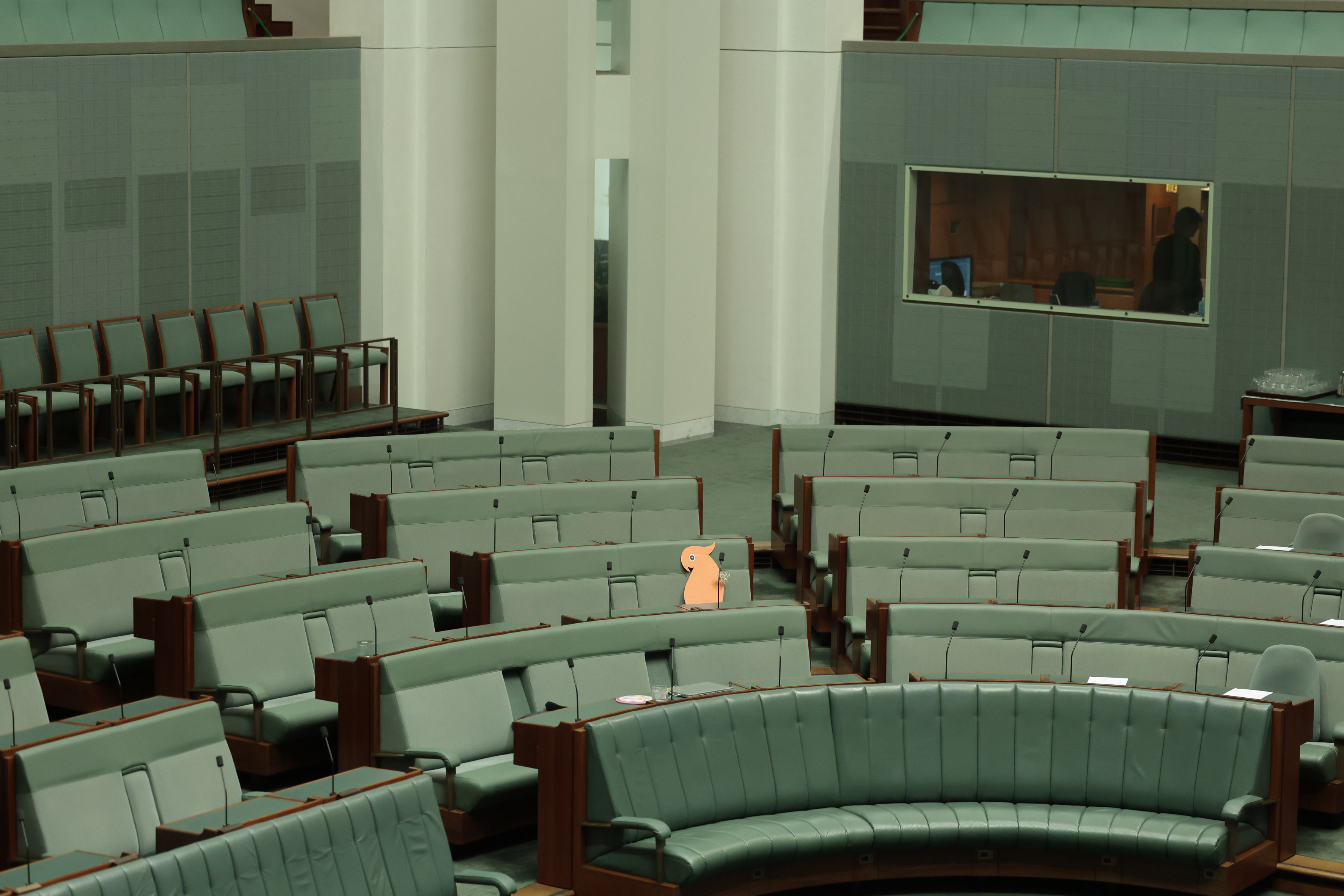
The building was flooded in orange hearts, Haines’ signature color, matched by a huge cutout of an orange cockatoo, her campaign mascot, assuming her seat in the chamber.
We saw Labor MP Matt Smith cross the chamber to console a weeping Monique Ryan. Haines’ close friend, independent Sen. David Pocock, listening alone in the public gallery long after his upper house colleagues had left. And while he acknowledged Haines as someone who “epitomizes civility, ” Taylor bucked the trend by going on to declare the temperature of political rhetoric is just right.
“It’s been suggested by some [that] there is a causal connection between robust parliamentary debate and political violence. I disagree with this view,” the opposition leader said, before noting his seat in parliament was “the length of two swords” from the PM’s. “Too many Australians have been taught to feel guilty and shame about our history and our country,” he said. “Is it any wonder that some people feel deep animosity towards our democracy, our institutions, and our nation?”
“Tone deaf”: How Ryan, an independent, described Taylor’s speech.
Compare and contrast: Taylor’s presumed leadership rival Andrew Hastie called for more civility. “We should strive to do better,” Hastie said. “Let’s play the ball, not the person, and leave the nasty personal politics of MAGA in the United States.”
“Like a stone in our hearts”: How Prime Minister Albanese described the shock of the attack a week on.
TRIBUTES: “My greatest wish is that I could be Helen when I grow up” (Kate Chaney). “Someone I go to when I don’t know what to do” (Allegra Spender). “The matriarch of the crossbench” (Zali Steggall). “Completely incapable of being nasty to anyone” (Richard Marles).
THE KINDER, QUIETER QUESTION TIME
You could hear a pin drop in question time on Monday. A simple broken glass at Labor MP Basem Abdo’s desk rang out through the entire chamber, in a muted hour of questions almost entirely devoid of interjection and aggression.
Even when Taylor was antagonistic, his MPs were largely silent in the pews. Albanese was subdued and factual. Interjections were soft and sotto voce. The opposition raised just one point of order.
National-turned-independent MP Andrew Gee asked about violence against women and the need for mental health funding in the regions. Independent Nicolette Boele, the first female member of Bradfield, noted the attack on Haines may discourage women and girls from taking part in public life. Minister for Social Services Tanya Plibersek said she understands those questioning if it is worth it, but her answer is “100% it is worth it …. can’t vacate the field.”
After a flurry of international trips, podcast appearances and interviews, including with Canberra Playbook Podcast’s Amanda Copp, Chalmers seemed a bit tired — out of energy and ideas, his opponents say — but his answer about savings and pressures in the global economy was pedestrian rather than defeated.
At 2:46 p.m. the father of the House, independent Bob Katter, finally brought some volume, shouting “it’s wiped out whole sectors” in response to an answer from Agriculture Minister Julie Collins’ to a question about free trade and fruit exports.
OVER THE RAINBOW: Taylor and Michael McCormack asked about the rainbow coalition of opponents to the selloff of defense assets, including Victoria Barracks, Sydney.
Albanese repeated the lines of Richard Marles: that an independent audit had found the sites made “no contribution to capability.” He said Victoria Barracks can’t be developed because of heritage listing — a claim disputed by opponents of the sell-off, and which logically contradicts the plan: why would you bother selling it if it can’t be turned into housing or a public park or facility?
Haines was granted leave until Parliament returns in 2027: a motion passed in gentle unison.
STATE OF THE NATION
VICTORIA — BULLET THREAT TO MINISTER: Victorian Emergency Services Minister Paul Edbrooke has decried a “new low” in political debate, after a bullet etched with the word “RAT” and his old firefighter number was found on his car.
Edbrooke suspects militant members of his former union, the United Firefighters Union, are bullying him. The union has urged voters to put Labor last at the Nov. 28 state election, and it also condemned the act.
BY THE NUMBERS
POLL POSITION IN VICTORIA
Latest Newspoll primary votes: Labor 24. Coalition 33. One Nation 20. Greens 14. Others 9.
Redbridge latest seat results modeling: Coalition 59. Labor 25. Greens 4. One Nation 0 — for a Coalition majority government.
One Nation, zero seats: Under these scenarios the rising party gets 20% statewide and wins no lower house seats. Compare that to previous modeling where One Nation was set for 23% to 24%, winning around 10 seats in the lower house.
PARTY ROOM
ONE NATION — PLEASE EXPLAIN THE TEMPERATURE: Hanson canceled an interview with News24 political editor Andrew Clennell yesterday. The reason? Hanson thinks Clennell is a “dickhead” for linking the party’s cartoons with political violence, her advisor James Ashby explained in a text that Clennell put to air.
“Make sure you add the part where she thinks you’re a dickhead,” Ashby told Clennell in a follow-up.
COALITION — OPPOSITION SAVINGS PLAN: Angus Taylor and Coalition treasury spokesperson Tim Wilson have unveiled $31 billion of proposed budget savings.
They want to cut climate programs, including electric vehicle tax concessions; “corporate welfare,” including subsidies for green hydrogen, aluminium and critical minerals; and housing programs, including Labor’s shared equity scheme. Other savings would come from removing non-citizens from welfare and the National Disability Insurance Scheme; and claims it will gain an extra $7.9 billion from cutting tobacco excise to reduce leakage to the black market.
The Coalition said more proposed savings would follow — including possible means testing of other programs. Labor says their $31 billion pales compared to the $140 billion in new funding promises its calculates the opposition making.
What businesses want: They’ve answered Jim Chalmers’ call for proposals for cuts, in The Australian. Gerry Harvey (Harvey Norman) said “the size of the public service.” Former Reject Shop chief executive Andre Reich: “Removing bureaucracy.” Graham Bradley, former chairman of EnergyAustralia, HSBC, Stockland and GrainCorp: “Eliminating duplication with state government agencies in areas such as planning, education, environmental approvals and licensing generally.”
GLOBAL HAPPENINGS
BRAZIL — LULA’S 52-48 COMEBACK WIN: In the end, it wasn’t that close, with Luiz Inácio Lula da Silva, the Brazilian president, winning a fourth term by around 5 million votes, to ring in his 81st birthday today.
The result is unprecedented at two levels: Lula came from behind after losing the first round vote, and he’s the first president to serve four terms.
SERBIA — VUCIC KICKED OUT BY STUDENT PARTY: Aleksandar Vučić’s 12-year reign as the most powerful man in Serbia has ended, with the Student List protest movement achieving a sweeping victory in national elections. The Student List won between 135 and 140 seats in the country’s 250-seat parliament, while Vučić’s party won 105.
Path to EU membership: While Serbia has been an official EU candidate country since 2012, its candidacy remains frozen over rule-of-law and democracy concerns and Belgrade’s refusal to join EU sanctions on Russia.
ONLY IN AUSTRALIA
4,321 WOMBATS APPROVED FOR KILLING IN VICTORIA: Are wombats a special threat to fences in Victoria? And is it OK to leave a joey to starve in its dead mother’s pouch? You be the judge.
COMMUNITY CORNER
MOVES AND APPOINTMENTS
Rio Tinto exec Kellie Parker will be the inaugural National Armaments Director — a much needed addition to the new Defence Delivery Agency — reported Andrew Greene and Tom Rabe.
CSL chairman (and former CEO)Brian McNamee will exit the company in March, after four decades. Interim chief executive Gordon Naylor will take over the chair role, The Australian reported.
BIRTHDAYS
Victorian Deputy Premier Gabrielle Williams, former Liberal MP and Haines’ predecessor in Indi Sophie Mirabella, former national cricket captain and Australian of the Year Mark Taylor.
And it will be a particularly sweet 81st birthday for Lula da Silva, a day after his come-from-behind re-election win.