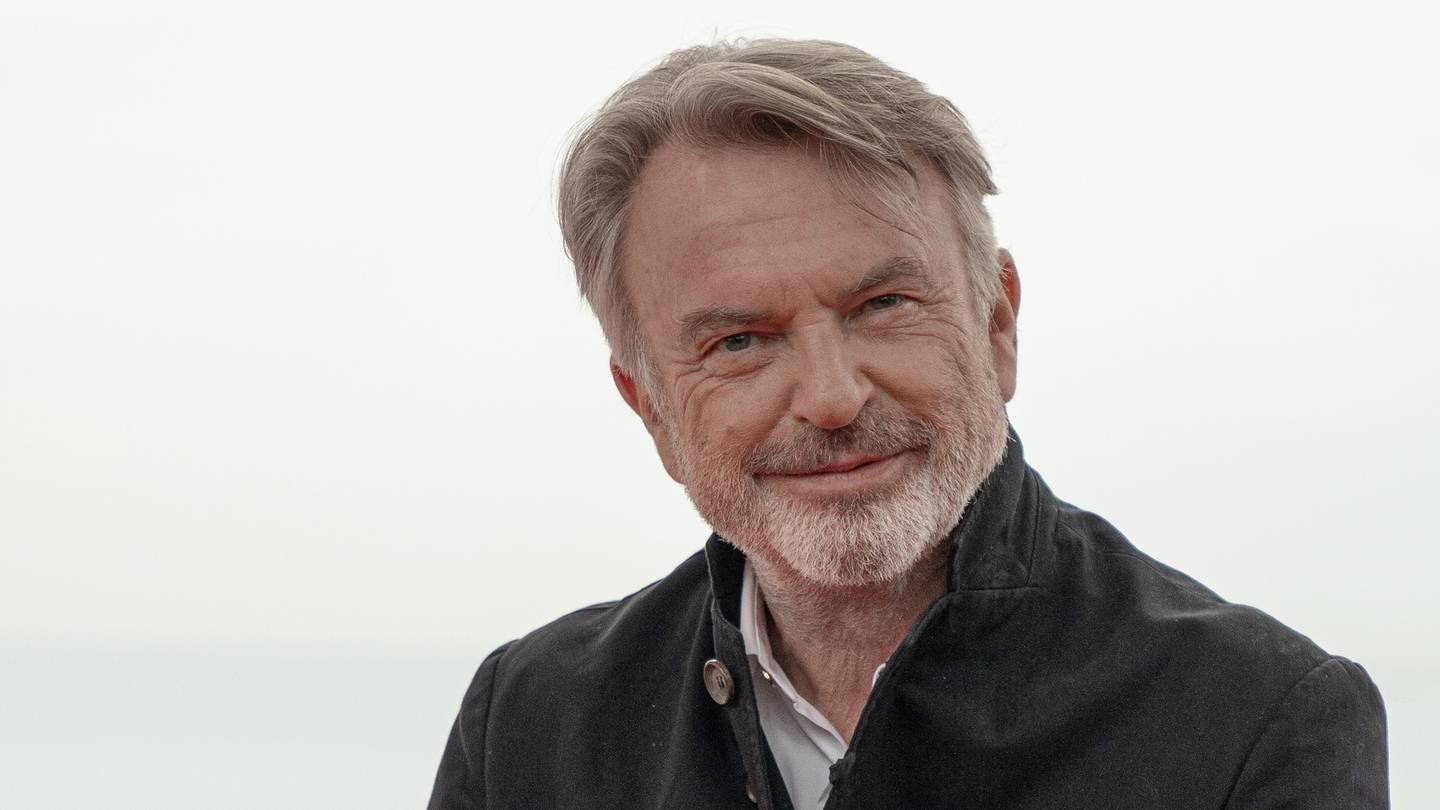
As he farewells the Jurassic period of his career with the final film in the blockbuster franchise, Sam Neill talks about the series, writing his memoir, and why he's not going the way of the dinosaur.
NZ Listener
Among his many achievements on screen, Sam Neill was in two Jurassic Park films and didn't get eaten. A little bloodied and bruised, but otherwise undigested. Now he's back for one last escapade in Jurassic World Dominion, the sixth and final in the franchise.
It's 30 years since he first played Dr Alan Grant, the man who took on a T-Rex while armed only with a distress flare in what ranks as one of the best scenes by Steven Spielberg, a man whose career doesn't lack for such moments. It was the first of Grant's many close encounters with the creatures. These days, the 74-year-old who plays him empathises with those prehistoric lizards.
"I'm just a dinosaur," he laughs down the line from Sydney. That's when the Listener points out that Kiwis doing well in Hollywood might be commonplace these days, but with Jurassic Park he was essentially the first.
There have been screen landmarks at home, too. Back in 1977, his debut feature, Sleeping Dogs, kick-started the New Zealand film industry. He made Cinema of Unease: A Personal Journey by Sam Neill, the spirited documentary about how our national identity was expressed in our movies. He played Uncle Hec in Hunt for the Wilderpeople, the biggest local film of all time.
Neill has been doing some looking back of late. He's 65,000 words into a memoir after six weeks of writing. He finally started one after multiple approaches over the years and an accident ("nothing to write home about"), which laid him up at his Sydney residence for a few weeks.
"I've always said, 'Nothing happened. And if it did, I can't remember.' It turned out that actually, quite a lot of things happened and I remember a lot of it.
He has been writing as the mood takes him. That's occasionally meant he has sat down to bash out a few thoughts and the next thing he knows, it's two in the morning.
The working title is Did I Ever Tell You This? That's thanks to Australian journalist David Marr. "We were talking one day and I said, 'Did I ever tell you this?' And he said, 'Stop there. That's the title of your book.'"
His triple Jurassic period is likely to loom large. After all, the 1993 release of Jurassic Park – until Titanic four years later, the biggest movie in box-office history – marked quite a time in Neill's career.
He went from shooting Jane Campion's The Piano in mid-1992, in which he played the cruel Alisdair Stewart, to the Hawaiian filming of Jurassic Park. Both films, ground-breaking hits in their own right, were out within months of each other the following year.
Spielberg's first dinosaur movie, from Michael Crichton's tale of untempered science, became a generational touchstone. There were Alan Grant action figures and other merchandise. "I think Lego bloody well owes me," jokes Neill.
Among palaeontologists, there's now such a thing as "the Jurassic Park generation".
"People who saw it when they were children never forgot it," says Neill. "When you see that T-Rex stomping towards you in the rain, it's genuinely frightening, and no one had done that before.
"If I go to Ohio, or somewhere like that, the thing I'm most identified with is Jurassic. I get a lot of letters from people who say, 'I'm a scientist,' or 'I'm a palaeontologist because of you,' which isn't what you're planning for when you take on something like this. We were making popular entertainment, really. But it's like pop music, which is designed to be disposable but which actually endures. Jurassic Park has kind of endured in a way that none of us could have expected."
Sleeping Dogs had given Neill a ticket to a career in Australia and further afield during the 1980s. It was in the 1989 Aussie thriller Dead Calm, opposite an unknown Nicole Kidman, that Spielberg noticed him in.
"Dead Calm really impressed Steven. I suppose he thought, 'That's a guy that's relatable', and, you know, reasonably convincing in action."
After meeting the director for coffee in Los Angeles, he went to Toronto to make the television drama Family Pictures. While there, he got a call from Spielberg to say he had the part. Dr Grant's boots and hat were delivered the next day.
The Hawaiian part of the shoot was memorable, less for the scenes with the animatronic dinosaurs, or having to imagine ones that would be computer-generated later, but for the film's real battle with Mother Nature. Hurricane Iniki hit the island of Kauai, destroying sets. "On this particular morning, they said, 'No work today, there is a hurricane due at three o'clock.' So we had a few hours to hang about and Laura [Dern] and I went down to the beach and we could see this incredibly black cloud approaching. And Laura said, 'Do you think we might die this day?' And I said, 'You know, we just might.' We both chuckled."
Cast and crew, including Sir Richard Attenborough who played park developer John Hammond, were ordered to hunker down in the hotel ballroom.
"There was stuff flying all over the place – the hotel was basically being destroyed around us," recalls Neill. "The noise was incredible. The best thing was Richard Attenborough. He went straight to sleep as chaos was all around us. He woke up momentarily and we said to him, 'Sir Richard, you don't seem fazed at all by this.' He said, 'Darling, I lived through the Blitz', and went straight back to sleep."
Alan Grant survived the first film, was otherwise occupied on the second and returned for 2001's Jurassic Park III, which had him on a rescue mission back to the abandoned island and confirming his theory that those velociraptors could talk among themselves.
The first film in the franchise without Spielberg at the helm, and the first that started production without a finished script, JP III is regarded as a series low point. The reviews weren't great and its box office lagged its predecessors. It seemed the franchise had run its course.
"Well, it did rather well, actually. It still made a lot of money. I think it has a slightly disappointing ending, but at least it had a beginning and a middle and almost an end.
"I'm actually rather fond of it and I think Alan Grant acquits himself well in it."
A reboot came with Jurassic World in 2015, followed by Jurassic World: Fallen Kingdom three years later. At Spielberg's suggestion, the first film revived the idea of a functioning dinosaur tourist attraction. Until the inevitable malfunctions.
Now, Dominion unites the three scientist leads from the first films – Neill, Dern and Jeff Goldblum – with Chris Pratt and Bryce Dallas Howard from the previous Jurassic World films, in a story about the dinosaurs having escaped into the wider world.
Director Colin Trevorrow has said it's designed to finish the story that began in 1993, and so needed the original old wise heads.
Neill says he, Dern and Goldblum were concerned about the level of involvement when the reunion was mooted.
"We weren't interested in coming in as cameos. The Jurassic World films are very different from the Jurassic Park ones. They're much more sort of action orientated. They're much more dinosaur orientated. And we didn't want to be sort of token-part people. We wanted to be integral to the story."
Well, apparently, they are, in a story that has Dern's Dr Ellie Sattler telling Grant, her ex, that he's needed once more. The dinosaurs might be roaming free but they are being rounded up by a giant biotech company with interests in food production. The film also touches on climate change. "There's always been a message with these films, even if it's subliminal," says Neill. "They're not anti-science as such; nor am I."
In 2020, Neill had headed to the UK to start filming when the pandemic had him soon heading back to Sydney, his urban residence when he's not in Central Otago where he has his Two Paddocks vineyards.
The shoot resumed a few months later under strict protocols, with the cast and crew all confined to a hotel near Pinewood Studios, as the Covid-19 hurricane raged outside.
"We all lived together for about three or four months, mostly in this one hotel, and we had no contact with the outside world apart from our mobile phones. We worked very hard and relied on each other. So, it was a good thing that we all got along because we could have driven each other completely crazy."
The production also headed to Malta and Canada. "We were like the canary in the coal mine. For quite a while, we were the only major film production that was turning over in the world. So all of the film industry was looking to us to see if it was actually possible to pull off a film under the very constrained circumstances that quarantine necessitated."
Not only did Dominion pull it off, it spawned a parody – The Bubble – a Netflix movie by comedy veteran Judd Apatow, about a bunch of actors in a long-running monster movie franchise forced to live together in a hotel during its UK production. Funnily enough, says Neill, they filmed in the hotel that Dominion used. But it was generally judged as terrible by reviewers and viewers alike, Neill among them.
"I mean, I like Judd Apatow, but a film about bored people can be really boring and we weren't that bored and we weren't that stupid.
"Oddly enough the whole Covid thing sort of enhanced the experience because we were all quartered together under siege. We weren't allowed into London or anywhere else. We were confined to quarters, we had to make our own fun and we bonded in a way that I don't think we would have otherwise."
As the film's international release date approaches, Neill has been on publicity duties. One aspect of his role in his original film that's already made a few headlines is the age gap between him and Dern – then she was 25 and Neill was 20 years older. Curiously, that was about the age gap between him and Kidman in Dead Calm.
But 30 years later, these things get noticed. "Yeah, I never considered that at the time and also, as I've said on social media, she always seemed more grown up than me – and still does.
"Look, if you want to get upset about it – people get upset about everything these days – go ahead. As far as I'm concerned, who cares? It seems completely harmless to me, but there's always something to take offence at.
"Remember that Laura had been in the movies for about 15 years already. She was probably more experienced than me. It's not even clear what sort of relationship they have. I mean, is it romantic? I don't think it becomes clear, really, until she turns up in the sixth film. She's divorced, she's single. She's not interested in Alan Grant and she was the love of his life. And the fact that he lost her, probably by his own stupidity, has always rankled with him. When she turns up, the day brightens, just like that."
Neill can't say whether Grant survives the last stand. "But if he survives this film, he will probably go into some kind of deep therapy to recover."
If he doesn't, the story of his character's demise should make for quite a chapter in that memoir. But the book isn't a sign he's easing himself out of his career. He's worked on two films and a television series since Dominion. This screen dinosaur is a long way off extinction.
"Yes, I like to be busy. In fact, the whole idea of retirement just fills me with uncommon dread."
Jurassic World Dominion is in cinemas now.