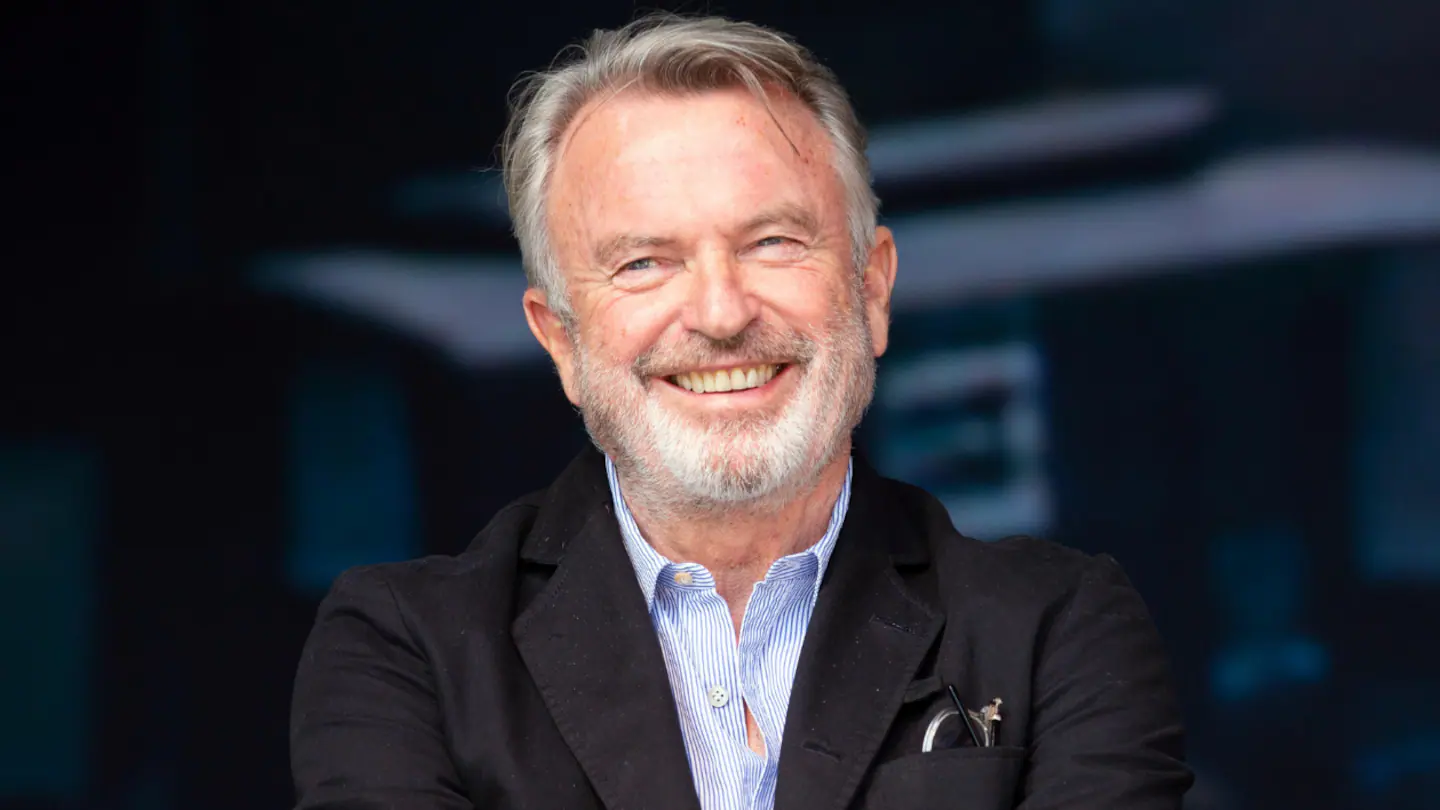
The Listener looks back in-depth at the career of Sir Sam Neill, the versatile screen actor, winemaker, environmental activist and Southern Man who died this week aged 78.
It’s September 2008 and Sam Neill, elder statesman of NZ cinema, star of Jurassic Park and The Piano, the man who could have been James Bond, the first Kiwi actor to conquer Hollywood, is on set in another glamorous location.
This writer finds Neill in the Wairau Valley, the bleak basin of workshops and warehouses by the motorway on Auckland’s North Shore. There, an anonymous commercial building has been turned into a studio for Under the Mountain, a movie of the Maurice Gee kids’ fantasy that spooked an earlier generation as a television series. Neil is playing Mr Jones, the good centuries-old alien helping the hero teenage twins against the bad alien Wilberforces. Fortunately for Neill, Mr Jones is a low-maintenance extraterrestrial. This pleases Neill, having been in a few sci-fi and horror films before that required heavy make-up. “I’ve served my time in latex.”
Essentially, Mr Jones is a geezer about Neill’s age in a tweed jacket. Grabbing a few minutes to talk, it’s clear he’d rather chat at length about that garment than the actor inside it. After all, it’s a vintage one with a Mosgiel Woollen Factory label, which he proudly displays. He grew up down that way himself, of course. He’s also vintage and quite tweedy himself. It was clearly meant to be.
“It’s the first time I have ever worn a costume I actually envisioned in my head beforehand. And they produced exactly the jacket I was thinking of.”
The role comes amid an early-2000s patch where Neill appears in a run of modest-budget NZ movies, such as Gaylene Preston’s Perfect Strangers (2003) and Toa Fraser’s Dean Spanley (2008), and a little later, the Oscar Kightley detective mini-series Harry. Presumably, he’s not doing them for the sort of money he might get from playing dinosaur bait.
“No. I don’t have an altruistic bone in my body,” he says, batting the question away. “I only do things for selfish reasons and one of the selfish reasons is it’s nice to be home.”
Of the nearly 100 features Neill starred in a nearly 50-year screen career, he didn’t do many at home.
Still, he starred in three of our most significant films. There was Sleeping Dogs which jump-started the New Zealand film industry; The Piano, which was both an Oscar and Cannes triumph and international arthouse hit; and Hunt for the Wilderpeople, which, 10 years after its release, remains our reigning domestic box office champion.
All three caught Neill at different ages and stages in a globetrotting, prolific, diverse, random, genre-hopping acting career that had its roots in his time as a boarder at Christchurch’s Christ’s College.
It was during his school days that he opted for “Sam” as a first name over the “Nigel” he had been christened because he had so many Nigel classmates, and thought Sam sounded like a name from the cowboy movies he loved.
“At school, acting was about the only thing that I enjoyed doing. We did three productions a year at Christ’s College, and if you were any good you might be lucky enough to score a role. Acting wasn’t on any syllabus in those days; it was something you did in your spare time. A hobby. Most of the other boys at school thought it was for ‘poofs’. I didn’t care, I enjoyed it, and it was about the only thing I was even halfway good at.”
While at Canterbury University he continued acting, first in a Drama Society production of A Midsummer Night’s Dream directed by famed crime writer Dame Ngaio Marsh, who gave him some direct feedback on his first night.
“Ngaio stormed down the stairs, looked me in the face close up, and thundered in her basso profundo voice, Sam, that was a sissy performance!”

From stage to screen
He continued acting on the Wellington stage after transferring to Victoria University then getting a job as a trainee director at the National Film Unit. When another NFU director, Barry Barclay, cast him as priest in a short drama, Ashes, his performance attracted the attention of Roger Donaldson, who with Ian Mune was on a mission to turn CK Stead’s 1971 novel Smith’s Dream into the first NZ-made 35mm feature film.
As Smith in the film, titled Sleeping Dogs, Neill brought a nervy, wide-eyed edge to his leading man looks. He was the convincing centre of the political thriller and rough and ready action film. But Neill didn’t like what he saw. “It’s hard to describe how excruciating I found it watching myself on the big screen. It only confirmed for me that, as far as screen acting went, this was the end of the road,” he wrote in his 2023 memoir, Did I Ever Tell You This?
When Sleeping Dogs was released, the Listener reviewed it favourably. Though, as Neill teased its writers from that point on, the review made no mention of whether Neil was good, bad or indifferent. It made no mention of him at all, instead focusing its praise on director Donaldson and co-writer Ian Mune, who also starred in the film.
The magazine made up for it in a post-release profile of the newly anointed local film star, who was still working as a documentary director at the National Film Unit. The story found Neill philosophical about what the movie had done for him, and not yet ready to give up the day job. “Just about the only time I’ve been recognised was by a girl in the pub who said I looked like the man in Sleeping Dogs.”

He was yet to get an agent or receive the phone calls from overseas offering him parts in the likes of Australian period film My Brilliant Career, putting his devilish handsomeness to the role of the Antichrist in The Omen sequel The Final Conflict, or the lead in British period espionage series Reilly, Ace of Spies. But in the profile, he sounded a bit fed up with New Zealand and ready to go: “Success is not really approved of here.”
My Brilliant Career began his long and lucrative attachment to Australia and its screen industry, which adopted him as one of its own. The Final Conflict started his regular habit of playing unhinged characters in horror films over the decades while being happily unfussed about the results. Reilly was his breakthrough in the UK. It also made him a Listener cover star in 1984.
“One of the big satisfactions for me with Reilly was that I discovered I was all right. I could cut that particular mustard,” he said in a story where the writer strained to get him to say anything much about his new-found fame and fortune. Reilly also put him in the sights of the Bond producers, who were needing to replace Roger Moore. But he was a reluctant candidate.
“I was made to do an abortive audition at Pinewood Studios by my agent. I hated every moment of it and knew with utter certainty I did not want the gig. I had no desire to be the one Bond that no one liked.”
Two late-1980s Australian films would set him up for greater success. First was Evil Angels, the dramatisation of the Azaria Chamberlain case and the trial of her parents, Lindy and Michael, for their daughter’s death at Uluru in 1980. Neill starred opposite Meryl Streep – for a second time, after 1985’s Plenty – as Michael Chamberlain. Neill prepared for the role by spending time with the Chamberlains.
“I tried diligently to convey his immense pain, his patient dignity. I admired him more than I can say, but I also bled for him, poor bastard. He was never as strong as her, and I think it broke him in the end.”
Then came Dead Calm, the psycho-killer yacht thriller that was a breakthrough role for Nicole Kidman as the younger wife to Neill’s character. Their boating holiday is interrupted by a crazy castaway. Neill’s performance, which required a bit of action muscle, put him on Steven Spielberg’s radar for Jurassic Park.

Neill back home
In the meantime, Neill returned to New Zealand for Jane Campion’s The Piano. It wasn’t the first time he had been directed by a Campion – her actor parents Richard and Edith, who had founded touring theatre company the New Zealand Players, put Neill in a 1976 production of Juno and the Paycock at the newly established Circa Theatre in Wellington, shortly before Neill’s professional screen career took over from his theatrical one.
In her next film after An Angel at My Table, Jane Campion cast Neil as the stern, stifled 19th century settler Alisdair Stewart, the man who has brought Holly Hunter’s mute Ada McGrath to the untamed colony for an arranged marriage. But discarding her beloved piano on the beach, he found himself losing his betrothed to Harvey Keitel’s George Baines.
Neill had a tough and lonely time on the shoot. There wasn’t much camaraderie with his American co-stars. But when he saw The Piano, he realised it was the best film of his career.
“When it was finished, I couldn’t leave my seat. I was in tears that Jane had made something so grand. I sat there for a long time thinking about it, and how completely grateful I was to be a part of something so transcendentally beautiful,” he wrote in his memoir.
“I don’t think I can overestimate how important The Piano was for me in hindsight. It sits on my funny old CV like a medal on my chest. It wasn’t my film. It was Jane’s. I wasn’t the star of the film. That was Holly, but there is honour to be found in the second fiddle. Or fourth ... It’s a film that will always have a place in cinema history. And I served in it.”
The Piano debuted at the 1993 Cannes Film Festival, where it was joint winner of the top prize, the Palme D’Or, with Chinese film Farewell My Concubine. Neill accepted the trophy on an absent Campion’s behalf. Another Listener cover.
A month later, Jurassic Park came out. Neill would also appear in the third of the original trilogy of films and in a reunion with his co-stars Laura Dern and Geoff Goldblum in 2022’s Jurassic World Dominion. They would be by far his biggest box office hits internationally.

But in Aotearoa, his biggest movie will remain Hunt for the Wilderpeople. He was Uncle Hec, the man-alone bushman saddled with foster kid Ricky Baker as the pair hide from the authorities. The movie had echoes of Sleeping Dogs and the local 1980s films that followed in its wake, like Donaldson’s Smash Palace.
Wilderpeople might be remembered as a comedy, but Neill didn’t play Uncle Hec for laughs. His performance as the reluctant runaway babysitter gave the film its emotional heart beneath Waititi’s efforts to drag the story it was based on, Barry Crump’s Wild Pork and Watercress, into the 21st century.
The role cemented Neill as a kind of favourite uncle/national treasure figure. His self-deprecating sense of humour was on full display via his Instagram account, which often starred his Two Paddocks vineyard farm menagerie. The animals were named after his favourite co-stars. During the pandemic lockdowns, Neill’s social media offered DIY films and musical performances.
As Central Otago’s best known winemaker, a diehard Labour supporter on both sides of the Tasman, as well as a well-liked celebrity, Neill was happy to lend his prominent voice to what he saw as good causes. A spat with Queenstown mayor Warren Cooper over development in Queenstown and the Wakatipu Basin earnt him another Listener cover in 2000.
In recent years, he was the face of opposition to the proposed fast-track consent for the Bendigo-Ophir Gold Project near Cromwell by Australian mining company Santana Minerals.
For Neill, this meant his final documentary – after fronting others on New Zealand cinema, Captain Cook and Anzac history – is a five-minute mini-doc entitled Into the Dunstan Mountains – with Sam Neill. “I’ve loved this place all my life, and I’ve lived here for decades,” he says in the film. “And we can’t let this travesty happen.”
Sam Neill is his own words
On his voice: “The New Zealand accent can be thin soup, and a bit miserable. Like an Australian with a heavy cold. But on a marae, you hear people speak as if they actually enjoy vowels. My voice lies somewhere out in a neutral blue ocean. In England, I get teased by my friends for sounding like someone from the colonies. And at home in New Zealand, some people think I sound like a stuck-up Pom. Too bad. It’s my voice, and I’m sticking with it.”
On being rejected by NZ television as an actor: “While Roger and lan were casting Sleeping Dogs, we somehow had access to TVNZ’s casting files. I was curious to see what was in my file. I’d auditioned for a couple of productions there to no avail, and indeed there I was under N. The summation on me was brief. “Sam Neill. ‘Could be all right in homosexual roles’.”
On having his academic career saved by mate John Clarke: “It was a week or two before exams, and we were queuing for a pie in the university cafe. He asked me what was wrong, and I told him I was rooted – there was no way in the world I could possibly pass [philosophy paper] logic. Another wasted academic year. John said, ‘No worries, son. Give me a couple of hours in the library, and you’ll be right. And that’s exactly what I did – John spent two or three hours talking to me, the moron, and I passed the damn thing. Miracles happen when you know someone like Clarke.”
On starring in Melbourne black comedy Death in Brunswick with Clarke: “There was a solidarity between us, two expats trying to make our way … it remains one of my favourite films, not least because of the partnership between John and me.”

On being Dr Alan Grant: “I get a lot of letters from people who say I’m a scientist or I am a palaeontologist because of you, which isn’t what you’re planning for when you take on something like this. We were making popular entertainment, really. But it’s like pop music which is designed to be disposable, but which actually endures. Jurassic Park has kind of endured in a way that none of us could have expected.
“I don’t think the Jurassic series made any seismic shift in my career … though there is a weird action man figurine from 1992 in which a muscular version of me wears peculiar underpants.”
On his worst film, United Passions: “In the Fifa-endorsed film for the 2014 World Cup, he played Fifa’s long-time president, João Havelange: “I am reliably told (I haven’t seen it) that it is rated as one of the worst films ever made, if not the worst. Frankly, I couldn’t give a damn.”
On reviews: “I could quote the bad ones word for word. I never remember the good ones.”
Sir Nigel John Dermot “Sam” Neill was born in Omagh, Northern Ireland, in 1947. His NZ father was a British army officer stationed there, his mother was English. They emigrated in 1954, initially to Christchurch then Dunedin. Sam Neill was diagnosed with stage 3 lymphoma in 2022 and underwent chemotherapy, then CAR T-cell therapy, writing about the experience in his 2023 memoir, Did I Ever Tell You This? He died in Sydney on July 13, reportedly from pneumonia. He is survived by four children and eight grandchildren.