
When you follow someone, you'll see their latest stories on your homepage in the 'Following' section.
Autonomous trucks are being trialled on roads in Australia, as experts warn policy must keep pace with technology.
The results of the first trial of a connected and automated vehicle in live-traffic conditions has highlighted the technology’s use to support Australia’s growing freight task.
Transurban general manager Tien-Ti Mak said the technology was rapidly evolving.
“We’ve got an opportunity in Australia to lead the world in terms of how we actually bring this tech to commercialise scale for our freight task,” he said.
“It is high-volume, highly repeated movements with the same origins and destination point, which is perfect for innovation.”
Automated trucking is in the spotlight globally for its potential to deliver the growing freight task, overcome driver shortages around the world, and improve safety.
It is expected that hub-to-hub freight delivery will be rolled out at scale in the US and possibly Europe this decade. But industry experts have cautioned that without regulatory reform and a commercial focus, Australia may be delayed until the later 2030s.
Mak said Australia had some of the most technologically advanced roads in the world, which would enable autonomous trucking safely and efficiently.
“The City Link Road has somewhere in the vicinity of 600 cameras and other sensors,”he said.
“It makes it an ideal testing ground for those sorts of technologies. We are also using those cameras and sensors in order to help the truck do its job. We can help it see around the corner, and we can simplify the truck’s operations.”
The Transurban trial was conducted late last year over four weeks at night on the Transurban-operated CityLink and the DTP-operated Monash Freeway in Melbourne, travelling a total of 370 km.
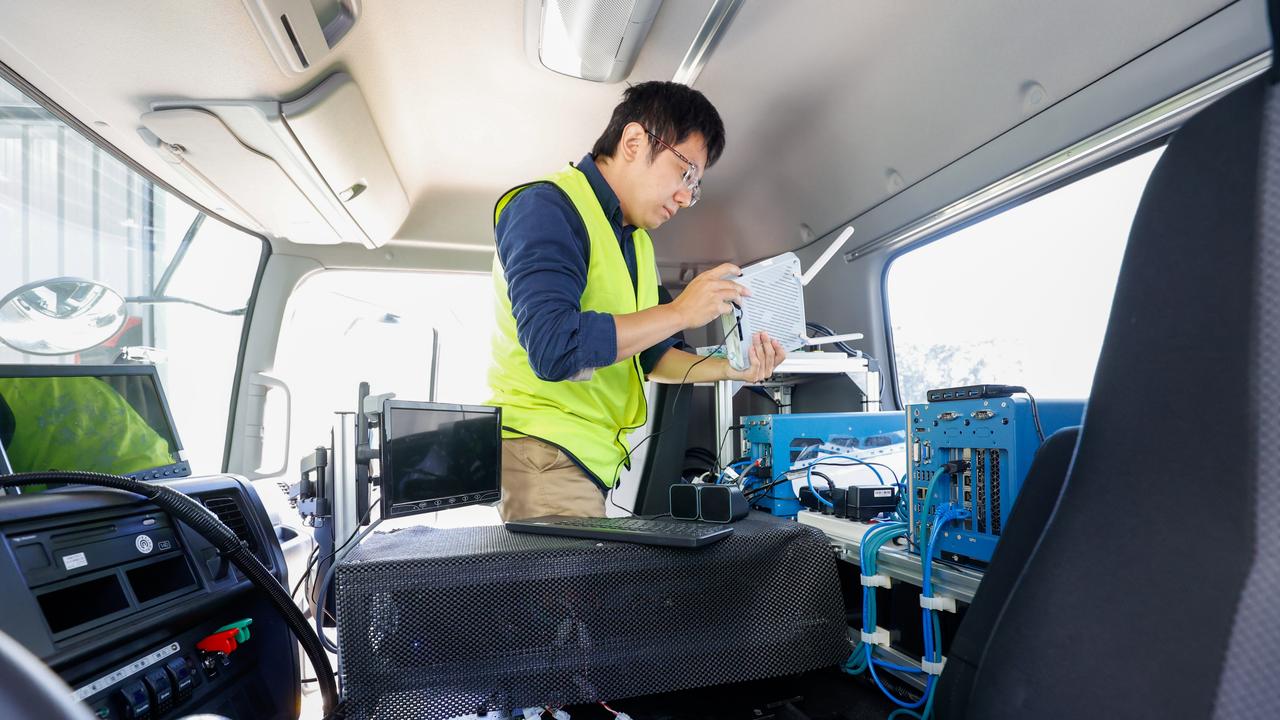
The vehicle was a modified left-hand-drive Hino 700 SH 4x2 tractor with built-in heavy-duty, trailer-towing capability. The Industrial technology Research Institute (ITRI)’s autonomous driver system of two industrial computers and a cab-based sensor suite included mounted lidars (light detection and ranging units), inertial measurement units, cameras and radar. Three experienced truck drivers were on hand to take over if necessary.
The trial also incorporated the road-infrastructure data into the autonomous driving system to extend the range of the sensors. The truck was in autonomous mode 92 per cent of the time. The other time was largely lost due to internet-connection issues.
Technological enhancements in trucking have been assessed as having the potential to save more than 100 lives per year.
A 2015 study found features such as autonomous emergency braking, lane departure warnings, electronic stability control and fatigue warning systems could save 104 lives annually and between $171 million to $292m.
And autonomous heavy vehicles are already in use in controlled environments, such as mine sites, feedlots and Defence applications. Australia has the highest number of autonomous haul trucks in the world with a fleet of almost 1000 in May 2023, according to GlobalData’s Mining Technology publication.
BHP had more than 300 trucks in operation, with plans for more than 500 by the end of the year, while Fortescue Metals Group and Rio Tinto were also utilising the technology.
The trucking industry is supportive of the introduction of the development and deployment of automated trucks, as long as there is a supportive regulatory environment, education for the public and an appropriate infrastructure and training sector.
Daimler Truck Australia Pacific Head of Vehicle Homologation, Regulatory Affairs and Future Mobility, Romesh Rodrigo, said the challenge to progress autonomous vehicles was getting the right infrastructure and policy in place.
“Policy will be the key driver for so much of this and we are lacking in policy,” he said.
“There’s a lot of aspirations that are out there. The infrastructure needs to support it.”
He said in addition to enabling policy around connected vehicles and dedicated pathways, the physical road infrastructure had to be more robust to carry the future autonomous and zero-emission heavy vehicles, which could be up to 40 per cent more load for the same haulage.
“We really need to think about how we move in the future,” he said. “The roads are actually limiting our ability to carry the same payload. For the big trucks, we are not able to exploit their capacity on Australian roads.”
Trucking Industry Council chief technical engineer Mark Hammond agreed, saying there were both regulatory and compliance hurdles to be overcome before companies would adopt the technology.
He said the current proposal placed liability for accidents on the vehicle manufacturer — including personal liability for directors — which was not the regulatory scenario in Europe.
In Europe, he said, the vehicle had to meet safety tests before being released but once the tests were met, there was no direct legal liability for the manufacturers.
“The single biggest challenge we have at the moment is the regulatory path that Australia looks as though it’s going to choose,” he said.
“It is out of step with Europe, which doesn’t make a lot of sense.
“The major automotive suppliers will probably shy away from it because the legal ramifications are just too great.
“The technology is here and it works, but until we get the laws right, that is going to be the single biggest impediment in the short to medium term.”
Transurban’s Mak said there was a need for board stakeholder engagement across industry, government and regulators to support the advancement of autonomous technology.
“The size of the prize is fantastic,” he said. “You make this investment, the benefits associated with automated freight are huge. We’ve got an ever-increasing freight task, there are massive driver shortages.”
He said being able to utilise automated vehicles for freight transport at night would also alleviate traffic congestion while better using the assets available.
A spokesperson for the Department of Infrastructure, Transport, Regional Development, Communications and the Arts said the Australian government acknowledged how the new and emerging technologies of connected and automated vehicles as well as co-operative intelligent transport systems could bring opportunities to improve transport safety, accessibility, productivity and sustainability.
“Work is under way on a new automated vehicle safety law and supporting framework, expected to be in place by 2026,” the spokesperson said.
“This includes determining how the framework can best ensure automated vehicles operate safely and legally on public roads when they are commercially available.”
The Australian government, states and territories, the National Transport Commission and National Heavy Vehicle Regulator were working to better understand the practical aspects of implementing the automated vehicle regulatory framework, as agreed at the Infrastructure and Transport Ministers’ Meeting in February 2022, with the timeline of 2026 as the implementation target date.