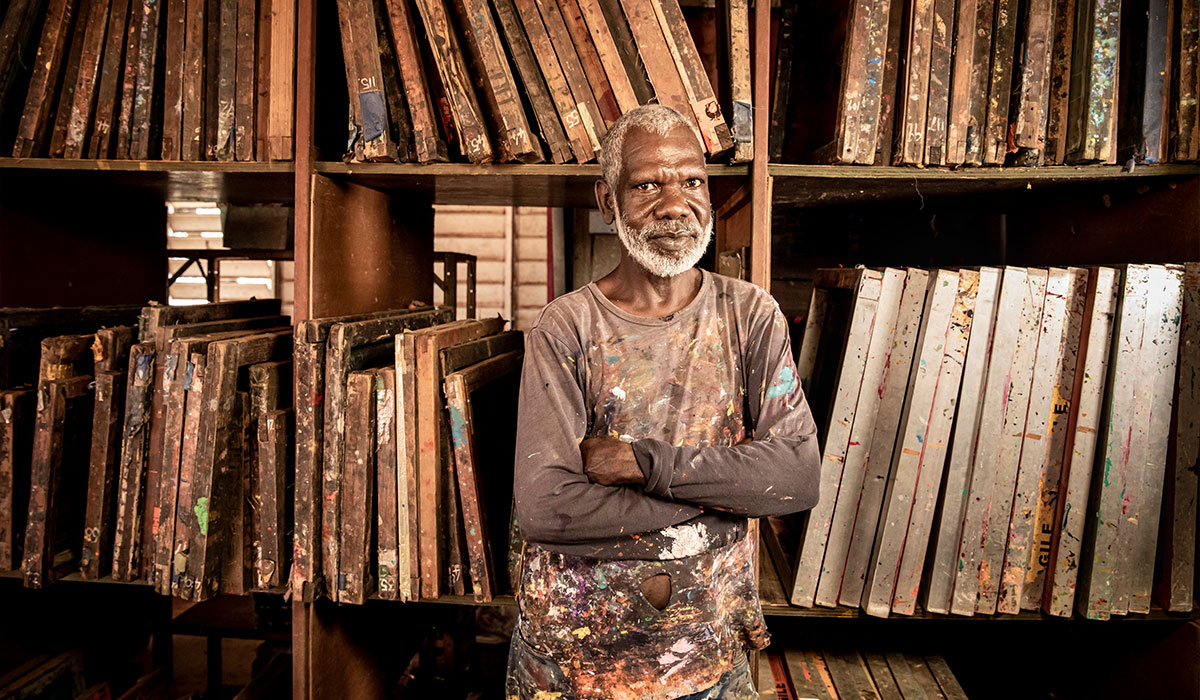
Aboriginal artist, Tiwi Islands. Image: Tourism Australia/SeaLink NT – Tiwi Islands/James Fisher
When travellers visit the expanse and diversity of the Northern Territory, they might find the art and culture is not what they might expect.
It could be a beanie festival in the heart of the Australian desert, a leading fashion exhibition on a remote tropical island, or a globally significant arts centre 500km from the nearest city.
“Art and culture in the Territory is embedded in everyday life,” says Kathy Burns, Director of Arts and Culture at Northern Territory Major Events.
“It is not obvious,” she says. “It is not necessarily always in the gallery. Sometimes it's just on the corner of the street. Or you might be on a desert trail and all of a sudden you open up to a beautiful rock art formation.”
The region’s internationally significant arts scene is on display through the Territory Arts Trail, a new plan to steer visitors through easy and achievable self-drive and tour itineraries that traverse the Territory.
Routes from the major centres including Darwin, Alice Springs, Katherine, Uluru and Kakadu allow visitors to choose from a selection of suggested itineraries that follow different paths and include a variety of arts and cultural experiences. Even before they leave, visitors can arrange highlights through the new online itinerary builder tool at territoryartstrail.com, which allows travellers to curate their own experiences.
In November, a new light installation will open in the streets and waterfront of Darwin from renowned light-installation artist Bruce Munro.
Already well-known to visitors for the dreamlike Field of Light at Uluru with more than 50,000 lights in front of the monolith, Munro’s new work is the Tropical Light exhibition.
This is a 2.5km self-guided path of eight illuminated sculptures through the centre of Darwin. It will operate throughout summer, complementing the existing street art canvases across the capital.
While the Top End’s tropical summer offers a spectacular landscape and more intimate viewing experiences for regional art centres, many of the major events occur in the drier winter months.
Major events season kicks off with the Museum and Art Gallery of the Northern Territory’s Telstra National Aboriginal & Torres Strait Islander Art Awards (NATSIAA), the premier indigenous art exhibition for Australia.
MAGNT Director Marcus Schutenko says the awards, which began in 1984, are the best place to see the best quality contemporary indigenous art.
“It’s both an award ceremony and an exhibition,” he says. “Seventy finalists are chosen for the exhibition, which runs from August to November.”
He says the awards – which attract up to 300 entrants – have generated other spin-off events. This includes an exhibition of the works that were not selected in the final show of the NATSIAA, a Salon Des Refuses.
“It’s great to make a comparison,” he says. “People can look and say, ‘Oh, did the selection panel get it right? Did they pick the best works?’.”
Running at the same time, the Darwin Aboriginal Art Fair also offers collectors and buyers a chance to purchase works from more than 2000 artists from 70 community art centres across the Territory and Australia.
DAAFF executive director Claire Summers says the event highlights the spectacular diversity of artwork and is the most significant indigenous art fair globally.
Last year art worth $2.8m was sold, with 100 per cent of proceeds going back to the art centres.
Another offshoot includes a much-loved fashion festival on the Tiwi Islands, From Country to Couture, where textiles and prints from remote arts centres are transformed into wearable art.
This year popular contemporary fashion label Gorman teamed up with Mangkaja Arts to produce a collection.
Social media influencer and Darwin local Lisa Andrews says the range of textiles is extraordinary, and extraordinarily popular.
“All the different art galleries and art centres and the textiles are in one place, it's very convenient for people to go there and get what they want,” she says.
“Then you can literally spend hours there. There is just so much to choose from.”
MAGNT’s Schutenko says the diversity and quality of the arts festivals occurring at the same time in Darwin create a huge marketplace and a groundswell of support.
“There are thousands of people who converge on Darwin that weekend because of the collection of Aboriginal art events that are taking place,” he says.
Across the Territory, each centre offers its own take on culture. The Country to Couture and Beanie Festival bring artists and visitors to the Red Centre for high-level talks, arts networking, and quirky craft-making. In April, Parrtjima – a festival in light offers a spectacular series of light installations set against the backdrop of the MacDonnell Ranges.
Parrtjima - A Festival in Light. Image: Tourism NT/James Horan
Each winter, more than 2500 people from across the country make their way to northeast Arnhem Land for the influential Garma festival of music, art, dance, song, ceremonies, and famously, policy discussions.
In Katherine over the June long weekend, thousands also gather for the Barunga Festival celebrating remote indigenous Australia for music, sport and the arts.
Kathy Burns from Northern Territory Major Event says the diversity of experiences and events, as well as the different artists that travellers can interact with and meet during their visit, creates a unique experience.
“As a traveller, no two people would probably ever get the same experience if they're coming along and looking for an art trail,” she says. “It's not something that is always the same all the time.
“Everyone will have a very different experience.”