From millennia-old rock art to unexpected street art, the Territory’s newly-launched experience planner will amaze.
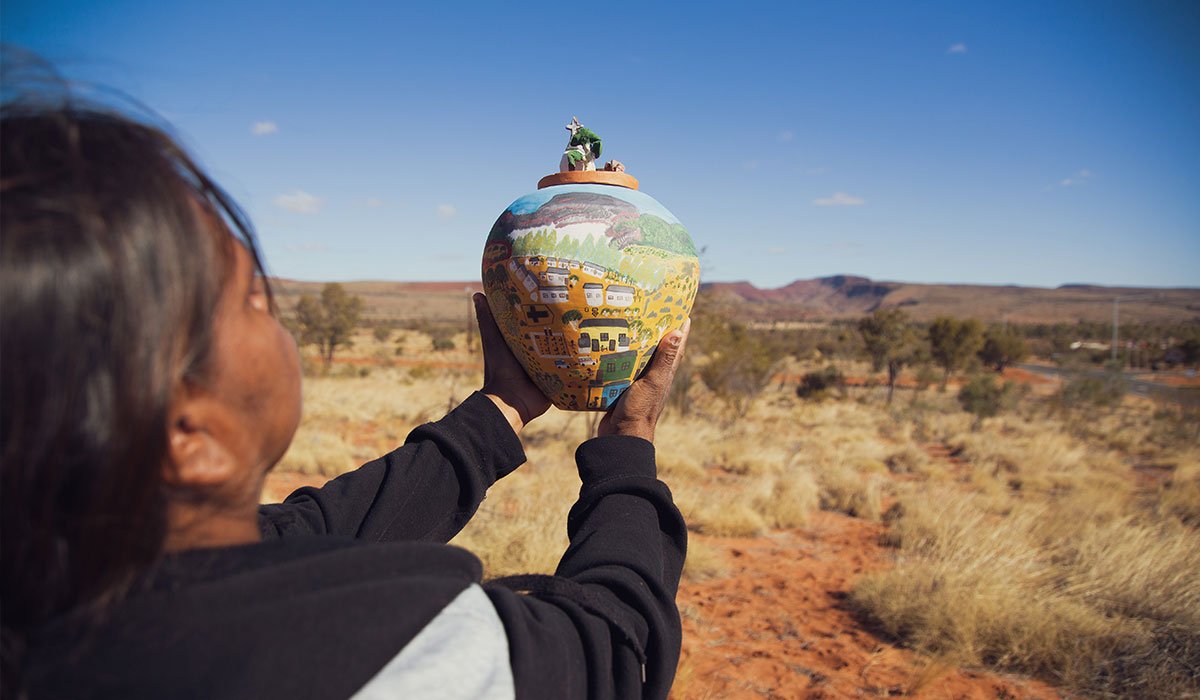
Northern Territory locals know discovering art across their region is an adventure.
It can emerge as millennia-old rock art, cross-hatched poles, vibrant textiles, unexpected street art, digital prints or dot paintings across the vast collection of cultures and societies from the Red Centre to the Top End of the Territory.
Director of the Museum and Art Gallery of the Northern Territory, Marcus Schutenko, says the Territory is the global centre for indigenous art, which is increasingly renowned for its powerful and compelling stories.
“It is an amazingly diverse ecosystem,” he says, of the Territory arts scene.
“Aboriginal culture goes back tens of thousands of years. One of the most accessible ways for people to encounter it and engage with it in a meaningful way is through Aboriginal art, particularly Aboriginal art being made by people who have an amazing connection to country.”
The newly-launched Territory Arts Trail offers travellers a fresh, clear and authentic way to experience the rich variety of arts through discrete itineraries.
Travellers can pick their own path using the new Northern Territory “My Trip” planner, which allows visitors to plot their itinerary and highlights online at territoryartstrail.com.
This could create an experience based around the birthplace of the dot-painting movement of the central desert in Papunya, to the bark painting totems of the Tiwi Islands, the pottery of Hermannsburg, or the street art and contemporary expression in Darwin.
Board member of the Northern Territory Tourism Commission Helen Martin says the arts centres across regional areas that are featured on the Territory Arts Trail have met criteria to ensure authenticity and a good tourist experience.
The arts centres also provide an insight into the artists’ practice as they are often creating in the studio or around the facility. Visitors can meet with them and hear their stories first-hand.
In the western Arnhem Land community of Maningrida, 500km from Darwin, artists are part of a celebrated movement that stretches across the world, often using the iconic cross-hatching technique known as rarrk.
Visitor permits are required to travel on tours to the community and its Djomi Museum and Culture Office, which house a nationally significant collection of film, sound and audio-visual materials.
Bawinanga Aboriginal Corporation General Manager – Arts and Culture, Michelle Culpitt, says the remote arts centre has been a powerful cultural hub for more than 50 years.
“This area is so artistically rich,” she says. “People are so culturally proud and connected to Country and it is expressed in the artwork. People are living and working on their homelands and it is that proximity to djang and sacred sites that is the essence, power that is transmitted through the artwork here.”
Contemporary artists from the remote western Arnhem Land region are distinguished globally. These include John Mawurndju, whose work is currently touring nationally with the Museum of Contemporary Art (MCA), and is on permanent display at Paris’ Musee du Quai and Houston’s The Menil Collection; the Babbarra Women's Centre, where a delegation visited Paris with their exhibition Jarracharra; and two artists were included in the MCA’s Primavera collection.
She says across the region there are 12 different languages and more than 110 clans, with connections to stone and rock country, freshwater country and saltwater country.
“That is all reflected in their song and dance and all their cultural expression, which comes right through to visual art,” she says.
In the region around Alice Springs, the Araluen Arts Centre is a visual art and performance hub, where artists descend for the annual Desert Mob symposium and exhibition.
West of Alice Springs in the West Macdonell Ranges is Ikuntji Artists, the first indigenous art centre for women in the esteemed Western Desert movement.
Artists from this remote arts centre include Eileen Napaltjarri Anyama, Mitjili Napurrula and Eunice Napanangka Jack, whose works are held in collections of the Art Gallery of New South Wales and the National Gallery.
And in Darwin city, contemporary artist Paul Arnold’s gallery displays his striking Phase One digital photography that he has interpreted into new arts.
“I take a photograph and then I flip it,” he says. “I've got images taken of mud from 8000 feet and it looks like the Great Barrier Reef. Each one starts from scratch; you never know what you're going to get.”
He says the Territory has an outstanding arts scene due to its strong mix of cultures.
“I can't really think of anywhere else in the world that has got such a strong cultural heritage when it comes to art and stories,” he says.
NT Major Events Company Director of Arts and Culture, Kathy Burns, says every visitor will have a different experience on the Arts Trail, dependent on the time of year they come, who they see and what they choose.
“It is an adventure,” she says. “Experiences change from a day-to-day basis.”