
Truck drivers know their jobs are at risk of automation long term. So they’re using this year of upheaval to invest in their long term careers.
This article was created in partnership with Griffith University.
Our workforce is rapidly changing. Jobs once requiring dozens of hands are in many cases now being done by a robot.
According to the OECD’s The Future of Work, about one in seven jobs will be automated and another one in three at “high risk” of partial automation.
But far from fearing automation, many workers are seeing it as an opportunity to reskill, and keep them involved in an industry they love.
Queensland Trucking Association Membership Service Manager Lisa Fraser said her members are coping with huge changes this year: a massive disruption to supply chains, plus a growing freight demand. But she said they’re aware of even bigger changes on the horizon, with the shift to automation meaning their days driving up and down the Bruce Highway could be numbered.
SENDING TRUCKIES BACK TO SCHOOL
Ms Fraser said her industry is working with Griffith University to enable trucking professionals to get the skills and knowledge they need to increase their capability in digital technologies, through short professional courses. “What the industry is really interested in is micro-credentials, where they can do short sharp courses to upskill in specific areas,” she said.
“Then they’re able to move to different areas of the business or increase their capability in digital technologies.”
She said the upheaval of 2020 meant many workers and small business owners recognised the need to upskill.
“This year has prompted a lot of people to want to become more skilled in digital.”
SHORT COURSES TAILORED TO OUR FUTURE NEEDS
Online short courses in business resilience, digital technologies and leadership have become increasingly common since the COVID-19-led disruptions of 2020, and they’re attracting students from a range of industries who are looking to grow their career in a rapidly changing workforce.
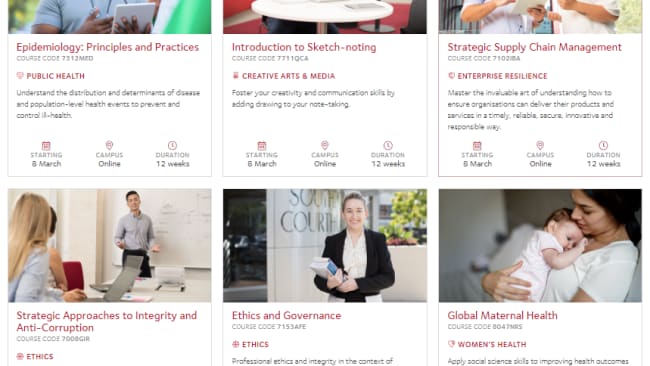
Griffith University has introduced Griffith Professional – a collection of almost 100 short courses to enable working professionals to boost their skills quickly. Professor Nick Barter, Academic Director of Griffith Online, who has led the launch of Griffith Professional, said short courses were focused on key areas that will be in demand as the economy evolves.
“These are not typical professional development courses, or your typical university experience” he said.
“They are specifically targeted to provide graduates with skills and knowledge in industries that will offer high-demand employment opportunities nationally as the economy inevitably makes its way towards a recovery.”
“The great thing about Griffith Professional is that it allows working professionals to take stock of their existing skills and knowledge, then match it with real time jobs data and insights to pick a short course that will give them the added skills and knowledge they need to continue to thrive in their industry.”
Experts have pointed to the changing nature of work and a growing demand from professionals for training to complement their existing skills, rather than retraining for a new career.
Griffith Professional short courses broadly focus on essential skills in leadership and management, increasingly popular information technology courses around cyber security and artificial intelligence, and business concepts.
There is also an extensive offering in the area of public health including courses targeting pandemic management.
WHY GROWING YOUR TECH SKILLS IS VITAL
Ms Fraser said the changing nature of industries meant the adoption of technology was vital for working professionals.
“Part of our role is to make sure businesses are able to manage the change with that technology,” she said.
“That change management is really important. It has been highlighted this year. [It’s about] understanding staff and how well that change is going to be taken on.”
In-demand skills included managing businesses for growth and efficiency, the use of digital tools, and general business skills, she said.
And with the flexibility and speed of the short courses, people were able to access quality education regardless of their location in the city or the regions.
“For many people, they’re time poor and resource poor,” she said.
“They’re running their own business, so a short course gives them the capacity to access those skill courses online and at a time that suits them.
It’s about business sustainability and the future of your business.”