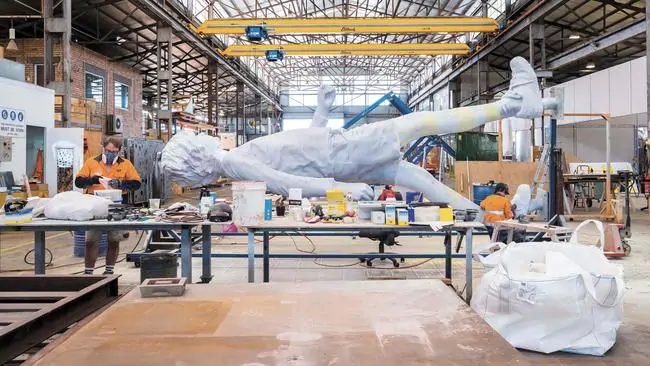
Brisbane-based art and architectural manufacturer UAP (Urban Art Projects) has re-shored much of its production to Australia, pulling it back from its China foundry, thanks to advanced manufacturing techniques, pioneering robotics and changed global trade conditions.
Co-founder and managing director Matthew Tobin says innovation and technology is allowing UAP to compete globally.
“Ten years ago we thought our workshop in Australia would be a prototype workshop and everything would be made in China,” he says. “A decade on, we know that is entirely inaccurate and our manufacturing will be made locally. To be viable and competitive as a manufacturer, especially as a custom manufacturer, it’s going to be cheaper to do it locally.”
Over the last two years, robotics and innovation have boosted the company’s ability to re-shore manufacturing from its Shanghai workshop to the suburbs of Brisbane. UAP is in the midst of a transformation: in 2017 it imported 32 per cent of all its works destined for Australian sites, compared with 8 per cent this year. UAP’s Queensland workshop has grown from 20 employees in 2017 to 57 this year. The number of Australia-based employees has risen from 82 to 125.
“Technology is making manufacturing cool again,” says Tobin, who runs one of the world’s biggest public art and architecture manufacturers.
When an artist dreams up the façade of a commercial building dotted with multicoloured stainless steel butterflies, UAP can make it real. When a public art commission demands a walking boy, mid-stride, six metres tall, UAP can make that too. Ditto a giant knitted octopus.
The company was founded in Brisbane in 1993 by Tobin and his brother Daniel. Just after its 25th anniversary last year, UAP bought New York’s Polich Tallix Fine Art Foundry, the company that makes the Oscar statues for the Academy Awards. It has worked with international artists Ai Weiwei and Idris Khan, and architects Zaha Hadid and Frank Gehry on creations big and small, but always unique.
‘Technology is making manufacturing cool again’
A few years ago, the brothers decided that to stay competitive, they would have to embrace technology. Their costs in China were increasing and the Australian dollar was plummeting, changing their business environment. The team was creating the sculptural staircase of Sydney’s UTS Business School’s Dr Chau Chak Wing Building, designed by US star architect Gehry. (Australian-Chinese businessman and philanthropist Chau Chak Wing donated $20 million to the project, with an additional $5 million for Australia-China scholarships.)
Tobin says there was a gap between the innovation in the digital design and the reality of its manufacture, which required the 5000-year-old technique of panel-beating and thousands of man hours. “The staircase started us on this process where we realised we needed to use some layer of automation to make us competitive,” he says. “But because we make unique objects, we needed that automation to see.”
They teamed up with the Innovative Manufacturing Co-operative Research Centre, QUT and RMIT University to introduce advanced robotics and technology, aiming to create smart and seeing robots for a new age of manufacturing.
QUT associate professor Cori Stewart commends the collaboration with UAP because all projects are custom-made, one-off or short-run pieces, allowing for relentless testing of the technology. “It’s making robots see, so they can do mass-customised solutions for manufacturing, effectively reducing the time between designing and manufacture,” she says.
Workers are also becoming skilled at programming the robots, upskilling traditional tradespeople. “They are becoming the future workforce because of their engagement with this research,” Stewart says.
The goal is to create automated smart machines powered by algorithms — the robot — that can see. These robots reduce the dull, dirty and dangerous work and free humans to do the more complex tasks. When creating major metal sculptures, one task is removing flashing — unwanted extra blobs of metal — from cast metal. Equipped with lasers, sensors and cameras, the robots will be able to compare a digital model to a cast product. They will see the extra flashing where it is not meant to be and shave it off. And they can learn, creating a digital pattern where there isn’t one or envisioning what material should be used.
Tobin says one of the first projects brought back from UAP’s China foundry was a series of parrots named Poll created by Melbourne-based contemporary artist Emily Floyd. A collaborating company, Ditto Labs, scanned and digitised Floyd’s model, then robots cut the art into resin. This eliminated the need for detailed patterning.
“We did 50 hours of robotic work on that and it on-shored 800 man hours,” Tobin says. “You just need the technology to do a segment of the work. That delivers enough of the cost saving to make it cost-neutral, whether it’s made in Australia or made in China or some other low-cost location.”
UAP says that for every robot, it employs a further five staff. “These robots don’t steal jobs, they change and make jobs,” says Tobin. “Certainly in our style of manufacturing they create jobs. We’ve even exported a few works to China from Australia because it’s starting to get cheaper to make things in Australia.”
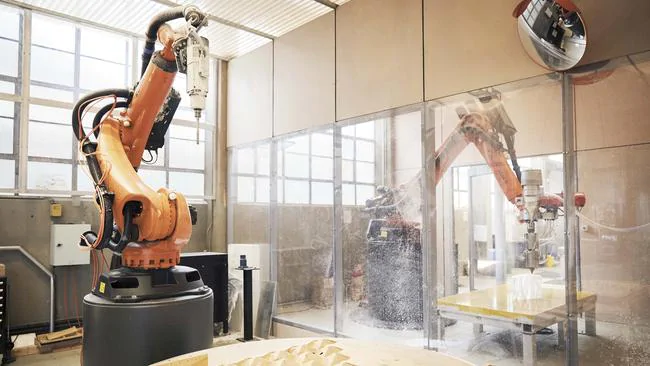
UAP is also adopting technologies such as augmented reality and virtual reality to assist in its manufacturing visualisations. It used virtual reality to “walk” through its sculptures and designs. It is also used as part of the manufacturing process, for example in pattern making.
Nike Savvas’ public artwork at Exchange Square at Barangaroo South in Sydney uses more than 800 strands of coloured plates. UAP used digital modelling and HoloLens virtual and camera mixed-reality technology to create a random pattern within a grid.
The digital tools slashed the days on site from an estimated eight to just three and a half. RMIT associate professor at the School of Architecture and Urban Design Roland Snooks says emerging technologies will shape future design.
‘Robots reduce the dull, dirty and dangerous work and free humans to do the more complex tasks’
“This is not simply about automation or about trying to make things more efficient, but it’s actually trying to open up new possibilities for design,” he says. “Design is always constrained by the means of production, the tools that we use.”
He says new algorithm-led digital designs allow for much more complexity in the form and structure of buildings that are ahead of the construction industry’s ability to build.
IMCRC managing director and chief executive officer David Chuter says pairing human creativity with the efficiency of robots could create immense value. “This is very much about robots and humans working in harmony,” he says.
Chuter cites other companies that are also re-shoring their manufacturing through smart business models and smart technology. UAP’s experience is not unique. “It is genuinely more competitive than doing it overseas,” Chuter says.
The Queensland government is also meeting the challenge. In July it announced it would grant $7.1 million towards the $18 million advanced robotics for manufacturing hub at UAP.
QUT’s Stewart says Australia is leading this capability. “It really bodes well for bringing manufacturing, in particular, back to Australian shores and actually exporting our manufacturing to countries like China,” she says.
RMIT Additive Manufacturing Industry fellow Alex Kingsbury says new and advanced technology is critical to the successful transition of manufacturing in Australia. “It can actually make sense to manufacture in Australia. If you choose the right tasks it can have a very strong ROI,” she says.
She says innovation and robotics are also spurring the development of software-as-a-service business models, where manufacturers develop corresponding programs and add-ons. “This is the kind of model that countries like Australia are working towards and really need to orient around,” she says.
Rosanne Barrett is a freelance journalist