After years of decline, the American labor movement saw a sudden resurgence in 2023. Aggressive new leaders; younger, mobile workers unafraid to demand their due; a post-pandemic shift in work-life attitudes; and a tight labor market all came together to embolden the national workforce.
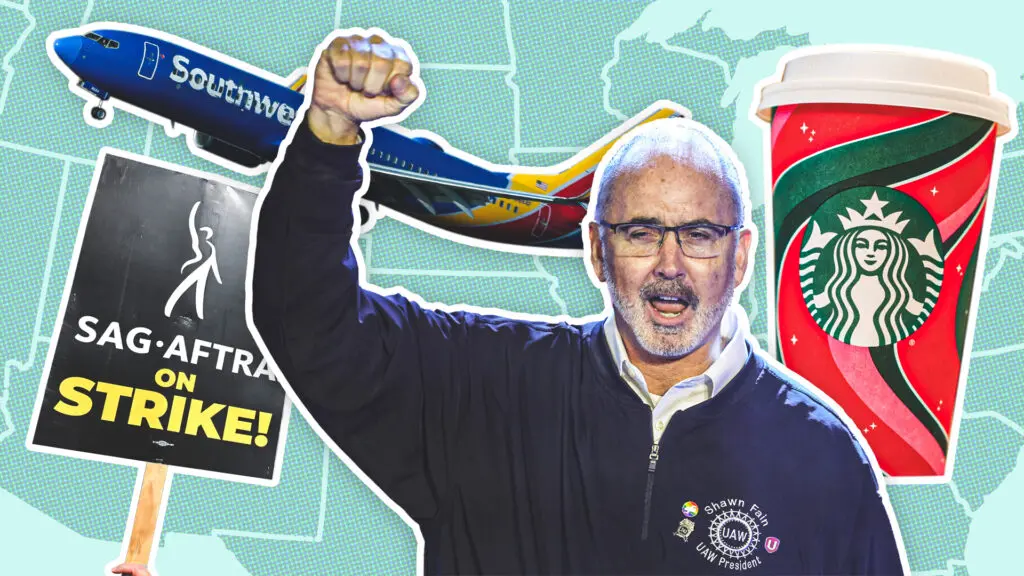
"Working class people are just tired of being left behind, they're tired of scraping to get by," United Auto Workers President Shawn Fain told The Messenger. "They're not living their lives, they're surviving. I think it's just a reality point people have hit, and they're starting to realize now that organized labor and unions are the way to equalize that."
The "Hot Labor Summer" of strikes and contract negotiations evolved into a year-long labor phenomenon as workers seized on new concerns, and on each other's struggles, to create one of the most surprising and unified moments in the labor movement's history.
From the start of 2023 to the end of November, there were 393 strikes involving approximately 510,000 workers, according to data compiled by the Cornell School of Industrial and Labor Relations Labor Action Tracker and shared with The Messenger. That’s nearly triple the number of striking workers compared with the same period a year earlier.
With that new landscape came new realizations for workers. For Fain, who led roughly 150,000 union members to contracts with the Detroit Three automakers — General Motors, Stellantis and Ford — the pandemic gave workers "a great lesson in the power that we have as working-class people."
26 Billionaires'
In the wake of the coronavirus, income inequality and inflation soared, and corporations that once treated their workers as "essential" left them feeling forgotten as American life began returning to normal, Fain said. That frustration felt by workers has helped them discover and wield their influence.
“When we withhold our labor, nothing moves, no matter what the industry is,” he said. “When 26 billionaires have as much wealth as half of humanity, that's a crisis. And the only way to fight that is for working people to get unified and stand up.”
Shep Searl, a longtime Starbucks barista and member of Starbucks Workers United, said working for the company during the pandemic made them recognize that a union was necessary to secure workers' rights at the coffee giant.
"I think realizing the collective injustice and repeated hypocrisy, and having my eyes opened to that throughout the pandemic and after the pandemic, was kind of my breaking point," Searl told The Messenger.
In November, workers at some 300 Starbucks locations walked out during the chain's annual Red Cup Day event to demand improved staffing and schedules. Although that's only a fraction of the more than 16,000 Starbucks locations in the U.S., Searl said the union is ratcheting up labor actions each year.
Cathy Creighton, director of Cornell University’s Industrial and Labor Relations Buffalo Co-Lab, told The Messenger that this year was unlike anything she has seen for labor in the U.S. The biggest difference is that workers today are "dead set on having a voice, a say in what happens to them at work,” despite labor laws that have historically been bad for bargaining and organizing, she said.
Historic Gains?
In part due to the more aggressive approaches taken by union leaders and their members this year — from the UAW stand up strikes that turned up the heat at individual plants to the Teamsters' practice pickets — unions made what many consider to be historic gains in 2023. About 900,000 unionized workers won immediate pay hikes of 10% or more this year, according to an analysis by CNN.
The UAW secured general wage hikes of 25% at General Motors, Ford and Stellantis, in addition to reinstating cost-of-living adjustments that boost the increase by several percentage points.
In August, the International Longshore and Warehouse Union ratified a new contract that included a 32% pay increase over the course of the six-year agreement. Pilots at United Airlines approved a contract that included a 40% wage increase, and last week, Southwest pilots ratified a contract with a 50% pay hike.
Even a newsroom made significant gains in an industry that has been battered by layoffs: The New York Times Guild ratified a contract that provided immediate pay increases of at least 10.6%.
Greg Regan, president of the Transportation Trades Department, a coalition of 33 member unions at the AFL-CIO (American Federation of Labor and Congress of Industrial Organizations), said the gains are part of the reason this year saw so much labor mobilization.
“I think that sends a really clear message to people who are thinking about joining a union,” Regan said. “When you see these numbers like the 40% wage increase, if you see the big wage increases for railroad workers and for auto workers and for everybody else, I think that that shows to people who might be on the fence about joining a union that the gains are real.”
Solidarity in Hollywood
In the 12 months ended in September, 2,594 union representation petitions were filed with the National Labor Relations Board — the highest number of filings since 2015.
“Once you see someone else doing it it seems possible," Linda Powell, executive vice president of SAG-AFTRA told The Messenger. "I think that has to have anyone on the other side of the table scared."
Among the largest shows of solidarity was the dual strikes by writers and actors against the Alliance of Motion Picture and Television Producers. SAG-AFTRA joined the Writers Guild of America on the picket line in July, and struck alongside them until the writers reached a deal with the AMPTP in September. The actors then built on the writers' gains to secure wage hikes and protections of their own against the rising threat of artificial intelligence.
In her 20 years with the union, Powell said she has never seen the levels of engagement she saw this year. The challenge now, she says, is remaining accountable to the union members who joined the union during the excitement of the strikes, and keeping new members engaged now that the year of unions is coming to a close.
"They became engaged because of the strike, and they’re not going to go away," she said. "They’re going to continue to demand things of us, they’re going to continue to want to be engaged. It’s our responsibility now to the people that we brought into engagement with the union.”
“That genie cannot be put back in the bottle,” she added.
America Approves
This year has not only been pivotal for union membership and getting workers out on the picket line, but for changing perceptions of organized labor throughout the country, as the strikes called national — and international — attention to the labor unrest in the country. Approval of labor unions hit its highest point since 1965 this year, with 71% of Americans holding positive views of organized labor, a Gallup poll in August found.
Across several of the highest-profile strikes this year, including the WGA, SAG-AFTRA and UAW strikes, Americans overwhelmingly sided with workers over companies, according to another poll from the D.C.-based consultancy.
"I have been continuously shocked at how awake the American workforce is and open to the labor movement," Creighton said.
Sara Nelson, who since 2014 has served as president of the Association of Flight Attendants, the largest U.S. attendant union, echoed the sentiment. She told The Messenger that the show of solidarity within and across industries, as well as from the public, has been unlike anything she's seen before.
“This is an extraordinary time,” Nelson said. “I've been out on a lot of picket lines and it's usually very hard to get the community with you. This is a real ‘which side are you on’ moment, and Americans are choosing to be on the side of labor, because they understand that just electing a sympathetic politician is not going to do the job when money is controlling our politics.”
Scraps or a Fair Share
Flight attendants at four of the largest airlines in the country — American, Alaska, United and Southwest — are negotiating new contracts and gearing up for potential strikes in 2024. They’re riding into the fight knowing that in the past year, pilots at five of the six largest U.S. airlines reached new contracts with economic gains valued at more than $27 billion, Nelson said.
Now, unions are eyeing non-unionized companies as the next step in continuing to build up labor momentum. Just weeks after securing contracts with the Big Three, the UAW launched an unprecedented push to organize workers at the non-union carmakers in the U.S. Workers employed by 13 automakers across the U.S. last month announced simultaneous bids to join the UAW, covering nearly 150,000 auto workers at BMW, Honda, Hyundai, Lucid, Mazda, Mercedes, Nissan, Rivian, Subaru, Tesla, Toyota, Volkswagen, and Volvo, according to the union.
“It's going to be the workers that are going to have to make the choice: Do they want to continue down the path they've been going down where they settle for scraps or do they want to get their fair share?” Fain said. “And the only way that's going to happen is if they organize. And so I think the time is right — just as in our fight, just as in any other union fights this past year — people are fed up.”
Companies that aren’t unionized, or have little union activity, tend to use this to their advantage by keeping wages low and profits high, according to Fain. Toyota alone made $256 billion in the last decade, the UAW has said, a little more than than the Big Three combined, with CEO pay at the company growing 125%, compared with 40% at each of the Detroit automakers. Delta Air Lines makes more than any other major airline in the U.S. and is the least unionized, Nelson said.
“What we would love is that companies recognize that they can have a powerful partner in their union,” Regan said. “People try to characterize unions as business killers, as somehow anti-business, which couldn't be further from the truth. We want the industries where we have workers to thrive, we want them to be succeeding. We just also want our members to have a fair share in the returns on all of that.”
No 'Third Party'
A Toyota spokesperson told The Messenger that the company is continuously reinvesting profits across its operations and has maintained competitive wages and benefits for workers through "two-way communication."
"We do not believe a third party at our manufacturing facilities would enhance the results, stability or team member experience that we have achieved together," the Toyota spokesperson said. "We are confident that with all of the facts, our team members would not choose union representation.”
A Delta spokesperson said that while it supports employees' right to choose whether to form a union or not, the airline believes a “direct relationship with employees is stronger, faster and more effective in driving improvements, which is why Delta employees have repeatedly rejected union representation over the past 20 years.”
To be sure, several non-unionized automakers, including Toyota, Honda and Hyundai, raised workers' wages on the heels of the UAW contracts, but those increases could also be tied to some non-union factors, Patrick Anderson, president of Anderson Economic Group, told The Messenger. He pointed to the tight labor market for much of the year and still-high inflation as possible factors behind some of the gains.