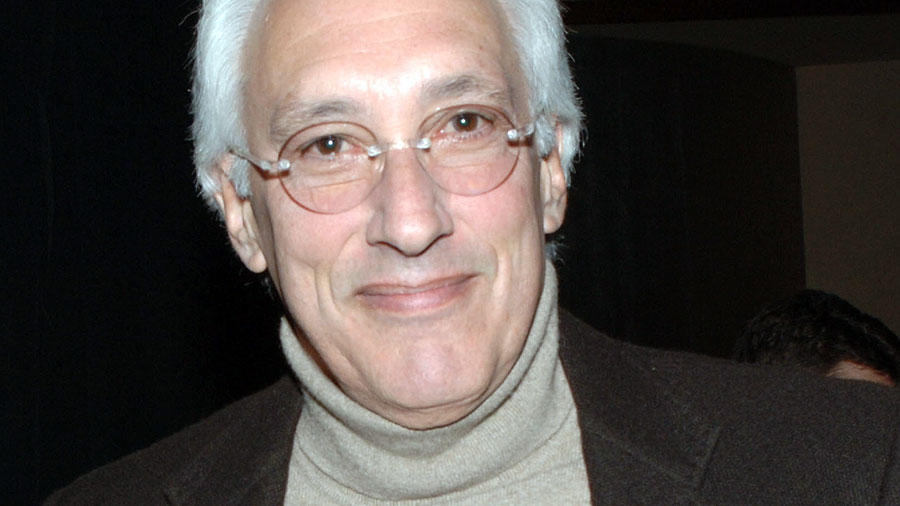
Steven Bochco has co-created two of the most acclaimed and important cop shows in TV history, "Hill Street Blues" and "NYPD Blue." He's worked on numerous others in a career that spans more than four decades, and is still in the game as co-creator and executive producer of TNT's "Murder in the First."
He doesn't, however, actually watch crime shows.
"I'm slightly embarrassed, just slightly embarrassed, to admit that I don't," Bochco tells Zap2it with a laugh. "I'm not a big TV watcher to begin with. Not out of snobbery. Partly due to the fact that it's what I do. I spend so much time doing it that when I go home, I'm not that interested in watching crime shows."

The 10-time Emmy winner also doesn't want anything from another series to subconsciously make its way into his work, and he says there's no way he can be a "typical viewer" of any cop show.
RELATED: Lessons from 78 hours of crime shows | Crime shows by the numbers | How 'Bones' and more create the perfect crime
"When I watch one of those shows, I'm deconstructing it as I'm watching it," he says. "And usually, I get there so far in advance [laughs] of when they want me to that it's of not a lot of interest to me."
Zap2it spoke at length with Bochco for our Crime Report series. He discusses his process for breaking stories, the state of the genre now and whether he'd return to the network fold after working primarily for cable channels in recent years. An edited transcript of the interview is below.
Zap2it: When you're breaking case stories for a show, what's your starting point and the process you follow?
Steven Bochco: I think you have to start with, what's the basic environment of your show. If you're doing "Hill Street Blues," which is a show about a group of cops in a deeply urban, crime-ridden environment, the victims of your crimes and the kinds of stories you tell are really going to be neighborhood-centric. So you're gonna look at the realistic demography of the area in which your precinct exists. The vast majority of your stories are going to come out of the realities that exist in a neighborhood like that.
If you're doing "Columbo," the mandate of that show -- not to take you back to the Neolithic era -- but the mandate of that show was always to have a really sort of high-style, arrogant, hugely successful, celebrity-type perpetrator. The victim was usually the wife, the girlfriend, the partner. So the idea was to take this schleppy detective, Columbo, like a fish out of water and drop him into the tank and watch how he brings down the high and mighty. If that's your mandate, that becomes the template for virtually all your stories.
"L.A. Law" was the same thing. I took the basic template we had applied to "Hill Street" and applied it to an upscale law firm in Los Angeles -- multiple characters, multiple storylines. But because of the environment of "L.A. Law," the only time you would do a quote-unquote downscale story was when you were involved in that percentage of work the firm does that's pro bono.
Did you ever take any flak, either from the network or an outside group, over the way you portrayed violence on screen, or the people involved in crimes?
Sure. ... We never had an issue over violence on "NYPD Blue." We never had any issue over racial stuff. In fact, we told a lot of racially charged stories on "NYPD Blue," but they were usually racially themed in the context of the politics of the department itself. They were very, very strong and effective stories. We never got any flak from the network about that. All the notes I had to deal with on that show were language and sexuality.
The only show where -- and it was only in the beginning -- I really had battles with the network about the skewed demographics, or what they thought of as the skewed demographics of our victims, was on "Hill Street." My argument was twofold. One, given the reality of the environment in which these cops operated, they were going to be dealing with a lot of minority perpetrators, as well as minority victims, because that's what you get in the ghetto. That used to come up a lot, and what I would say to them was in the fullness of time, I'm going to end up being an equal opportunity offender, so don't worry about it [laughs]. Those kind of notes went away pretty quickly.
We found in studying current crime shows that the majority of victims were white men in their 30s and 40s. It seems like they're sort of following the "Columbo" template to some extent, or looking for interesting subcultures to delve into.
It's interesting. As I say, I really don't watch most of the crime dramas currently on the air, but just off the top of my head ... I can't really think of too many really gritty ... urban crime dramas like "Hill Street" or "NYPD Blue."
"Chicago PD" is probably about the closest thing to that right now.
Right. And that's Matt Olmstead [as showrunner], who's a graduate of "NYPD Blue." With honors, I might add. ... But the whole thrust of network drama, so far as I've been able to track it over the last bunch of years, has been to move away from the more traditional, i.e., Steven Bochco-type crime dramas, and more toward the mystery type of crime drama. A little more upscale, premises that are a little more complex, maybe a little more fantastical. People with, if not super powers, super intellectual powers, whether it's "The Mentalist" or whatever, and those tend to be mystery-oriented shows as opposed to street crime kind of stuff.
And so does that in theory allow for more fantastical, as you said, or more puzzle-solving for the characters and the audience, as opposed to down and dirty police work?
I think these things run in cycles. It's probably fair to say that at a certain point, particularly with the way TV is changing technologically ... there's a general feeling, right or wrong, that in order to get noticed in a very cluttered environment, you don't want to just be doing business as usual. The sort of urban crime drama that I was noted for to a certain degree became sort of passe. But the truth is those things run in cycles. And of course if you're doing a show like "The Wire" or whatever on cable, you don't really have to worry about the mass audience quite the same way you used to.
Is the experience much different working for a cable network different than on a broadcast network?
Oh sure. Way different.
You're making fewer episodes per season, for one thing.
It starts with that, certainly, and that makes a big difference. I also certainly find in the three or four cable shows I've done that the level of micromanagement is a fraction of what it is at the broadcast level, and that's refreshing. It's not that you don't take into account your partner's thoughts about things, but you just don't get nitpicked to death.
What sorts of conversations do you have with TNT now? What kind of notes do they give?
Obviously at the very beginning of the year, when you're conceptualizing something you want to do that's going to essentially inhabit a full season of storytelling ... you obviously want to have your partner on your side. So you're not gonna just run off and do something without discussing what that story is with the network because you want their blessing on it. I can't think of anything that would be more unpleasant than trying to ram a full season's storyline down the throat of a network that fundamentally didn't believe in it. I don't think that's good business for anybody. So that's one kind of conversation you have.
But for instance, this year on "Murder in the First," that was essentially one conversation on the telephone. Then we just went about our business. As with all networks at this point in time, you're gonna run your stories by them, and whatever notes you're going to get of any significance are usually going to be at the story level. Questions will be at the story level. Once you get to the script level, they know what they're getting. Unless you're just doing a piss-poor job, not much is gonna come up. The network is gonna see your first cut of a show, and they may have a few notes about that as well, because as you know, everybody's Fellini.
That's fine; I get it. If you and your wife decide to build a home from the ground up, and you go hire an architect, and the architect says to you, "OK, give me your money and come back in 24 months and you'll have a house." You'd say "Wait a minute: I'm the guy spending the money. My wife needs an office, and I want a game room and a media room and a thing ... and I want an attached garage," etc., etc. You're spending the money; you have a right to your input. I always try to be fair about that with networks. At least moreso now than I used to be [laughs].
Historically, TNT shows have seemed like they could probably fit on a broadcast network, moreso than something on FX or AMC. But do you still feel you have freer rein there than on a broadcast network?
A little bit, but I think historically you're right. The perception was that it was a little bit more middle of the road kind of network, which in recent times and increasingly so today I think is looking to break away from that image and trying to brand itself as a network that's a little more distinctive. Which I applaud. Any network that is willing to go a little far afield from the rest of the group is my friend.
Would you ever do a broadcast show again?
Sure I would. In the past I've said I wouldn't, which I probably meant at the time, because I was pissed off or whatever [laughs]. But you know, you get old enough and you realize never say never. Everything changes. There are different circumstances that arise that might make a proposition like that attractive in a way you wouldn't have thought so two, three, four, five years ago.
I have absolutely nothing in mind vis a vis that these days, and I don't actively pursue broadcast networks with projects, just because most of the things being done on broadcast networks aren't really my cup of tea. I'm not that good at it, you know? But if that changed, or if a broadcast network came to me with something I thought was really interesting and worth developing, sure, I'd listen.
Would your approach be the same regardless of where you're working?
From my point of view, I think it would be. There are pluses and minuses always when you're working with a network. One of the minuses is you tend to be working in a lot more corporate environment. You tend to be working in an intensely more competitive environment. You tend to be micromanaged to a truly annoying degree, which very often is to the detriment of the creative vision.
I think one of the reasons, for instance, that "Empire" is such a big success is those guys were pretty much left alone. They had a vision of what they wanted to do, and FOX wisely said, "We believe in this. Go do it." They did it, and look what happened. I don't think anybody anticipated quite the cultural phenomenon that it has become, but you certainly have to applaud the effort to let good creators just run with their concept.
The upside to doing a network show is you have more money to spend. And in success, you can make a lot of dough. Which means a lot to artists in a business in which you may have one hit your whole life. You may have one five- to seven-year run that is essentially [laughs] going to be your future. Even though nobody likes to think about that stuff or talk about it, it's important.
Photo/Video credit: Getty Images, NBC, TNT