
By Rhonda Fletcher
It’s official: artificial intelligence has gone mainstream. From students cranking out essays in minutes, to office workers drafting emails with a keystroke, to hobbyists using it to “design” logos or write bedtime stories—AI is no longer a specialized tool for programmers or data scientists. It’s the Swiss Army knife in everyone’s digital pocket.
That ubiquity has benefits. Every day, AI can streamline tasks, help people explore ideas, and democratize access to professional-level skills. But there’s a creeping downside: when machines handle our everyday creation and reasoning, our personal standards shift—and not always upward. We risk racing, not toward innovation or excellence, but toward a kind of algorithm-powered mediocrity.
When “Good Enough” Becomes the New Standard
For decades, productivity tools, from spell-check to note-taking, have helped us work faster and cleaner. But these tools still relied on human judgment, effort, and taste. AI changes the equation. It doesn’t just assist the process; it can do the process.
That means the bar for “good enough” has subtly lowered. Why spend two hours refining an idea when an AI can churn out a passable draft in thirty seconds? Why wrestle with a tough problem when an AI can give you a neat, confident-sounding answer on demand?
The problem isn’t that these outputs are bad. It’s that they’re good enough to pass casual scrutiny—but rarely great. They’re often generic, recycling common turns of phrase, safe assumptions, and predictable structures.
A recent Stanford study found that large language models tend to converge on “median” style and reasoning patterns, smoothing over idiosyncrasies that make human work distinctive.
In creative and intellectual life, “good enough” is the gateway drug to mediocrity.
FAST FACTS: AI in Everyday Life
- 31% of U.S. adults have tried generative AI tools (Pew, 2024)
- Among professionals under 35, the rate is over 50%
- Generative AI tools now account for an estimated 2 billion prompts per day globally (industry estimates)
- A Stanford study found that Large Language Models (LLN) tend to converge toward “median” reasoning and stylistic norms.
The Comfort of Consensus Thinking
Common AI tools learn from massive datasets, billions of words, images, and code snippets. They detect statistical patterns and serve you what is most probable in the context you’ve given. That means the default AI answer is, by definition, the consensus answer.
If you’re booking a vacation, that might be fine. An AI travel planner will recommend the same safe, highly reviewed destinations as thousands of others. But if you’re trying to solve a novel business challenge, develop a unique brand voice, or push an artistic boundary, consensus thinking is a liability.
AI excels at remixing what exists, not imagining what doesn’t. When people outsource their everyday reasoning—how to structure a proposal, how to respond to a tricky email, how to frame a personal story—they unknowingly inherit the averages and biases baked into the model’s training data.
And because the AI often delivers these suggestions with an air of confidence, users may skip the slow, sometimes uncomfortable process of challenging assumptions. Over time, this reliance erodes independent reasoning skills.
Creativity in the Age of Copy-Paste Brilliance
Consider the current wave of AI-assisted visual art. The tools are dazzling: type “mid-century modern living room with a view of the Amalfi Coast” and you get a flawless image in seconds. The trouble? Thousands of others can do the same thing—and their results will look eerily similar.
In writing, the pattern repeats. Ask an AI to “write a blog post about productivity” and you’ll likely get clean, friendly prose with familiar beats: start with a hook, list three to five tips, end with a takeaway. It’s not wrong—it’s just the same structure everyone else gets.
When everyone’s creative process runs through the same statistical mill, we get a world where novelty becomes rarer, and where distinct human quirks—odd metaphors, unexpected leaps of logic, experimental forms—get ironed out.
Author and technologist Jaron Lanier has argued that AI’s strength is in amplification, not replacement: it can boost your ideas, but if you feed it the same input as everyone else, you’ll get the same output. Without intentional effort, the amplification is of sameness.
The Slow Skills Erosion
One of the less-discussed effects of everyday AI use is the gradual atrophy of low-level skills that underpin high-level thinking. There is a growing consensus of worry that:
- If you always let AI draft your emails, your ability to concisely articulate your own ideas may dull.
- If you habitually ask AI to summarize articles, you might lose the patience and practice needed for deep reading.
- If you use AI to brainstorm arguments, your ability to construct them from scratch, balancing logic, evidence, and rhetoric, will fade.
This isn’t alarmist speculation; history offers plenty of parallels.
Calculators revolutionized math education, but researchers found that over-reliance reduced students’ capacity to estimate or do mental arithmetic.
GPS made navigation effortless, but neuroscientists have documented measurable declines in spatial memory among heavy users.
AI is broader. The fear is that AI is not just taking over one skill, but a wide band of cognitive and creative functions at once.
The Mediocrity Check
5 Signs You Might Be Relying on AI Too Much
- Work sounds suspiciously familiar: Similar phrasing or structure is found in other content.
- AI’s drafts are used with very few material changes: Instead of using it as a starting point, the AI Draft morphs into the final content.
- You skip the “why”: AI answers, but you don’t dig into the reasoning behind it.
- You’ve stopped practicing the basics: You can’t remember the last time you wrote, solved, or brainstormed without AI.
- Your voice feels generic: You notice less of your personality or quirks in the finished product.
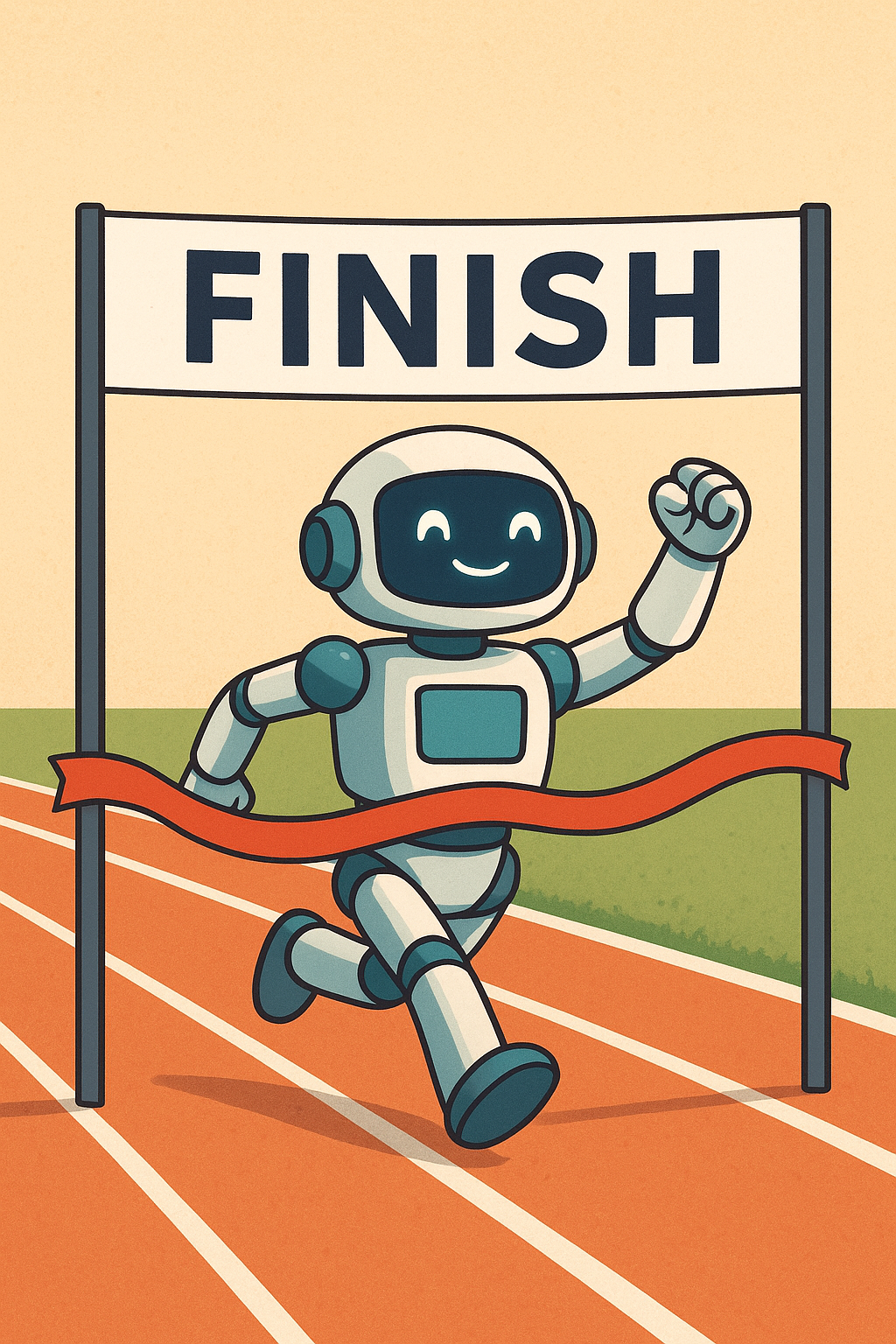
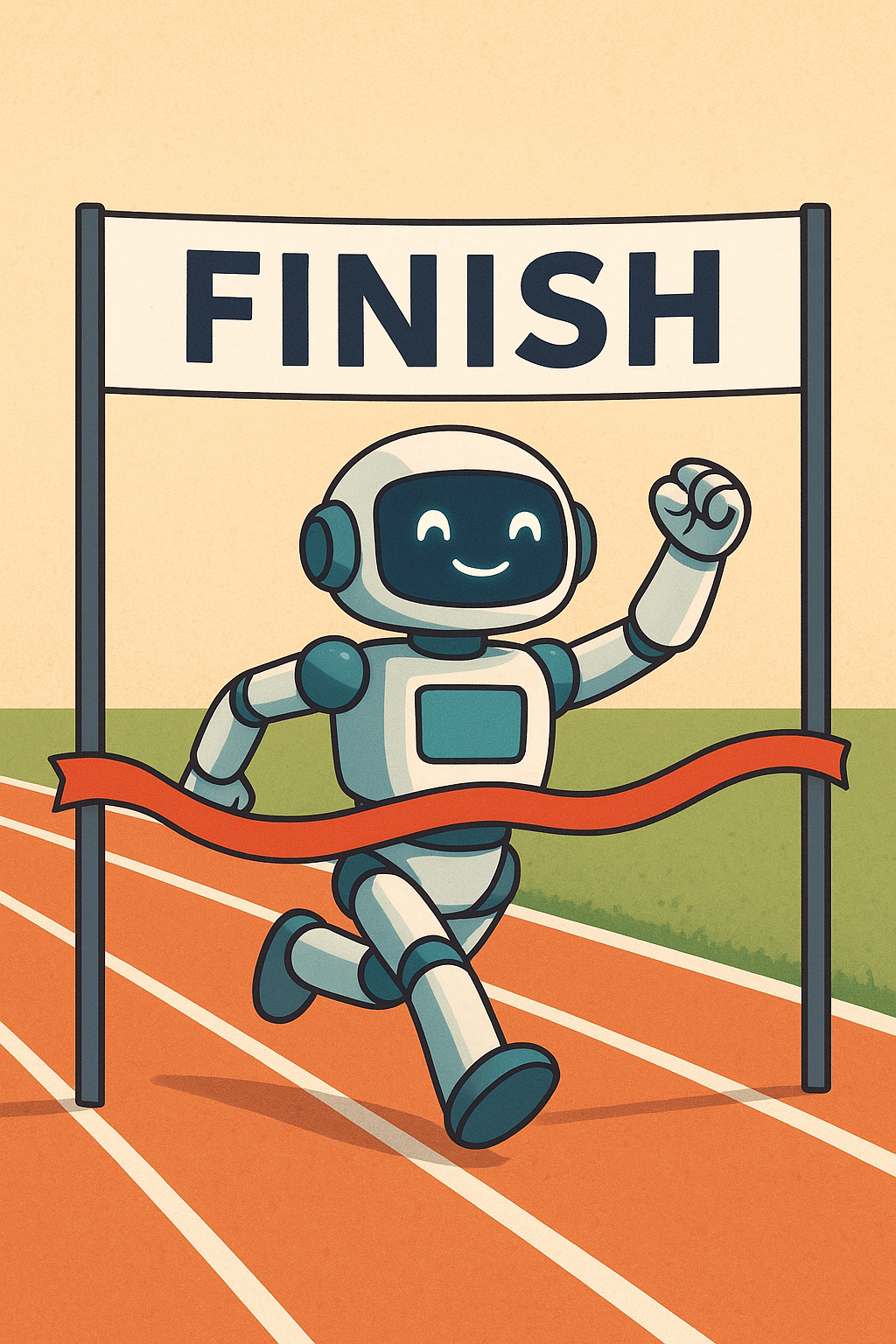
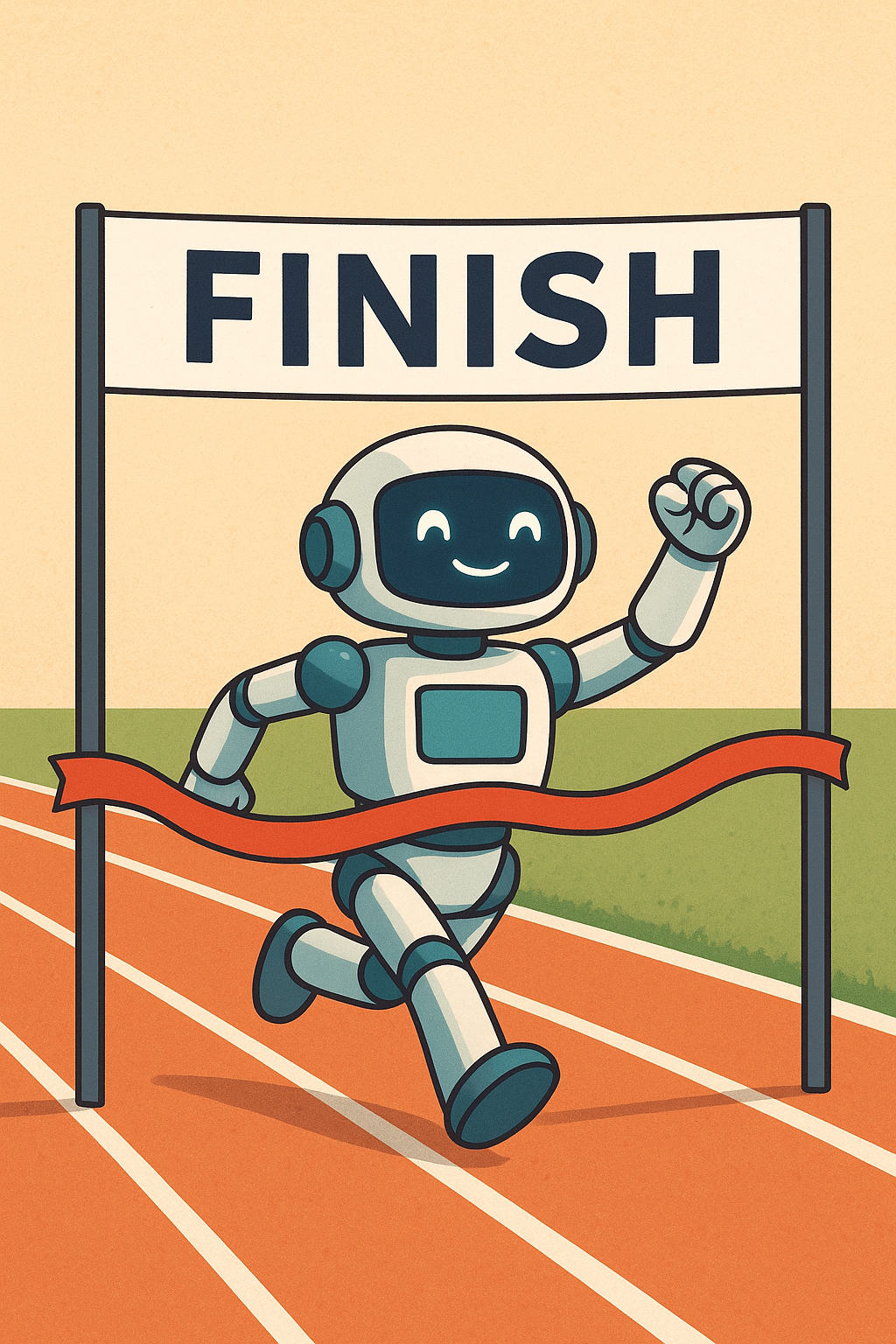
A Race With No Finish Line
Here’s where the “race” metaphor comes in. Once AI is in play, efficiency pressures spread. If one journalist uses AI to produce a clean, 800-word article in an hour (rarely possible by human standards), editors might expect others to match that speed. If one marketing team uses AI to pump out dozens of ad variations in a day, rivals will feel compelled to keep pace.
The result isn’t just faster output. It’s more output, saturating the marketplace with questionably competent, safe, AI-polished material. To stand out, humans either have to push harder for originality, which takes time and skill, or settle for the same AI-blended tone as everyone else.
This is the race to mediocrity: an environment where the easiest way to compete is to lower the originality bar, accept AI’s median quality as the norm, and focus on volume.
The Case for a “Human Premium”
Ironically, the very forces that drive us toward AI-powered sameness may also create new value for human distinctiveness. In a market flooded with AI-generated “content,” things that feel unmistakably human—personal anecdotes, flawed but heartfelt storytelling, deeply reported investigative work—may stand out more.
We’re already seeing hints of this. Some publications now label pieces as “human-written” to signal authenticity. Art collectors have shown rising interest in works that carry a clear, traceable human process. In education, professors are re-emphasizing oral exams and in-class writing to assess real-time thinking.
In other words: as AI makes average easier, excellence may require doubling down on what AI can’t easily replicate—emotional depth, cultural specificity, lived experience, moral judgment.
Strategies to Avoid the Mediocrity Trap
If we want to keep AI as a tool and not a crutch, a few principles can help:
- Use AI for scaffolding, not the final draft. Let it help with outlines, idea prompts, or fact-checking, but take responsibility for shaping the final product.
- Add human fingerprints. Infuse work with personal stories, niche references, and subjective insights that AI can’t plausibly invent.
- Challenge the consensus. If AI gives you the “most probable” answer, ask, “What’s the least probable but still possible alternative?”
- Maintain core skills. Deliberately practice writing, problem-solving, and reasoning without AI, the way musicians still rehearse scales or athletes run drills.
- Audit for sameness. If your AI-aided output looks and feels like what’s already out there, rework it until it carries your signature voice or perspective.
The Paradox of AI Progress
The irony is that the more advanced AI becomes, the more we’ll need to cultivate human excellence to keep from becoming interchangeable. This mirrors the industrial revolution: as machines took over routine manufacturing, human workers found new value in craftsmanship, design, and specialized expertise.
But that transition wasn’t automatic—it required conscious cultural and economic shifts. Without them, entire sectors became trapped in low-wage, low-skill competition. In the AI era, a similar fork in the road awaits: lean into the convenience, accept median quality, and drown in the flood of sameness—or use the technology to buy time for deeper, more original work.
The choice isn’t just personal; it’s collective. If enough people choose “good enough” over “good,” the average rises only slightly, but the exceptional becomes rarer. The very thing that makes culture vibrant—variation—gets diluted.
Why This Matters Now
We’re still early in the AI adoption curve, but the speed is blistering. A 2024 Pew Research Center survey found that 31% of U.S. adults had tried generative AI tools, up from just 14% the year before. Among professionals under 35, the rate was over 50%.
This rapid normalization means habits are forming fast. If those habits center on outsourcing daily creation and reasoning, the long-term effects will be hard to reverse. Mediocrity, once entrenched, is stubborn.
It’s tempting to frame this as an individual productivity choice, but the stakes are bigger. Creativity and reasoning aren’t just personal skills—they’re the raw materials of innovation, civic discourse, and problem-solving. When they degrade, so does our collective capacity to address complex challenges.
Unquestionably, AI is here to stay. And, it is not the enemy. The danger isn’t that machines will outthink us—it’s that we’ll stop thinking as deeply because machines make “thinking” feel optional.
The race to mediocrity isn’t inevitable, but it’s the path of least resistance. Choosing the harder road—using AI as a partner rather than a proxy—demands intention, discipline, and a renewed appreciation for the slow, messy process of human thought.
Because the truth is, the most valuable things we create—whether ideas, art, or arguments—aren’t just the product of intelligence. They’re the product of our intelligence, shaped by experience, emotion, and a refusal to settle for the statistically probable.
In the end, AI will give us what we ask for. The question is whether we’ll ask it to help us reach higher—or whether we’ll be content to cruise, smoothly and speedily, toward the middle.