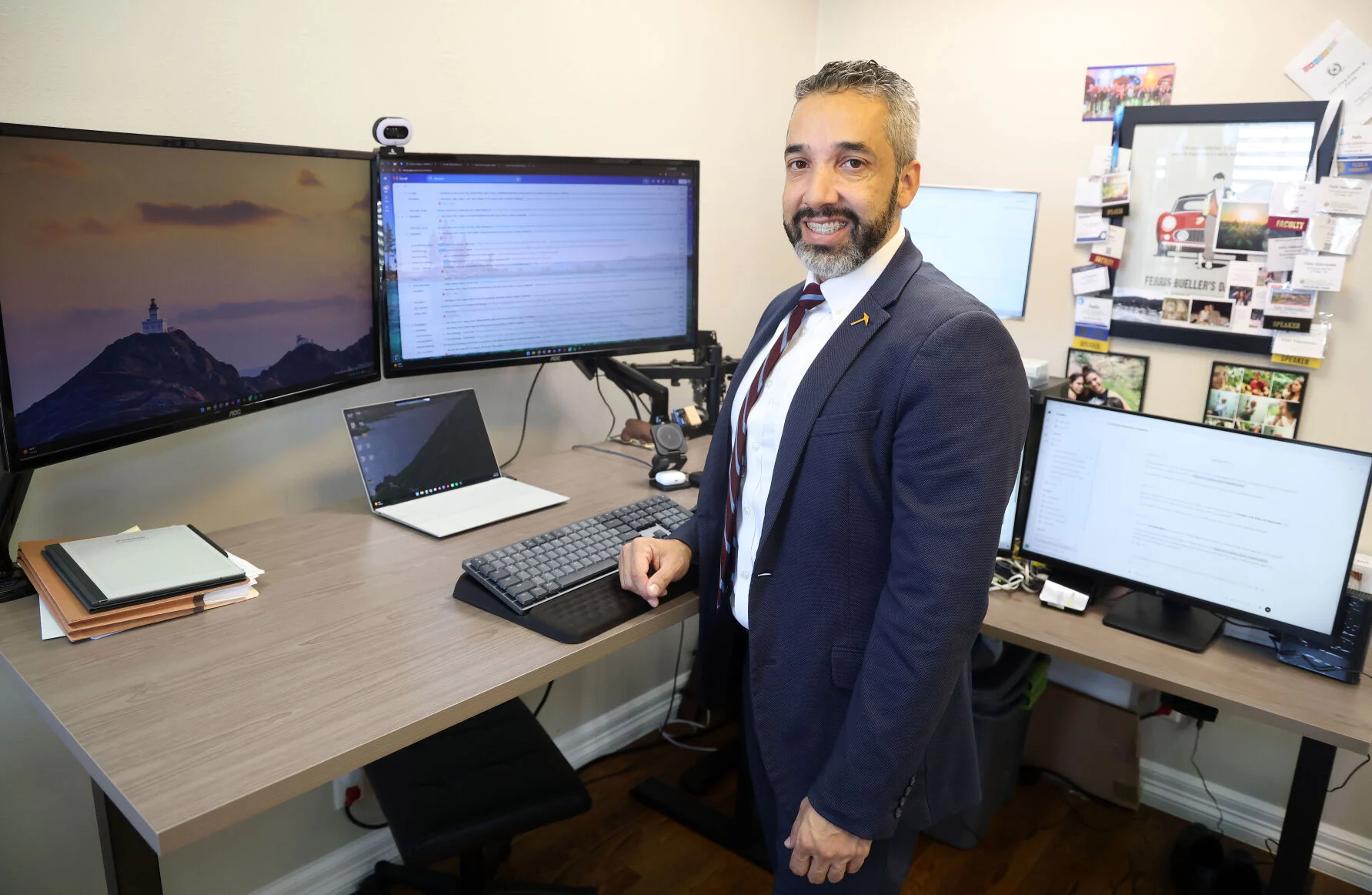
Fresh out of a successful federal court case, El Paso attorney Felix Valenzuela – a national presenter on Artificial Intelligence and the law – did a quick reflection on AI’s role in his recent victory.
“AI gave me great advice through most of it,” he said, then quickly followed with the big qualifier that illustrates the complicated impact of this new technology on the law.
“But there were some very serious pitfalls that it encouraged me to follow,” he said.
Valenzuela, founder and owner of Valenzuela Law Firm in El Paso, describes himself as a federal criminal attorney and technologist, and has spoken at more than 35 legal conferences around the country, teaching lawyers AI best practices. A crucial point among them is recognizing the types of pitfalls he avoided during his recent case.
AI is “pretty sycophantic,” he said. “It tells you a lot and makes you feel like, okay, this sounds accurate. But if you don’t verify it, then you could be relying on completely invalid or outdated, or even non-existent law, which works to the detriment of your client,” said Valenzuela.
As AI continues moving into nearly every aspect of global society, transforming entire industries in real time, the legal field in many ways is at the forefront. Judges are considering which guardrails, if any, to safeguard against the technology’s rampant spread, and attorneys from every practice area are maneuvering its adoption into the workings of their own firms and counsel.
Ethics and client privacy concerns surround attorney discussions on AI – can it be trusted to accurately synthesize mass tranches of data gleaned from often unknown corners of the internet? Is client confidentiality compromised by AI’s vast public tendrils? And, top of mind for lawyers wading into AI’s alluring power, is the question of whether clients are faithfully served when aspects of their cases are delegated to a faceless, artificial entity.
“For me, it’s very scary because it’s a huge sledgehammer that a lot of people don’t know how to use. It can cause a lot of detrimental, catastrophic problems. And the power that it has is something that is going to take a lot of human individual judgment, restraint, to make sure that we develop it in a way that’s helpful,” said Valenzuela.
At this juncture of AI, courts are taking different paths in curtailing the erroneous AI “hallucinations” that have been appearing in court briefs and filings. The United States District Court for the Northern District of Ohio in February banned all “generative Artificial Intelligence in the preparation of any filing submitted to the Court.”
While it carved out some new exceptions for legal search engines like Westlaw and LexisNexis, that district court will impose sanctions, strikes to pleadings, renderings of contempt and case dismissals for attorneys found using AI content from search engines like Google or Bing.
In Texas, on the other hand, the federal Fifth Circuit Court of Appeals opted “not to adopt a special rule regarding the use of artificial intelligence,” and stated that court filings “shall be carefully checked for truthfulness and accuracy as the rules already require.”
As a way of ensuring the integrity of AI-generated content for legal filings, law offices are increasingly using “closed source” platforms – paid AI subscription models that only synthesize from vetted legal data and a firm’s specific uploaded documents. By avoiding the open internet, these platforms reduce the chances of AI hallucinations conjuring up erroneous information that can undermine a case or, in some instances, lead to sanctions and malpractice lawsuits.
Attorney-client confidentiality, AI experts said, is indeed at risk if case details are entered into an AI chat box, which might feed that information into public portals somewhere on the internet. The best defense, experts say, is for both the attorney and the client to resist entering any information specific to a case into any AI engine. If information must be submitted to a prompt, they say a thorough reading of the terms and conditions of the AI service should be made to verify how and where that content will be stored and used.
The use of AI shouldn’t affect the integrity of a client’s case if its information is rigorously vetted, which should already be part of a responsible law firm’s protocol, attorneys said.
“We’ve started to implement it recently. It has its pros and cons, for sure,” said Jacob Noah Rey, an associate attorney at the Mendez Isaac Joudi personal injury firm, and the president of the El Paso Young Lawyers Association.
“Good practicing attorneys will do their due diligence and ensure that whatever it is they’re submitting to the court is accurate,” said Rey, who added that his firm uses Protege, a closed subscription model from LexisNexis. Even with a closed source AI platform, he said, mistakes can pop up.
“You think this case is on point, you click it, you read the case, and you learn that it actually has nothing to do with your case. So while it can be beneficial, you definitely do need to cross your T’s, dot your I’s and make sure that everything is correct before you submit it to the court,” he said.
Another impact AI is having on the legal industry is the jump in efficiency for handling cases. What used to take days of staff time, can now be done in seconds. With this trend, the traditional system of charging clients is being upended.
Decades ago, New York Attorney William Brewer was already sounding the death knell for law firm’s most entrenched revenue generator: the billable-hour model.
“The billable hour has long been an edifice to inefficiency. I believed that a better-informed generation of clients would want to pay for outcomes, not hours. At first, few agreed,” Brewer recollected in a March 2025 article published in Law360.
As a founding partner for Brewer, Attorneys & Counselors, Brewer has actively incorporated the latest technology throughout his long legal career. Billable time – a fee arrangement that tacks on client charges based on the hours of legal work put into a case – may be the major casualty of the legal industry in the AI era, he believes.
Analyzing contracts, conducting legal research and managing due diligence are now squarely in the AI wheelhouse, ushering in the performance-based attorney pay revolution he forecasted years ago.
“It’s a brave new world. And it’s fantastic,” said Brewer in a recent conversation with El Paso Inc.
“Anybody who’s afraid of changes will suffer the consequences,” he said. “Your business will do less well, it will be less efficient in the law business. You will probably drift from your clients’ best interest over time because your clients want to get where they want to go, efficiently, quickly and with greater certainty.”
Brewer, whose law office has operations in New York and Dallas, said he’s well versed in the arguments against incorporating AI into a law office. He waved them off as rhetoric from luddites grasping onto an outdated system that is fast receding.
“If you haven’t figured out that you don’t need to spend hours doing what can be done in minutes, it’s because you just don’t want to get down to the real work of solving your client’s problem and figuring out how you make a difference,” he said. “If you want to live in the rainforest and the ice age is coming, you’re done.”
While his steadfast belief in AI’s permanence in modern business is a widely held view, there is a faction of stalwarts in the legal industry who remain wary, even hostile, to AI encroachments into the day-to-day of lawyering.
In a 2026 “AI in the Practice of Law” survey by the State Bar of Texas, a random sample of 30,000 Texas attorneys in metropolitan statistical areas across the state were queried on their AI use and opinions on the technology. In the comment section of the survey, some attorneys expressed strong opposition to AI’s adoption.
“I don’t need AI tools to improve my work or effectiveness,” stated one commenter. “Wherever I have seen parties utilizing AI, it is usually wrong. I consider AI to basically be a short cut and form of cheating that minimizes the special skill set I have spent over 30 years to develop. The Bar should NOT embrace it.”
Another said, “I believe AI tools have an adverse impact on attorneys encouraging them to be lazy and reliant upon letting AI think and do the work for them. I’m not a fan. I think AI dumbs-down attorneys.”
Despite the holdouts, the survey shows that in the past two years, the use of AI in Texas law firms has doubled, jumping from 30% in 2024 to more than 60% in 2026, with corporate and in-house counsel representing the vast majority of this technology’s adopters.
Along with the increased usage of AI, a majority of polled Texas attorneys say they believe AI is having a significant impact on the legal industry, but “ethical concerns, cybersecurity, and lack of knowledge continue to deter non-adopters,” stated the study.
About 1,500 attorneys, paralegals and legal administrators responded to the questionnaire, and the survey has a margin of error of plus or minus 2%. A little more than 300 El Paso attorneys were sent the survey.
A decreasing number of attorneys from 2024 to 2026 said “they don’t know how” to use the technology – falling from 43% to 29% – which indicates an increase in AI literacy. But about half of the state’s law firms, according to the numbers, do not have specific AI policies or training. And only 9% of respondents said they were “extremely confident” in evaluating documents generated by AI.
“This could indicate that adoption is outpacing policy and guidelines,” noted the study.
The most common use of AI for Texas attorneys is drafting non-legal documents and legal document management, the survey found.
While AI has its critics in the legal industry, the big picture is clear, said Valenzuela.
“Definitely, 100%, the pros are completely outweighing the cons,” he said, adding that the technology’s handling of the drudgery of legal work clears the path for more effective lawyering.
“I find that I have more time to actually meet with my clients, actually talk to my clients, actually think about trial strategy and how I’m going to present things to the jury. I think that makes me a much better litigator,” he said.