
Brian King
Ruben R. Ramirez
Cigarette use in the United States has fallen to its lowest level on record, with about 10% of U.S. adults smoking. But young people are being targeted by an innovative nicotine industry using social media and the allure of celebrities, a public health expert warned during a recent El Paso conference.
“You’re seeing the industry go back to what they know works, and evolving with new products in order to advertise them,” said Brian King, executive vice president of U.S. programs at the Campaign for Tobacco-Free Kids.
Gesturing to a big screen behind him, he said, “This is a cover of Vanity Fair, and this is one of the Kardashians. I haven't the foggiest idea which one, but she is promoting cigarette smoking on the cover.”
The cover featured Kylie Jenner – the youngest of the Jenner sisters – in a black bustier and fitted slacks, straddling a couch and lighting a cigarette held to her mouth.
“We’ve made great progress in reducing cigarette smoking, and we don’t need celebrity endorsements and other promotions,” King said.
He spoke Wednesday at the Eastside Radisson Hotel during the 2026 Biennial Summit hosted by the Paso del Norte Health Foundation and the Paso del Norte Tobacco Control Network. The conference featured presentations on emerging vaping, nicotine and commercial tobacco products, and highlighted expert perspectives on the challenges of curbing nicotine use.
Traditional cigarettes, cigars and pipes have given way to a broader market of nicotine products that is introducing another generation to the addictive substance. E-cigarettes and nicotine pouches are among the most popular products among young people, King said.
“The advertising will lead a horse to water, the flavors get them to drink and the nicotine keeps coming back for more,” he said. “And it’s those same characteristics of these new emerging products that are continuing to entice youth to use these products.”
Data from 2024 and 2025 shows that about 10% of U.S. adults smoke cigarettes, 7% use e-cigarettes and 3.7% smoke cigars. Smokeless tobacco products have the lowest reported use rate – now at 2.6% of the population.
“If I had my crystal ball, I would anticipate we are going to see in smokeless tobacco what we’ve seen with e-cigarettes, where there’s a marked uptick among young people, and you see overall increases among adults,” he said.
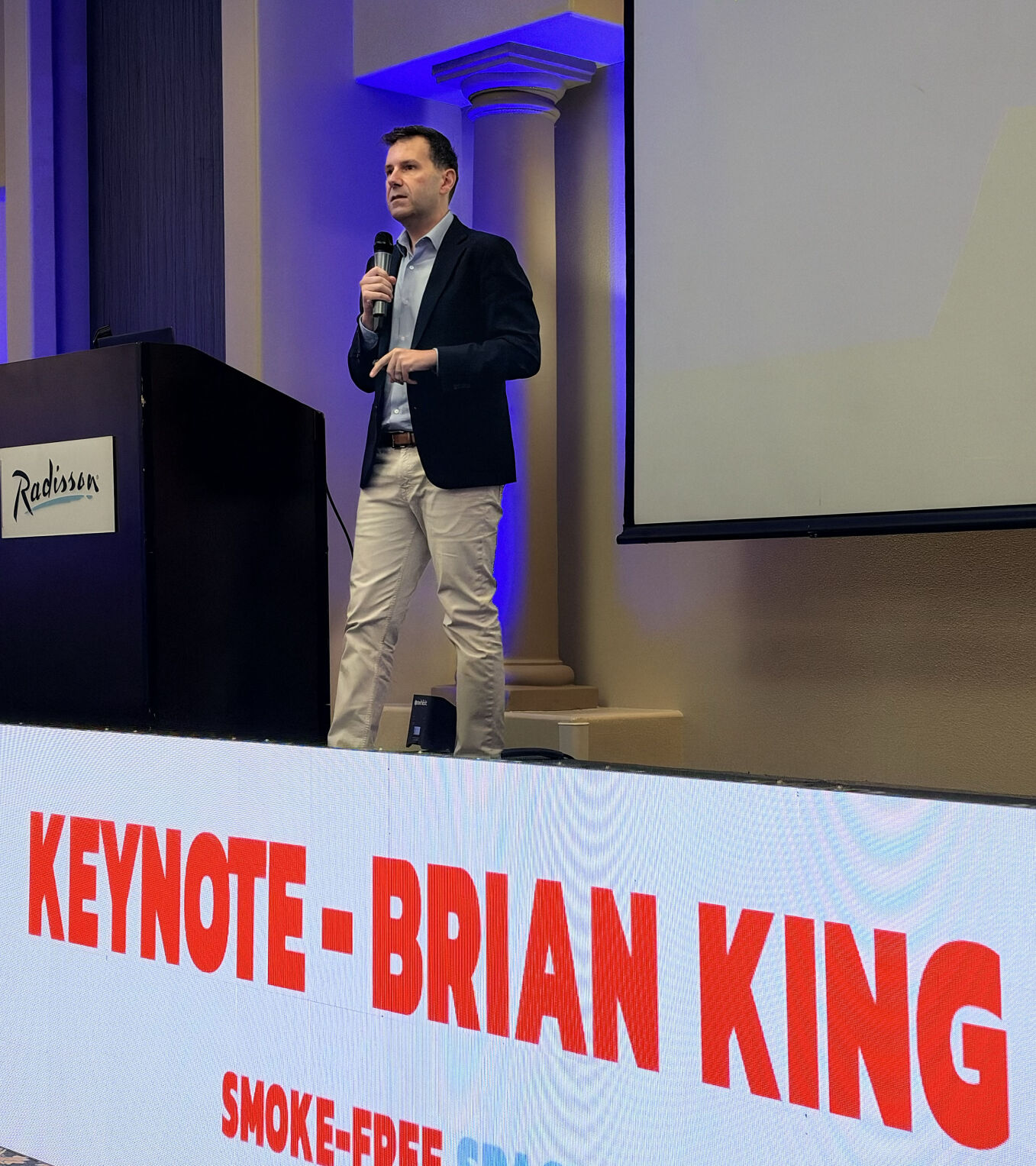
Brian King
Photo by Ruben R. RamirezIn his address to about 150 public health advocates and educators, King said tobacco use can interfere with learning among youths and young adults. The human brain continues developing until about age 25, one of the primary reasons King advocates for preventing young people from starting the nicotine habit.
King lauded progress in reducing smoking rates, citing research that shows a dramatic decline since 1964, when U.S. Surgeon General Luther Terry issued a report officially linking smoking to health risks.
“This is one of the greatest public health accomplishments of the past century,” said King, who has also been the director of the Center for Tobacco Products at the U.S. Food and Drug Administration.
Before joining the FDA, King was deputy director for research translation in the Centers for Disease Control and Prevention’s Office on Smoking and Health, and also served as executive editor of the Morbidity and Mortality Weekly Report.
Youth tobacco use has declined nationally to its lowest level in 25 years, King said. E-cigarette use has also dropped to its lowest rate of the decade, down nearly 80% from its peak.
But youths and young adults in Texas and New Mexico are smoking twice as much as the national average, said King, who called the celebrity endorsements of nicotine products a troubling trend for that demographic.
“Nicotine is highly addictive. It is a psychoactive substance and a highly addictive drug. It can also harm the developing adolescent brain,” he said. “It’s also the part of the brain that’s responsible for attention, learning and memory.”
There’s also a concern among public health professionals that society might view smoking as “a solved issue” that no longer needs attention.
“That is not the case,” King said. “We’ve got nearly 30 million Americans who continue to smoke cigarettes."
Smoking remains the leading cause of preventable disease in the United States, causing about 500,000 deaths each year.
The Trump administration has cut funding to the CDC, FDA and the National Institutes of Health, King said.
“We always face challenges, and in times of adversity, we’re running towards the fire, we’re blowing against the wind,” he said. “We’ve got to do our part to continue to keep that door open for those who are going to come after us. And particularly in these times of adversity towards public health, that’s now more critical than ever.”