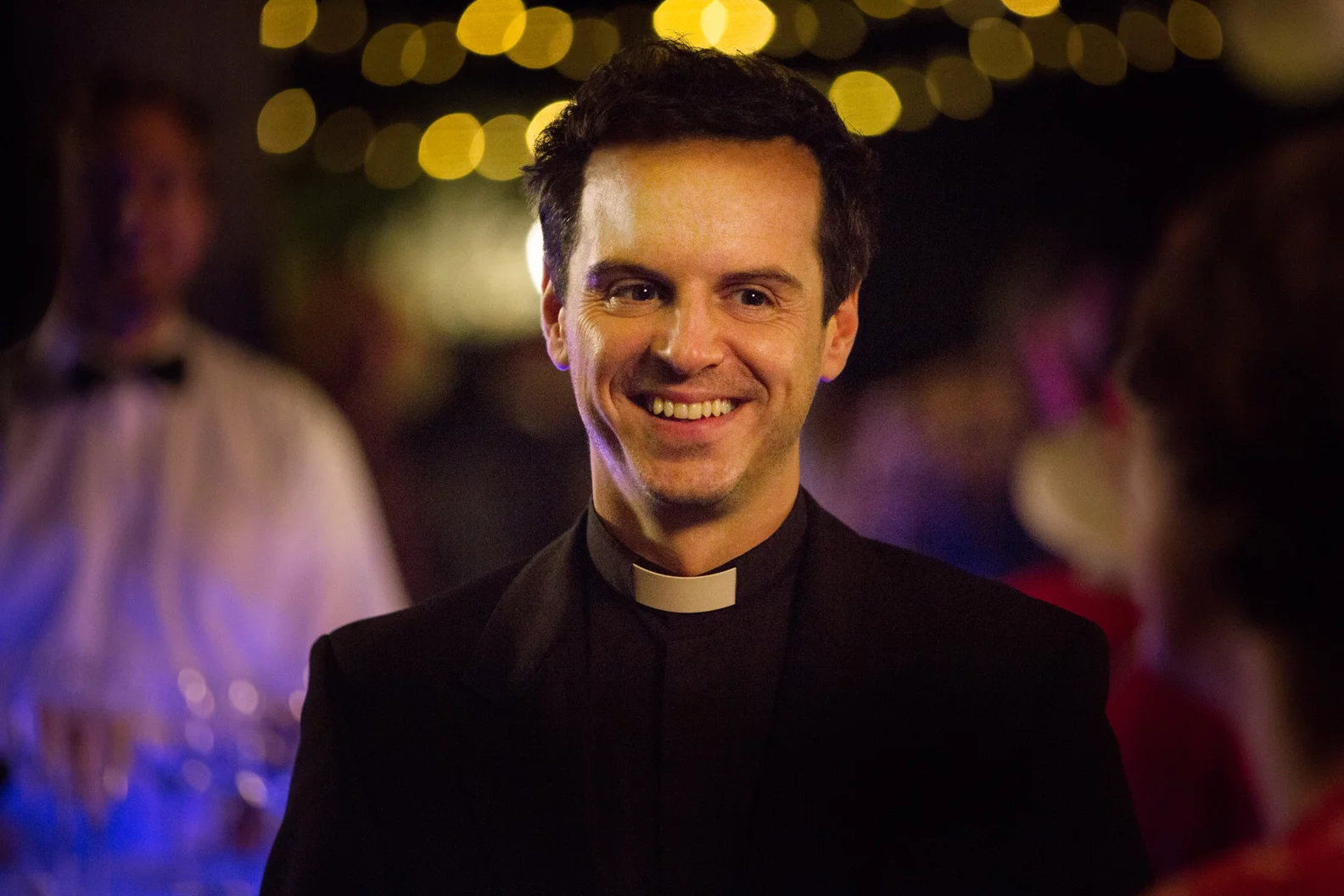
"It'll pass." That's what the Hot Priest (Andrew Scott) tells Fleabag (Phoebe Waller-Bridge) when she confesses she loves him — a line that, nearly seven years on from the finale, feels unintentionally ironic. Fleabag may have moved on, but culture never did. With Wake Up Dead Man landing on Netflix last week, the 'hot priest' trope is not only alive, it's thriving.
From James Norton's soulful Grantchester vicar to Derry Girls' chaotic Father Peter (Art Campion), and more arthouse turns like Ethan Hawke in First Reformed or the lead in Polish drama Corpus Christi, our screens have been crowded with attractive men in dog collars. Even papal thrillers like Conclave inspired fancams so prolific that social media account Pope Crave ended up at the Vatican itself. Other faiths have followed suit too, with Adam Brody's "hot rabbi" in Netflix's Nobody Wants This proving the appeal isn't denomination-specific.
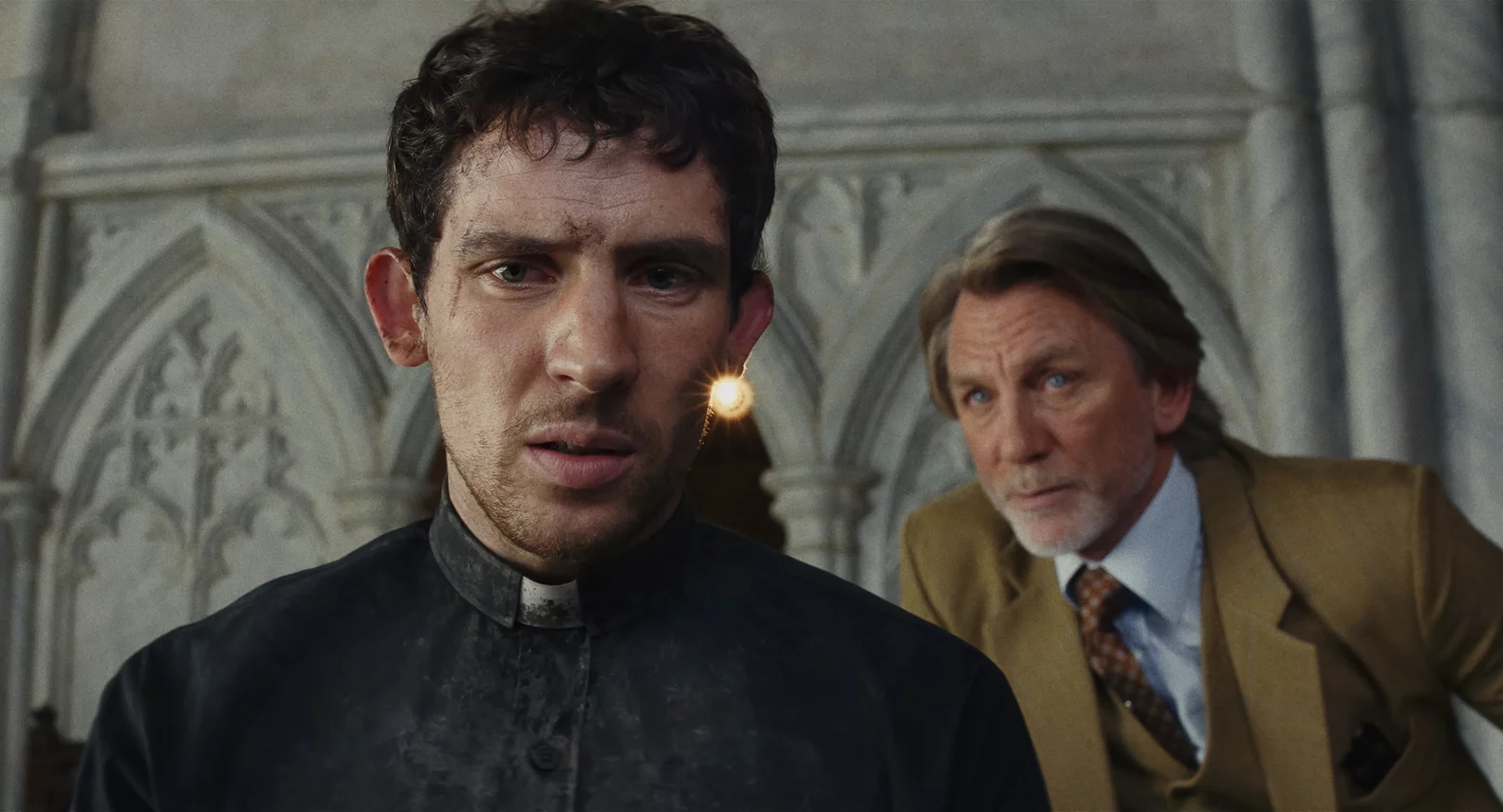
Fast-forward to today, and the timeline is yet again filling up with priest fancams, this time for Josh O'Connor's Father Jud Duplenticy in the latest Knives Out Mystery. A former boxer with tats peeking out from underneath his dog collar, it's easy to see why anyone would fancy Father Jud. But why are we so drawn to these characters time and time again?
The obvious explanation is the allure of the off-limits. Forbidden romances are, after all, a tale as old as time. Celibacy raises the stakes; the fantasy isn't just desire, but being chosen. It's no coincidence these roles are almost always Catholic - Anglican vicars who can marry simply don't carry the same taboo charge. The appeal relies on transgression.
The obvious explanation is the allure of the off-limits. Forbidden romances are, after all, a tale as old as time. Celibacy raises the stakes.
But forbidden desire alone isn't enough to sustain a cultural obsession. Nor is simply casting an attractive actor in clerical wear. What truly sets these characters apart is that they offer something increasingly rare in romantic fiction - and real life. They are committed, purposeful, emotionally literate men who take their values seriously.
For one, there is something attractive about the fact that these characters are ones who demonstrate commitment. Father Jud prays, "Christ, you didn't give up on me, so I'm not giving up on this church." And while Fleabag and her priest not ending up together is devastating, there is something powerful to be said for the fact that after everything, he remains true to his calling. That sense of purpose shows a driven nature, that makes us feel that if these men were to commit to us, they would be in it for the long haul. It opposes the culture of "You Up?" texts and swiping right that we have become so accustomed to, showing us men who are willing to put in the time and work for what they believe.
Their faith also grants them humility. Both Father Jud and Fleabag's priest know they don't have all the answers — and they aren't pretending to. Their confidence never tips into arrogance. In a culture where everyone is convinced they're right, that quiet assurance is deeply appealing.
On these potentially controversial depictions, I spoke to Rev. Shakeel Nurmahi, a young priest in the Church of England, about why the trope has become so popular. "When a young, hot priest comes along, they jar the viewer's perceptions and upset their worldview. A priest can't be young, hot, cool and interesting; they are supposed to be boring old people. They are new and different, and therefore very intriguing to people as they try to make sense of this person who goes against everything they thought about the church. These characters help to show that priests are normal people, and so are people who go to church. They reflect all walks of life," he says.
In many of these stories, the storytellers are willing to show us this normality, without any sort of judgement or preconceptions of what a priest should be. These men can be sweary and have their vices, be it sex or violence, and yet, at the end of the day, their heart remains firmly in the right place. When Fleabag assures the Priest that he won't burst into flames if they have sex, he responds, "I can't have sex with you because I'll fall in love with you. And if I fall in love with you, I won't burst into flames but my life will be fucked." There is no supernatural undercurrent to his decisions, but an authentic and human understanding of his beliefs, and what that means for how he lives; something refreshing to see in a priestly depiction, but also just a vulnerability that can be missing from male characters.
In Wake Up Dead Man, Benoit Blanc (Daniel Craig) accuses Father Jud of having entered the priesthood to absolve himself of the guilt of having killed a man in his boxing days. However, Jud pushes back against this, with a stark self-awareness, telling Blanc, "God didn't hide me or fix me, he loves me when I'm guilty." Like Scott's Priest, he knows he's not perfect and is unafraid of his parishioners seeing that. Rev. Nurmahi said of Father Jud, "It was refreshing to hear his honesty about his challenges and personal wrestling with his faith and calling. I think he beautifully captures the notion of 'being' a priest, as opposed to doing the work of a priest." This willingness to wrestle with the darker sides of himself shows an emotional maturity, which is also an incredibly attractive trait.
"I think these Hot Priest depictions are helpful for audiences to have a positive interaction with ideas of faith, priests and church."
But these darker traits are always balanced with a deep compassion. One of the stand-out scenes from Wake Up Dead Man occurs unexpectedly, when a bumbling contractor on the phone changes tone to ask Father Jud to pray for her. And he does. He drops everything, all the chaos and urgency of the murder mystery, to come alongside this woman with love, tenderness, and genuine care. To remind her she's not alone. We all long to be cared for in this way, whether romantically or otherwise.
Although our love for Hot Priest characters is certainly not as godly as the characters themselves, maybe it's no coincidence that the rise in this trend has aligned with studies in the UK and US showing that Gen Z are much more open to faith than their predecessors. Rev. Nurmahi points out: "It's worth recognising that in an increasingly secular world, many people are growing up with no experience of church and religion. Therefore, when they encounter a priest, there is this natural fascination and interest in something of which they have no prior experience or understanding. Younger generations today typically have no household faith to reject. Thus, they approach it with fresh eyes and a genuine interest in what faith and church are all about. Consequently, I think writers are increasingly including priestly characters because they offer a fresh perspective to audiences with an appetite for engaging with spiritual matters and questions."
On whether the trope is positive for the Church, the Rev. adds: "They inspire people to see faith in something bigger as plausible, even if there are so many questions left unanswered with it. For all [the trope's] ups and downs, I think these Hot Priest depictions are helpful for audiences to have a positive interaction with ideas of faith, priests and church."
Whether these characters reflect our sexual urges for the forbidden, or whether they are a much more wholesome reflection of our society's desire to engage with the deeper questions of life is left to be seen. But it's looking pretty certain that the Hot Priest trope will live on, regardless of the intent of storytellers. The people can't help but love a man in a dog collar it seems. Maybe Fleabag was right, when she said, "I just think I want someone to tell me how to live my life Father, because so far I think I've been getting it wrong. And I know that's why people want people like you in their lives. Because you just tell them what to do and what they'll get at the end of it."
If Father Jud or Hot Priest were to tell us how to live our lives, would we willingly follow? That can't be known. But these characters can be loved and enjoyed regardless of the answer. Roll that Father Jud 'Like a Prayer' fancam . . .