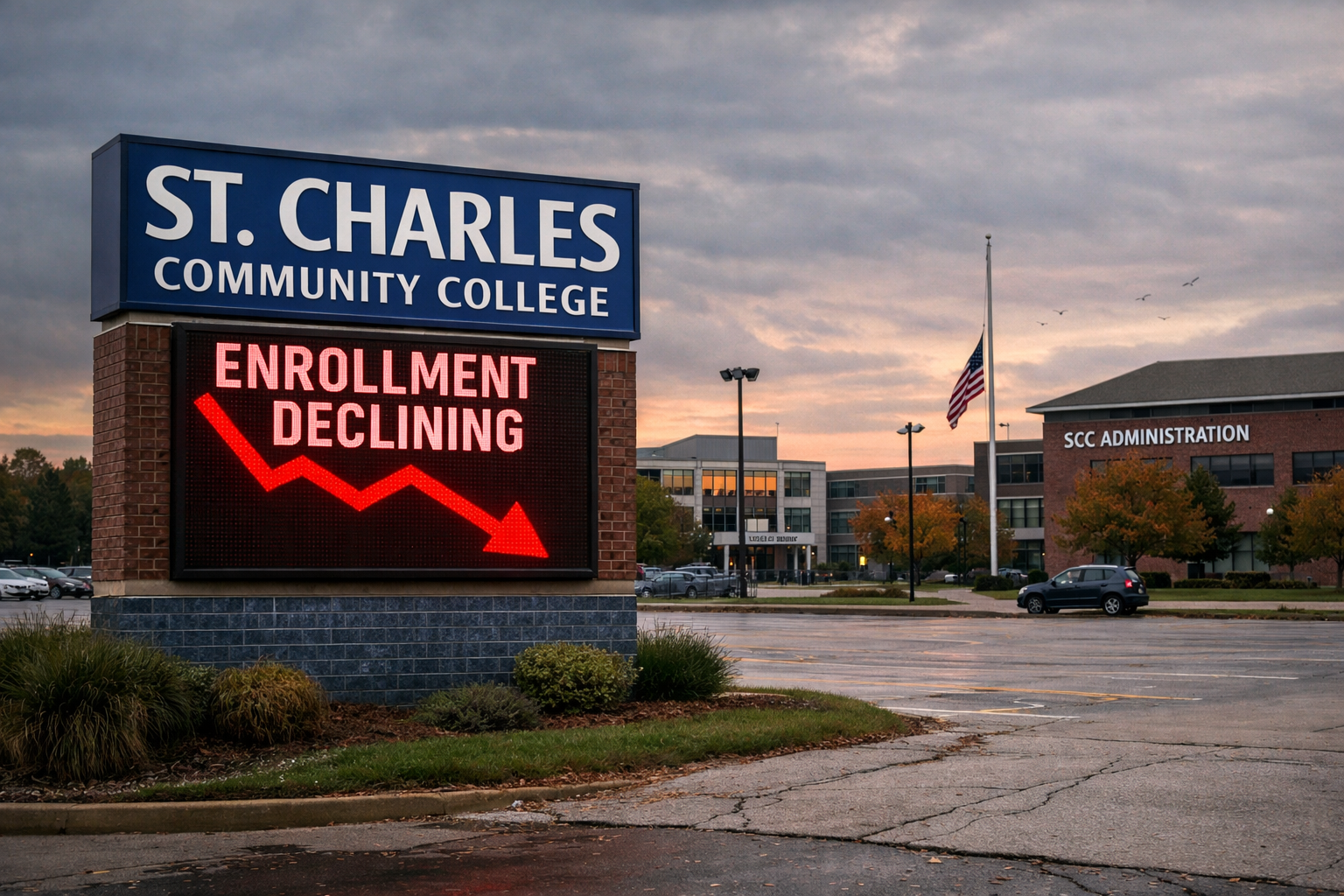
Discover the story behind St. Charles Community College’s declining enrollment and underutilized facilities. Learn what voters in St. Charles County need to know before the 2026 Board of Trustees elections.
By Karen Jones
St. Charles Community College Visionary, Faculty Union Leader & Distinguished Former Faculty Member
St. Charles Community College (SCC) has a story it does not want told — taxpayer dollars flowing into underutilized buildings while programs that students need disappear. Enrollment that collapsed while campuses multiplied. A community college that has forgotten it belongs to the community.
In April 2026, St. Charles County voters will fill two of the six Board of Trustees seats. Before voters cast their ballots, they deserve to know what has happened inside the institution their tax dollars fund duringPresident Barbara Kavalier’s nine-year tenure.
THE NUMBERS DON’T LIE
At peak enrollment of nearly 12,000 students, SCC operated from a single campus. Today, the latest published numbers show less than 6,000 students, with nearly half enrolled part-time.
Yet taxpayers funded the purchase of a second, $9.45 million campus in 2017 and a $41 million third campus completed construction last Fall.
Why is three times the real estate required to serve half the students? Why are expensive campuses being added while fully enrolled classes and entire programs that the community needs are being cut.
This math doesn’t add up, yet President Kavalier, whose total compensation exceeded $318,000 in 2022 – the last year public records are available – continues to preside with little oversight and accountability. Crowder College serves a similar number of students with a president earning nearly $120,000 less.
WHAT THIS MEANS FOR STUDENTS
While millions of dollars poured into new buildings under Kavalier’s leadership, the programs and people that serve students were gutted.
In 2023, the Social Work program was eliminated while the nation faces a mental health crisis and desperately needs social workers.
Winning programs that earned students national recognition have been decimated – rebuilt with a fraction of the participants and none of the success.
Former students report being unable to file complaints through mandated oversight mechanisms.
Students pay full tuition for an education increasingly delivered by part-time instructors. The Labor Tribune reported the administration has been systematically converting faculty positions — nearly 30% — into non-union staff roles. Your student has a one-in-four chance of being taught by a full-time professor. Nationally, it’s one in two.
At least nine current or former faculty/staff are suing the institution. And these are just the current cases. The legal costs should alarm taxpayers.
HOW DID WE GET HERE?
Before Kavalier became president in 2016, this institution worked. It served students with programs they needed.
Recognized as a St. Louis Post-Dispatch Top Workplace, employees believed in their leadership and a culture built on transparency.
Everyone was accountable — faculty and staff evaluated administrators, administrators evaluated faculty and staff, and citizens addressed their elected board at public meetings.
The evaluation system that once held administrators accountable? Eliminated immediately upon Kavalier’s arrival. The public comment that once allowed citizens to address their board? The Labor Tribune has documented its unprecedented restriction.
Grievances that once went to the board for review now stop at President Kavalier’s desk. According to the faculty MOU, “The President’s decision will be final.”
The very person whose actions are being contested gets the final say. The board has abdicated its oversight responsibility.
A PATTERN THAT PRECEDED ST. CHARLES COUNTY
Barbara Kavalier has left similar trails at previous institutions.
At San Jose City College (2010-2013), virtually the entire administrative leadership team departed during her tenure.
At Navarro College (2013-2016), she abruptly resigned following a discrimination scandal that drew national media coverage. The previous president had to come out of retirement to restore order.
Then, Kavalier withdrew from consideration at Butte College before public forums were held. She was not selected for a College of DuPage position.
When SCC began its presidential search in 2016, faculty expressed reservations about Kavalier’s history. The board hired her anyway.
Nine years later, taxpayers are still paying for that decision with an institution that has lost its way.
THE PROTECTION
Amid this extreme dysfunction, how does Kavalier remain employed and empowered with unprecedented authority?
Those who have watched this institution over the years have their theories. They point to relationships – between the boardroom and county leadership, between the institution and the state capital, between those who hold power and those who are supposed to provide oversight.
WHAT COMES NEXT
The board of trustees exists to provide oversight and accountability on the behalf of St. Charles County citizens.
Taxpayers deserve to know where their money goes. Students deserve an institution that prioritizes their success. The employees who have been targeted, marginalized, and discarded deserve recognition that what happened to them was neither acceptable nor inevitable.
SCC belongs to the community. Voters finally have an opportunity to reclaim SCC on April 7.
KAREN JEANNE JONES BIO
Karen Jones has a remarkable multi-decade history with SCC:
- Founder / Charter Author — Karen Jeanne Jones conceived the vision for SCC and physically wrote the college’s founding charter, famously on a typewriter placed on her ironing board, out of reach of her young daughters. The college was established in 1986.
- English Faculty & Department Chair — Karen, a retired, long-tenured SCC faculty member, served as English Department chair and as Executive Director of Global Education and International Students Support Services.
- Union Leader — She is the former president of AFT Local 4803, the faculty union. As recently as December 2023, she appeared at the SCC Board of Trustees meeting in a show of solidarity with faculty, standing with union members opposing President Kavalier’s administration.
- School Board Leadership Karen was a member of the Fort Zumwalt School District Board for nine years.