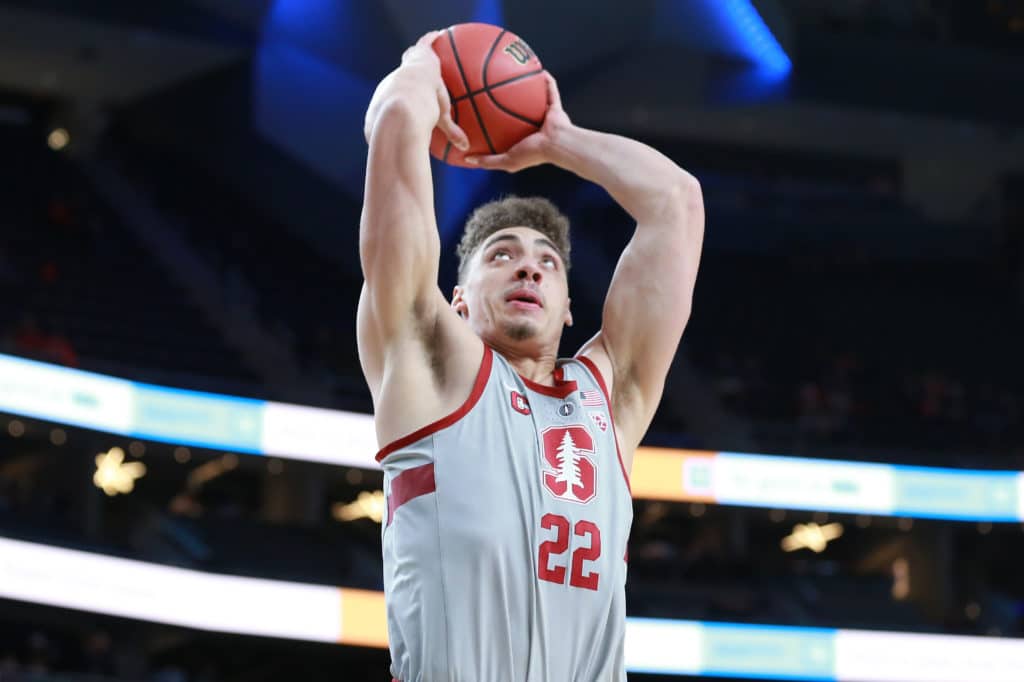
A Bay Area basketball team just lost an elite player in free agency. (Relax, the Warriors’ roster is still intact.) The local star who’s leaving town is Stanford’s Reid Travis, the 6-foot-8, 245-pound power forward— emphasis on power — and two-time all-Pac-12 selection who announced on Wednesday that he is leaving the Cardinal to play his final college season at Kentucky.
Travis, who graduated from Stanford last weekend with a degree in Science, Technology and Society, has a fifth year of eligibility due to a redshirt season he was granted when a leg injury ended his sophomore season after only eight games. He is taking advantage of the NCAA’s controversial graduate transfer rule — essentially a form of free agency — that allows players who still have eligibility remaining after they have completed their undergraduate degree to transfer to another school without sitting out a year.
The rule, according to the NCAA, is intended to “assist academically high-achieving students in pursuing a degree of interest that may not be offered at their undergraduate college.” With all due respect to Kentucky, if you’re wondering what academic pursuits Lexington has to offer that Travis couldn’t find at Stanford, well, you’re not alone.
The stated purpose of the rule has largely been ignored in college basketball and football, where it has become an easy way for powerful programs to scoop up experienced players from less successful teams. According to NCAA research, data shows that “many transfers in those two sports earn few graduate credits and leave school when their athletics eligibility expires.”
It’s not exactly going out on a limb to assume that Travis’ preference for Kentucky over another year at Stanford is more athletic than academic. Clearly, the interest he’s pursuing is a trip to the NCAA Tournament, a destination Stanford was unable to reach during his outstanding career, which included his 19.5 points and 8.7 rebounds last season.
It’s understandable that he would be attracted to the glamor, national exposure and Final Four potential of Big Blue Nation over the decidedly tepid local interest in a Stanford program that has been mostly mediocre for the last decade. It’s hard to fault a player for taking advantage of what little freedom of movement is allowed in college sports, but one regrettable consequence of it is that it often leads to the rich getting richer.
That’s exactly what’s expected to happen at Kentucky, where the addition of Travis has made the Wildcats national championship favorites in the eyes of some observers. When Travis made it clear he was open to leaving Stanford, he was viewed as a game-changer among big-time programs; Kentucky coach John Calipari had to out-recruit Duke’s Mike Krzyzewski and Jay Wright of Villanova to land him.
“Our fans know that when it comes to talent and experience, I’m always picking talent,” said Calipari, who normally shops heavily in the one-and-done aisle. “But Reid gives us both.”
Travis is a beast around the basket, where he uses his powerful lower body to establish low-post position and his barrel-like chest and shoulders to play through contact around the rim. He also plays with a certain level of nastiness that Kentucky fans are clearly looking forward to seeing up close:
If @2ReidTravis2 don’t elbow somebody in the head like this whole at UK ima be disappointed @DrewFranklinKSR https://t.co/73UMVj1jQh
Combine all that with the kind of nimble, polished footwork that most NBA big men would envy, and Kentucky is getting — and Stanford is losing — a dominant interior scorer. Travis has proven to be a physical match for the most elite competition. His physical style helped put Arizona’s Deandre Ayton, expected to be the No. 1 pick in tonight’s NBA draft, on the bench in foul trouble in a matchup last January. Travis finished with 20 points and 10 rebounds to Ayton’s nine and eight.
The reason that Travis isn’t considered NBA-ready himself is that he’s not nearly as accomplished on the perimeter as he is in the post. He tried last season to develop a 3-point shot for the first time and still has a long way to go in that area — he shot 28.9 percent (11 of 38) behind the arc last season, as well as at the free-throw line, where his 66.9 percentage last year was his career high.
Stanford helped arrange several workouts for him with NBA teams, including the Warriors, Cavs and Timberwolves with the hope that if Travis didn’t receive positive enough feedback from pro evaluators, he would return to the Cardinal. With him, Stanford, which finished tied for third in the Pac-12 last season, would have been expected to have a reasonable chance to end its four-year tournament drought (and only one tourney appearance since 2008.)
Without him, Stanford still has a promising core with point guard Daejon Davis and a pair of long-armed, versatile forwards, KZ Okpala and Oscar Da Silva, but the Cardinal may be one more solid recruiting class away from making a tournament run. While the loss of Travis isn’t optimal, “we still have a chance to be pretty good,” said Stanford coach Jerod Haase.
Kentucky has a chance to be great — or even greater — and Travis, with the opportunity to play for an elite program that has a history of churning out NBA draft picks, has a chance to improve his stock enough to be selected next June. Stanford really can’t blame Reid Travis for leaving, it can only work on improving its program enough that the next Reid Travis won’t have as much reason to want to.
(Top photo: Leon Bennett/Getty Images)
If you enjoyed this article, start a free trial today to get full access to all the smart, in-depth coverage on The Athletic, then get 25% off the annual plan.