There was a brief time, decades ago when it was new to the Oakland cityscape, that people occasionally referred to it as the Jewel Box. But the nickname didn’t stick, probably because it was too flashy for a building that didn’t stand out or call attention to itself. It was, after all, a huge but otherwise unremarkable circle of concrete and glass when viewed from the outside, about as charming as your typical office building.
Its official name, the Oakland-Alameda County Coliseum Arena, wasn’t exactly catchy, either, and though that eventually changed, to the simpler Oracle Arena, the building’s essential nature never did. Oracle has always been a fairly plain backdrop, a canvas upon which its many tenants have painted every type of picture imaginable. It has been home to minor sports and major ones, to comically awful teams and awesomely skilled ones. The great performance and gimmicky promotion have always been equally welcome at Oracle. In roughly the same spot that the Warriors raised their NBA championship trophy before a global television audience last June, a live seal once flopped around on the ice to entertain a sparse hockey crowd back in the ‘70s.
It’s telling that the only moniker that has lasted, “Roaracle,” says less about the place than the people who fill it. Built in 1966, Oracle is the oldest venue in the NBA, two years older than the rebuilt Madison Square Garden, but it has never been considered a shrine, as arenas like MSG, the old Boston Garden or even the much younger Staples Center have been. Yet as the Warriors begin their final season at Oracle before moving across the Bay to the new Chase Center, the people who played there, coached there, broadcasted there or just watched games there are already feeling nostalgic about the place.
“This last year is going to be special,” says the Warriors’ Steph Curry, who has been responsible for so many of the building’s most memorable moments. “From some pretty down years, to some entertaining basketball that didn’t win much, to now having won three of the last four (championships). All that happened at Oracle. Our crowd has made it a feared place to play for our opponents in terms of noise and energy and atmosphere. It’s my 10th year in the league and that’s been my only experience. It’s something I’ll remember for a very long time.”
Though the Warriors’ current dynasty is unquestionably the high point in the life of the building, it represents just one part of Oracle’s eclectic history. The first ABA game was played there, in 1967, between the Oakland Oaks and Anaheim Amigos. A teenager from Concord named Tom Hanks once roamed its stands, selling hot dogs at California Golden Seals NHL games.
Some of the first seeds of the marriage of hip-hop and hoops were planted there when Run DMC took part in the pre-game introduction of the Run TMC Warriors of Tim Hardaway, Mitch Richmond and Chris Mullin before a playoff game against the Lakers in 1991. And if you’ve ever detected a somewhat, shall we say, distinctive aroma in the building, it might be because the Grateful Dead has played more concerts there than any other indoor venue.
In its quietly offbeat way, the arena represents the breadth of the West Coast experience.
“It felt very California to me, when I first came out here from doing Indiana Pacers games in 1986,” says Greg Papa, the Warriors’ play-by-play broadcaster from 1986-97 who now hosts the pre- and post-game shows on NBC Sports Bay Area and is a radio host on 95.7 The Game. “The sun hitting all that glass, sitting right next to a freeway. It was kind of unlike any other place.”
Occasionally, the building itself has been a part of the story. In 1987, then-Warriors coach George Karl, enraged at center Joe Barry Carroll’s laid-back attitude, famously ripped Carroll’s locker door off its hinges. Three years ago, Cavaliers coach Tyronn Lue collected $100 from each of his players and other Cavs employees and then stashed $4,500 in the ceiling of Oracle’s visiting locker room after Game 5 of the NBA Finals, as motivation for his team to win Game 6 in Cleveland and force the series back to Oracle to retrieve their cash, which they did.
But more often than not, it was the players and fans who made Oracle special. There was Eric “Sleepy” Floyd’s 29-point fourth quarter to win a playoff game over the Lakers in ‘87 (“Probably the loudest I’ve ever heard it in that building,” says Papa), and Baron Davis’ dunk over Utah’s Andrei Kirilenko in the “We Believe” Warriors playoff run in 2007. (“I can’t believe there was ever a louder moment in there than that,” says ex-Warrior Adonal Foyle.)
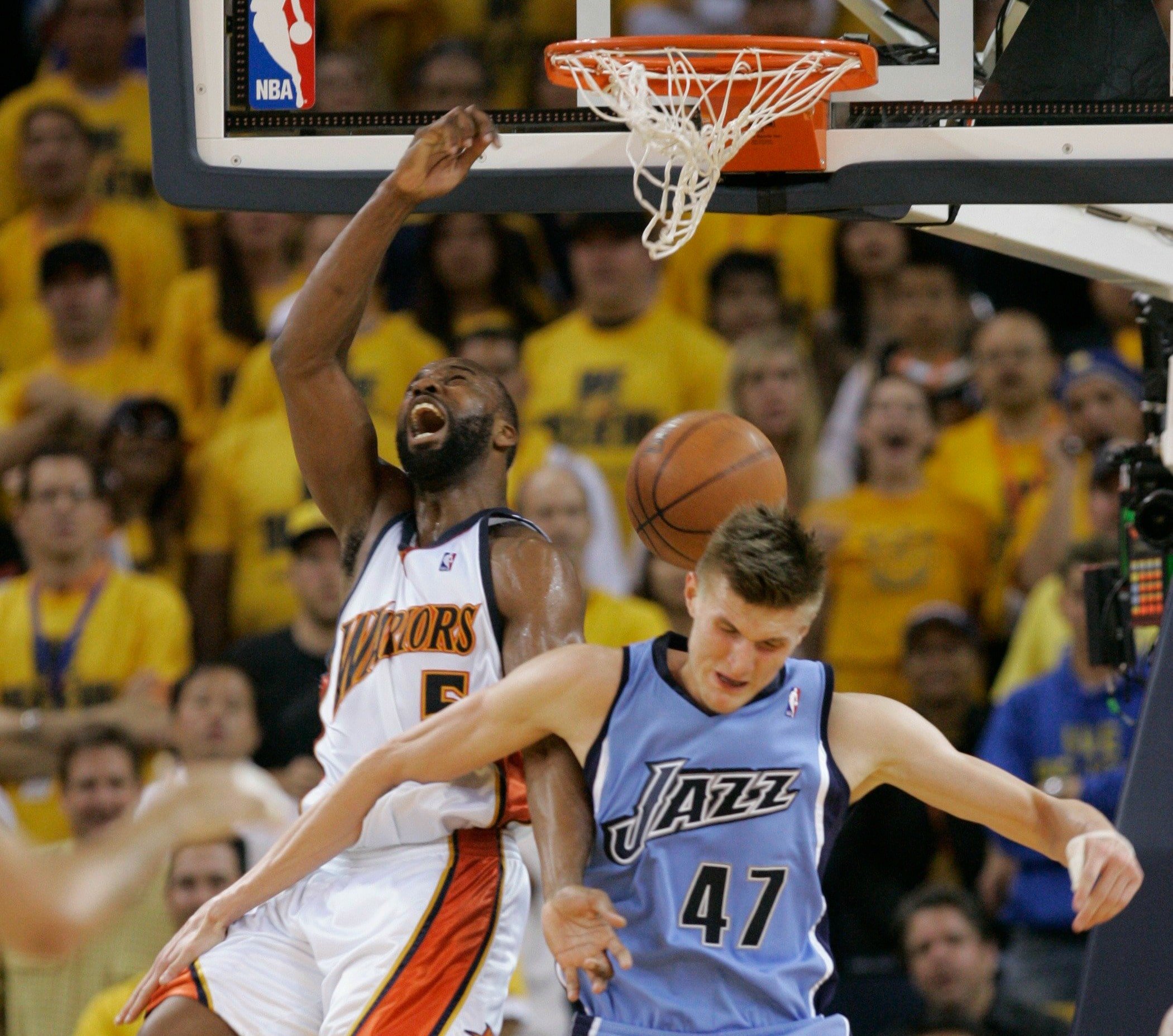
There was Klay Thompson’s 37-point quarter in 2015, and the unexpected scoring duel between Antawn Jamison and Kobe Bryant in 2000, when they scored 51 points each in a what was then a rare Warriors win over the Lakers.
“For me, the first memory that comes to mind is seeing Rick Barry score 64 points there (against Portland in 1974) when I was a teenager,” says Brad Gilbert, the former top 10-ranked tennis player who has been a diehard Oakland sports fan all his life. “And this was before the 3-point line. He had 30 buckets that game (out of 45 attempts), and a lot of them were bombs. If there had been 3-pointers, he would have had at least 70 that night.”
Gilbert scalped tickets at what was then the Coliseum Arena as a teenager, and he always managed a prime seat for himself.
“I was friends with the son of the Warriors’ team doctor, Dr. (Robert) Albo, so I would sit with them a lot, right near the court,” he says. “Dr. Albo was the nicest, most dignified, respected man you could ever imagine, but when he was at Warrior games he turned into a different guy.
“He would ride the refs without mercy. Nothing really profane, but just relentless. Sometimes the players and coaches would even turn around to get a look at where this constant ref bashing was coming from. That’s one of my clearest memories — sitting near Dr. Albo while he unloaded on the refs. He was a legend.”
But at least once, a ref had a legendary comeback.
“There was this one game where he was all over Joey Crawford,” says Papa, referring to the long-tenured, short-tempered NBA referee. “It had been going on all night long. ‘Joey, how could you miss that call? Joey, you blew another one!’ So at one point, the teams were coming out of a timeout and Joey waited until he was just about to hand the ball to a player to inbound the ball and the timeout music had stopped, that moment when the building was as quiet as it could possibly be, and he turned to Dr. Albo in the stands and said, ‘Hey Doc, at least I don’t bury my mistakes.’”
It was all in good fun. Oracle, like the city it represents, has been a place where a little attitude was not only accepted but welcomed. Davis’ dunk over Kirilenko is memorable partly because of the way it was punctuated by Davis’ sneering, in-your-face expression. Vince Carter’s famous performance at the 2000 Slam Dunk Contest at Oracle is remembered not just because Carter put his arm through the rim up to his elbow, but because of the throat-slashing “It’s over” declaration he made when he finally landed.
But along with the swagger, there is a sadness to the building’s history that can’t be denied. Richmond remembers the nights when coach Don Nelson would come into the locker room before a game and tell his high-scoring crew, “Alright boys, first team to 125 wins,” but along with all the highlights that Run TMC brought to the arena, for instance, one of Richmond’s clearest memories is of being traded to Sacramento and returning as a visitor for the first time.
“I went to the Warriors’ locker room out of habit before I stopped and realized,” he says. “That was the moment that it really hit me that this wasn’t my home anymore.”
Oracle was the scene of many a Warrior embarrassment during the team’s lean years.
“Legacy is weird,” says Foyle. “You have to take all that comes with it. In order to appreciate what you have, you have to appreciate what was. You have to take all of it, the good and the bad. All those down years, the way the fans stuck by us and stayed just as loud — that will always be part of Oracle’s legacy.”
Although the arena has been home to pro basketball far more than the college game, Cal played two seasons there, from 1997-99 while the Bears’ Harmon Gym was being renovated, becoming Haas Pavilion. But the most memorable college hoops event at Oracle belongs to Stanford. The Cardinal was ranked third in the nation when they beat top-ranked Duke there in 2000 in what was then the biggest crowd (19,084) to watch a college hoops game in California history. Casey Jacobsen banked in a fallaway jumper from the wing with 3.6 seconds left to give the Cardinal an 84-83 victory over a Blue Devils team that featured Jay Williams, Shane Battier and future Warrior Mike Dunleavy.
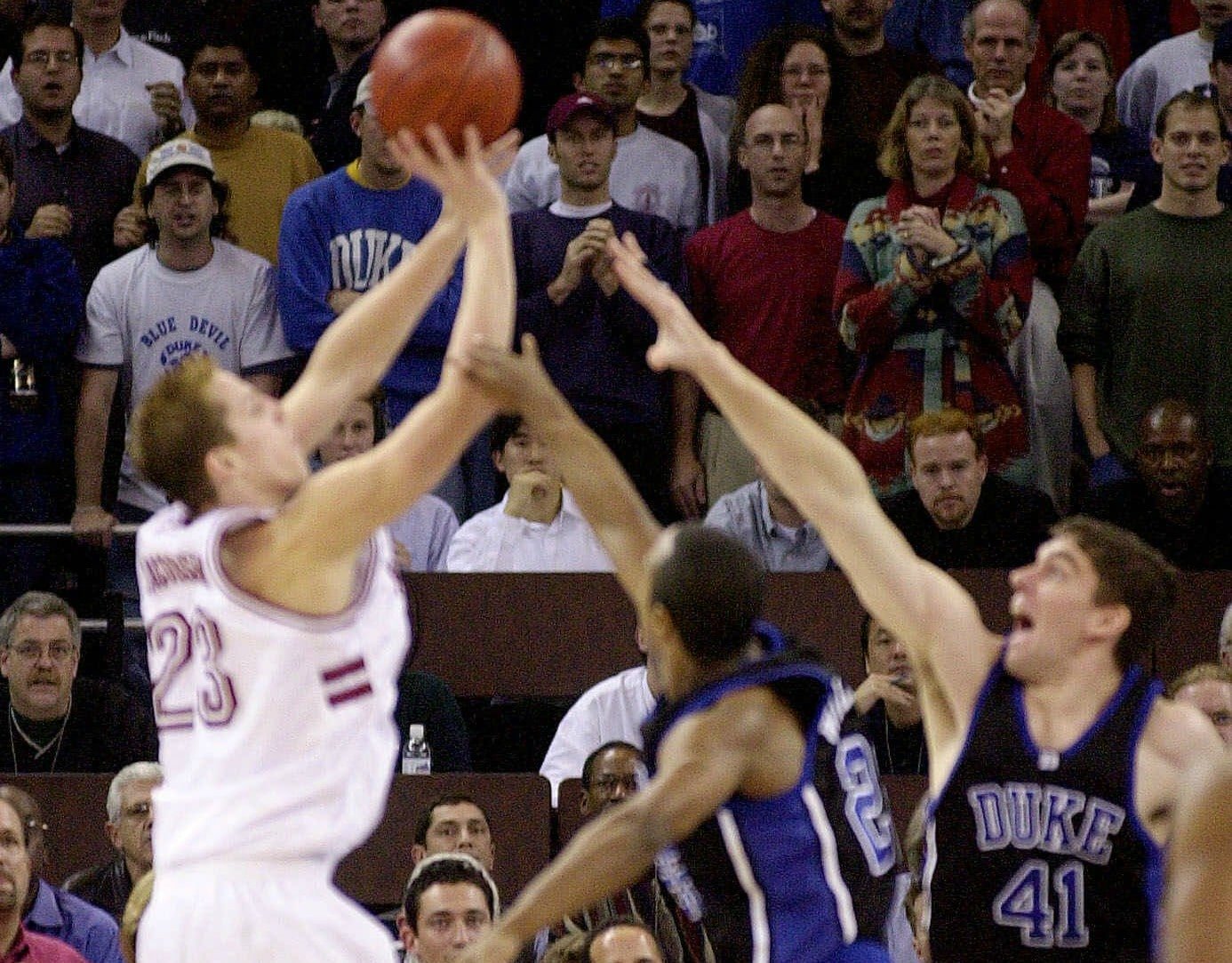
Jacobsen felt the difference between an NBA arena and Stanford’s home gym, 8,000-seat Maples Pavilion, immediately.
“It was huge, twice as big as our place, and the rims were unbelievably tight,” he says. “The rims at Maples were a little bit forgiving, but at Oracle if your shot touched the iron, forget it. It was like, OK, in this building, your shot better be perfect.”
The shot that beat Duke actually did catch iron, but it didn’t matter.
“It wasn’t my greatest game and winning NCAA tournament games have to rank as bigger thrills,” Jacobsen says. “But that shot against Duke was probably the defining one of my college career, the one that people remember me for, and I’ll always have a fondness for the building because of that.”
Others will always have a soft spot for Oracle because of the quirky, non-mainstream sports that found a home there back when it was the Coliseum Arena. In the ‘70s, roller derby drew raucous crowds with the Bay Bombers, led by bad-ass Joanie Weston, trading elbows with opponents and body-slamming each other as they skated laps around the track. The Golden Bay Earthquakes of the Major Indoor Soccer League bounced balls off the arena walls in the ’80s, and during the inline skating boom of the ’90s, the Oakland Skates played their home matches in the start-up Roller Hockey International League.
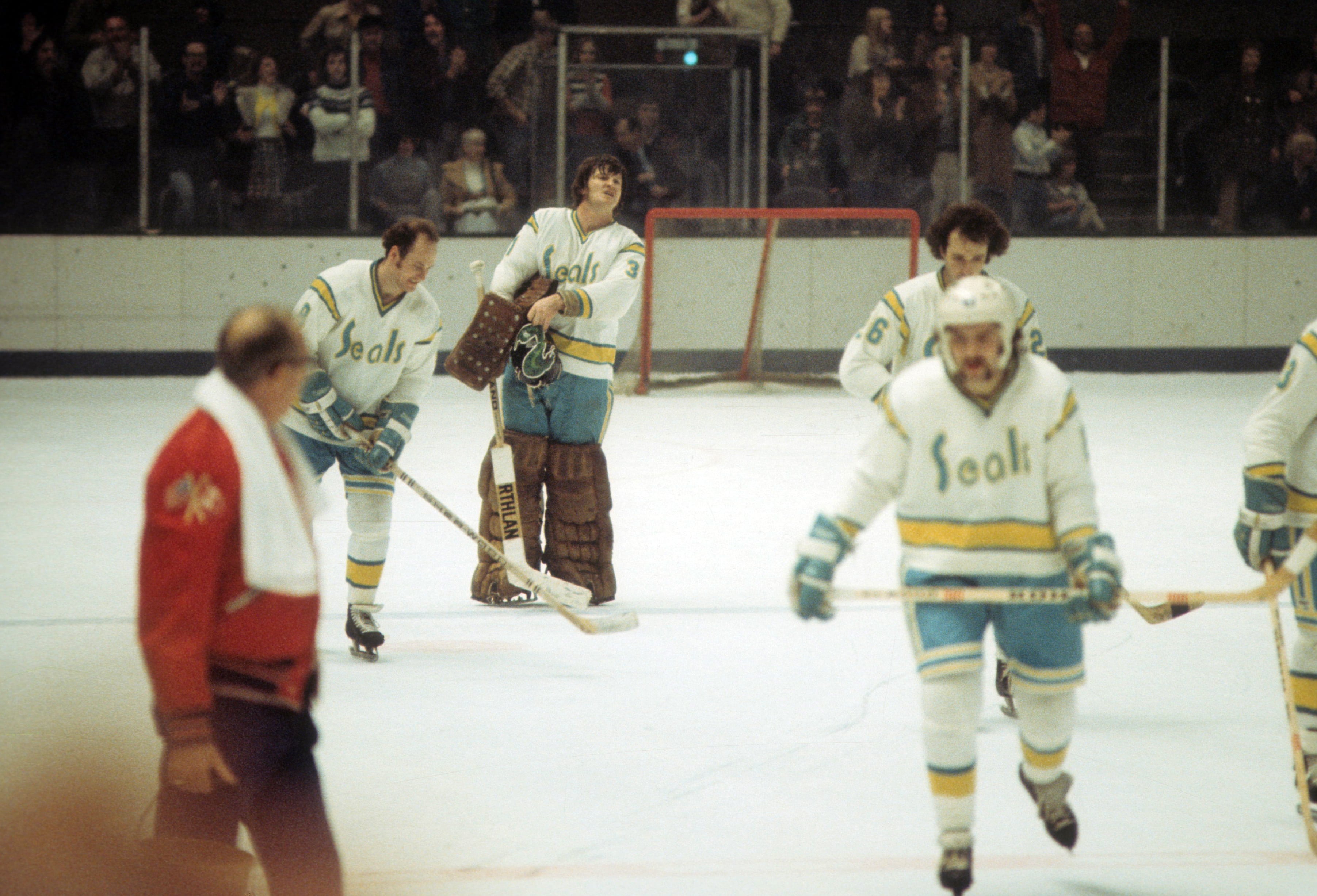
But it was the short-lived Seals of the NHL who were most responsible for the building’s early reputation as a place for the wild and bawdy. The Seals were the arena’s first tenant in 1966, having been added to the league as an expansion franchise on the condition that they move across the bay from the Cow Palace, where they had played as a minor-league team. After the Seals struggled to draw fans during their first few seasons at the arena, A’s owner Charlie Finley bought the franchise in 1970 and quickly brought his flamboyant, showman’s style to the building.
Cartoonist Charles Schulz, one of the team’s biggest fans, had taken time out from drawing the Peanuts comic strip to design the franchise mascot, Sparky the Seal. But Finley switched from Schulz’s animation to live action at least once, bringing that live seal out onto center ice between periods. That was G-rated fun, but he went a little racier for one game when he hired a female streaker — the girlfriend of one of the team’s staffers — to skate across the rink in the nude as the players came out onto the ice to begin the second period. She raced out from behind the team bench wearing nothing but a smile, a pair of skates and “SEALS” written diagonally across her torso from shoulder to hip.
Sometimes, the bonus entertainment at Seals games wasn’t Finley’s doing. Krazy George (Henderson), the famed wildman/cheerleader for Bay Area teams, quickly became a fixture at the Coliseum Arena, banging on his drum and shaking his tambourine both to stir up the home crowd and irritate the opposing players. He once succeeded so well in getting under the skin of Boston Bruins tough guy Terry O’Reilly that O’Reilly jumped out of the penalty box and chased him in the stands. Accounts vary as to whether O’Reilly ever caught him, but in any case, Krazy George lived to tell the tale. The Seals, sadly, didn’t live much longer, leaving town to become the Cleveland Barons in 1976 before folding two years later.
Warriors opponents have created their share of Oracle memories. In addition to Lue’s money-in-the-ceiling gambit, there was LeBron James’ famous chase down block of Andre Iguodala in Game 7 of the 2016 Finals, and the Kyrie Irving jumper that sealed that game, and the championship, for the Cavs.
There was also the night Charles Barkley put on a one-man show to eliminate the Warriors in a first-round playoff series in 1994. Not surprisingly, Sir Charles added a little spice to his performance. After the Suns won the first two games in Phoenix, he pulled Papa aside before the series headed back to Oakland.
“He said, ‘Interview me on TV before the game,’” says Papa. “I asked him why, and he said, ‘Just interview me.’”
Papa did so during pregame warmups, and Barkley said, “Tell that old man if he don’t double me, I’m gonna go for 50.”
The “old man” in question, Warriors coach Don Nelson, didn’t double Barkley — at least not enough — and Sir Charles was true to his word. He hung 56 on the Warriors as the Suns finished the three-game sweep.
No opponent has been nearly confident enough to make such bold predictions at Oracle lately. Although they are looking forward to the luxuries of the Chase Center, the current Warriors use words like “bittersweet” and “bummer” when they talk about leaving the building for good.
“My whole NBA career has been in that building,” says Thompson. “My favorite memory, it’s hard to pick one. My first playoff series (against Denver in 2013) was a ton of fun just because the team had been itching to get back to the postseason for about five or six years at the time. It was my first taste of playoff basketball, so those are probably some of my best memories.”
More playoff memories will almost certainly be made this season. The Warriors will shoot for another title as the reality of saying goodbye to Oracle adds a year-long touch of sentimentality to the chase.
“Every time I drive to the arena I’ll think about how this is the last year of doing it,” Papa says. “I’m going to miss the place.”
“I just hope they can leave with another championship,” says Foyle. “That would be the best way to close the doors. It’s what the fans deserve. And you know what? It’s what the building deserves.”
After all these years, maybe it does deserve to be called the Jewel Box, because the memories it holds are precious.
(Top photo: Justin Sullivan/Getty Images)
If you enjoyed this article, start a free trial today to get full access to all the smart, in-depth coverage on The Athletic, then get 25% off the annual plan.