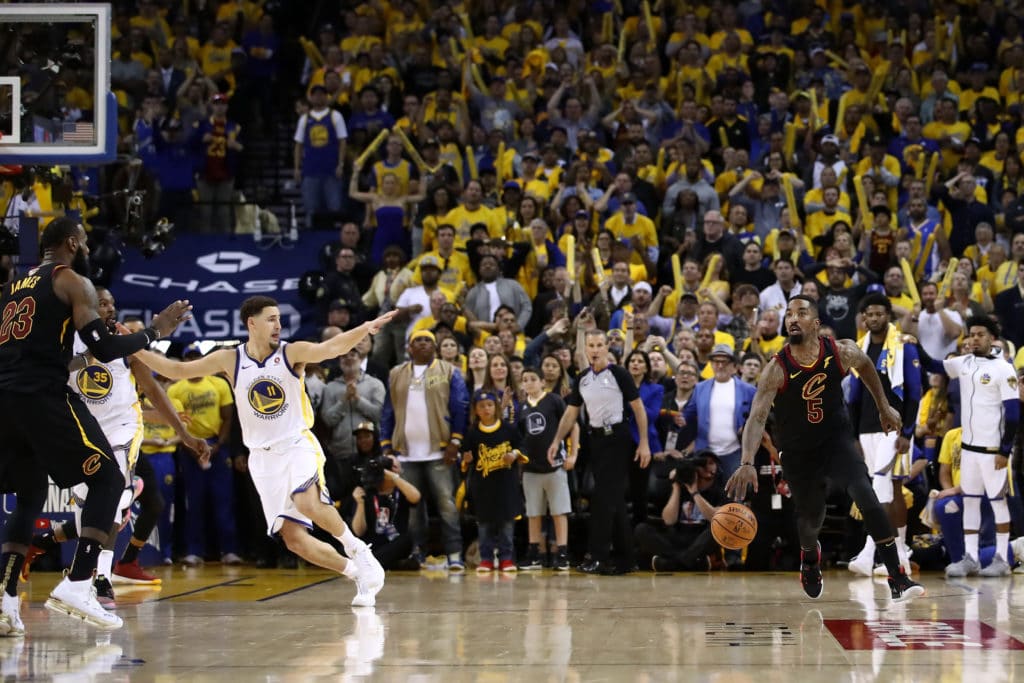
Every team that wins as much as the Warriors have won over the last four years inevitably attracts more than a few buzzkills who want to diminish their accomplishments by attributing them to lucky breaks, biased officiating and/or preferential treatment by the league. Think of the Patriots, the Yankees, Duke basketball. Sure enough, there were plenty of TV talking heads — you can probably guess the ones — who were quick to chalk up the Warriors’ Game 1 overtime win over Cleveland to luck.
To be clear, what follows is not meant to feed those jealousies or give ammunition to the conspiracy theorists. The Warriors find themselves three wins away from their third championship in four years due much more to their good performance than their good fortune.
However.
It is also fair to say that they have had a remarkably charmed run through this postseason. They haven’t gotten all the breaks — a look over at their bench, where the injured Andre Iguodala has been sitting for the last five games, is a reminder of that — but there have been quite a few critical developments that have fallen their way. The two latest examples of that came in the final, frenetic moments of Game 1 of their annual Finals appointment with the Cavs on Thursday night, with J.R. Smith’s scoreboard brain cramp and the extremely rare replay reversal of a block/charge call in the Warriors’ favor. But the Warriors have appeared to have an angel on their shoulders long before that.
Consider where they were when the playoffs began, having lost 10 of their final 17 regular-season games and with Steph Curry sidelined for the first round with a strained knee ligament. They were vulnerable, ripe to at least be pushed harder in the opening round than they wanted to be. But as luck would have it, they drew San Antonio, which was missing its own star, Kawhi Leonard, due to a mysterious, much-debated season-long quad injury. Without Leonard, the punchless Spurs were perhaps the Western Conference playoff team least equipped to take advantage of the Warriors’ weakened state, and they went quietly in five games.
After a five-game dispatching of the Pelicans, who were also missing a key player, injured big man DeMarcus Cousins, the Warriors found themselves on the brink of elimination in the conference finals, down 3-2 to Houston. But they came back to win the series in seven games, a job made easier by the absence of Rockets point guard Chris Paul, who missed Games 6 and 7 with a hamstring injury.
Losing Paul at such a critical point was bad luck for the Rockets, but the real disaster was missing an NBA playoff-record 27 straight 3-pointers in Game 7. Some of those misses can be attributed to the Warriors defense, but 27 bricks in a row? That’s the basketball gods encasing the Rockets’ shooting hands in a bucket of ice. The Warriors benefited from a Houston frigid streak that was beyond improbable. Philadelphia-based analytics writer Eric Sidewater calculated that the odds of a team with Houston’s 36.2 three-point shooting percentage missing that many treys in a row are one in 118,757.
Given all that, maybe it shouldn’t have been that surprising that the fates smiled on the Warriors in Game 1 in two ways that hardly ever occur separately, let alone in the same game. The odds of a player mistakenly thinking his team was ahead instead of tied on the final possession are unknown — although for the ever unpredictable J.R., they might not be as high as you think — and even the Warriors had a hard time wrapping their heads around what Smith had done.
There were lots of quizzical looks and gracious attempts to explain his mistake afterwards. Draymond Green and Kevin Durant both said they thought Smith was dribbling out to get the ball to LeBron James after Smith rebounded George Hill’s missed free throw. Curry kept a straight, respectful face in the postgame press conference even as media members were chuckling over Smith’s gaffe.
But as hard as it was to grasp how Smith could have made the error, it was even harder to reconcile his explanation. He said he was “trying to bring it out to get a shot off. I knew we were tied. I thought we were going to call timeout.” Uh, yeah, except that Cavs coach Ty Lue said, “he thought it was over. He thought we were up one.”
Smith might not have been in position to make that crucial mistake if not for the block/charge reversal moments earlier, when contact between a driving Durant and James, the defender, was initially called an offensive charge on Durant. That would have given the ball back to the Cavs with a 104-102 lead and 36.4 seconds left in regulation. The officiating crew changed it to a blocking foul on James after a replay review, a move that many longtime NBA observers (including this one) didn’t even know was even allowable. In the final two minutes, referees are allowed to check replay to determine whether the defender’s feet were outside the restricted area beneath the basket on a block/charge call, and they can also review the contact while doing so.
The question: was it really necessary to check whether James’ feet were outside the restricted area? It seemed clear, even without a second look, that they were. Lue’s anger at the reversal was understandable, but his comments that “it’s never been done, ever, in the history of the game,” weren’t accurate. The wisdom of the rule can be debated — does it really make sense to allow refs to change their minds on a foul call, which is a subjective judgement? — but its application on that play cannot.
It all fell in the Warriors’ favor once again, a common occurrence in this postseason and one for which they need not apologize. It’s no coincidence that they are not the team that gets the cold shooting hand at the worst possible time, they are not the team explaining how they made the devastating mental error in crunch time. Sometimes what looks like luck is really superior preparation and execution.
As Klay Thompson said after the Game 1 win: “There are no breaks at this point. If we would’ve won by 30 or won in overtime or at the end of regulation, it does not matter. You can look at it as catching a break, but at this point in the year breaks are more than welcome.”
— Reported from Oakland
(Top photo: Ezra Shaw/Getty Images)
If you enjoyed this article, start a free trial today to get full access to all the smart, in-depth coverage on The Athletic, then get 25% off the annual plan.