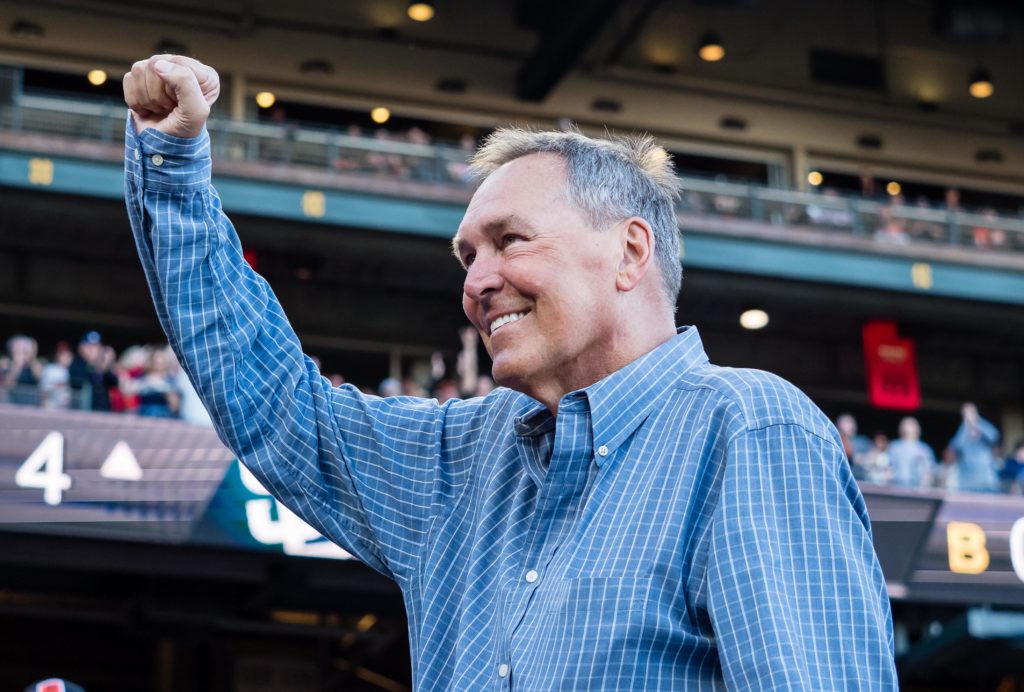
The mourning continues. Dwight Clark’s death on Monday brought on a sorrow for everyone who knew him, loved him or just loved watching him that remains fresh and will not soon subside. Memories of “The Catch” and all it meant to the 49ers, to the Bay Area, are still flooding back, and the countless stories of his kindness to fans are being told everywhere, in news articles, on social media, around the dinner table. We remain staggered by the cruelty of such a good man being taken far to soon.
If your eyes are still misty, that’s understandable. But as we sort through our memories of Clark and the glory days of the 49ers, let’s be clear-eyed enough to remember, too, that he had some very definite opinions about the correlation between football and amyotrophic lateral sclerosis (ALS), the disease that killed him, as well as about the NFL’s responsibility to play an active role in reducing the likelihood of its players suffering neurological problems.
“I’ve been asked if playing football caused this,” Clark wrote in March of last year when he publicly announced he was suffering from ALS. “I don’t know for sure. But I certainly suspect it did. And I encourage the NFLPA and the NFL to continue working together in their efforts to make the game of football safer, especially as it relates to head trauma.”
There are no definitive answers yet as to exactly what role football’s inevitable blows to the cranium play in triggering brain-related illnesses, but a 2012 study by the National Institute for Occupational Safety and Health found that pro football players are four times more likely than the general population to suffer from ALS or Alzheimer’s.
Strangely, an unusually high number of Bay Area players are on the tragic list of those who have fallen victim to ALS. Six of the 14 current or former NFL players known to have had the illness have ties to the 49ers or Raiders. In addition to Clark, three other former 49ers, linebacker Matt Hazeltine, running back Gary Lewis and quarterback Bob Waters, died from illness, all in the 1980s. Ex-Raider offensive lineman Mickey Marvin died of ALS in March of last year, and former Raider running back Steve Smith has been living with it, currently with the help of a ventilator and feeding tube, since July 2002. Within the Bay Area group there are other sad connections. Hazeltine, Lewis and Waters were all teammates on the 1964 Niners. Marvin’s death came just two weeks before Clark went public with his condition, and the two men died at the same age, 61.
The NFL has paid out more than $440 million in compensation to former players as part of its January 2017 settlement of a concussion lawsuit. Some of those funds went to Clark even though he did not choose to be a member of the original group of plaintiffs. Although he remembered having at least three concussions in his career, including one that briefly left him without vision, he said that he felt in choosing to play he had voluntarily accepted the risks. But when reports surfaced in recent years that the NFL had more information about the long-term dangers of concussions, Clark did hold the league responsible.
“I knew there would be some ramifications,” he said on an NBC Sports Bay Area podcast in February, referring to the physical toll on his body. “But I didn’t even think about it being brain trauma that would kill you. Apparently, somebody in the league had reports that was the case. That’s when I said, ‘Well, if they knew, they should’ve told us.’ That’s my only knock on the league. They should’ve started safety stuff way long ago.”
That slowness to act will forever be the NFL’s shame, and whether the league is doing enough to atone for it is open to debate. The NFL donated $40 million last year for research into head injuries, which seems less generous than it could have been in light of the roughly $17 billion in revenue the league reportedly took in last year, or that commissioner Roger Goodell’s average annual salary alone has been between $30 and $40 million over the last five years.
Consider also the way that the league’s concussion protocol still seems to have significant lapses — quarterbacks Tom Savage of Houston and Cam Newton of Carolina both had incidents last season in which they were allowed back on the field after serious blows to the head and seemingly cursory examinations — and it’s fair to question whether the NFL is truly committed to eliminating tragic stories like Clark’s.
The final weeks and months for Clark were filled with saying the proper goodbyes. He said farewell to Niner fans at Levi’s Stadium last season in a halftime ceremony that was filled with both tears and smiles, and old friends and teammates made the pilgrimage to his home in Montana to swap stories and laugh with him for the last time. Those were not the times nor the places to discuss the NFL’s monetary commitments and responsibilities to the health of its players.
But now that we have only his memory, it’s time to think about some of the hard truths that Clark alluded to after being diagnosed with ALS. We already know that no one will ever live a life quite like Dwight Clark’s. The NFL’s best tribute to him would be to do everything possible to help reach the day when we’ll never see a player’s life end like Dwight Clark’s, either.
(Top photo: Kelley L Cox/USA TODAY Sports)
If you enjoyed this article, start a free trial today to get full access to all the smart, in-depth coverage on The Athletic, then get 25% off the annual plan.