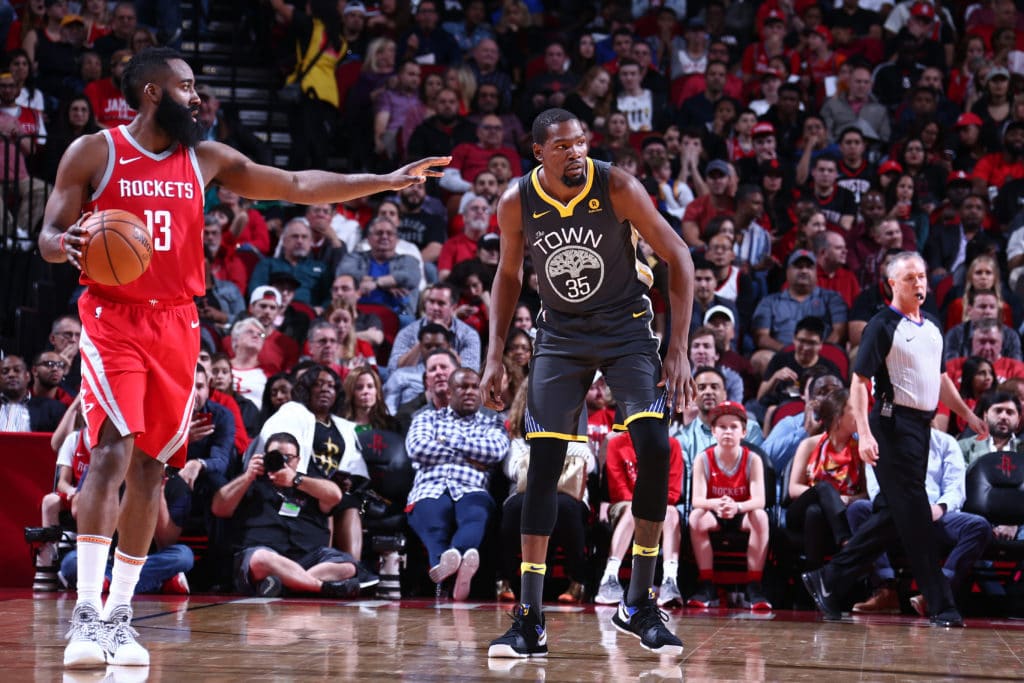
We are only a few days away from finding out whether the switch that everyone is waiting for the Warriors to flip really exists. As they enter the playoffs this weekend they are much more of a question mark than any 58-win defending NBA champion ought to be, with concerns about their health and their hunger having downgraded them from heavy favorites to one of a handful of serious contenders.
Finishing the season as the second seed in the West, looking up at the Houston Rockets, isn’t necessarily the end of the world. But a look at the past, especially the recent past, shows that it’s an ominous sign for their parade plans.
History suggests that what the Warriors are trying to do, win a championship as a No. 2 seed, isn’t impossible by any means, but it’s fairly unlikely. Since the NBA adopted its current playoff format in 1984, 22 of the 33 champions have been their conference’s top seed, including the last five in a row.
The last team to win the title without being a No. 1 seed was the LeBron James-led Miami Heat in 2011-12, and even that was an anomaly for a couple of reasons: It came after a 66-game, strike-shortened regular season, and the second-seeded Heat effectively became the top seed when the No. 1 team in the East, the Chicago Bulls, went out in the first round after Derrick Rose tore his ACL in their opening playoff game. The only other team in this decade to win the championship without being a No. 1 seed was the Dallas Mavericks, who beat Miami in 2010-11 as the third seed in the West.
Warriors fans can take heart in the knowledge that the top seeds haven’t always dominated this way. None of the three champs from 2005-07 — San Antonio (2), Miami (2) and the Spurs (3) again — were one-seeds. But that brief run was more the exception than the rule.
Teams that earn a No. 1 seed have been more than twice as likely as second seeds to reach the Finals since ‘84. Of the 66 finalists in that time, 37 have been top seeds, compared to 17 No. 2 seeds. (There have also been eight 3-seeds and four teams seeded below No. 3 who have made the Finals).
So, even though the prevailing wisdom in recent years is that being healthy and rested for the postseason is more important than going all out for the top seed, that approach hasn’t led to many championships. Cleveland tried it with only partial success last year, essentially conceding the No. 1 spot and home-court advantage to Boston by resting James, Kyrie Irving and Kevin Love at times late in the season — including one game in which all three were healthy scratches — and then beating the Celtics in five games in the Eastern finals. But the Cavs then lost to the top-seeded Warriors in the Finals.
The Warriors’ situation is somewhat different from last year’s Cavs because they didn’t just choose to take their foot off the gas in the Western Conference race. Injuries in the second half of the season to all four of their All-Stars (most notably the ankle and knee problems that sidelined Steph Curry for 31 regular season games) as well as to key reserves like Andre Iguodala kept them from being able to make a full-fledged run at the top spot.
The optimistic take on the Warriors is that because they’ve so rarely had a fully healthy rotation to work with, they are a team of one-seed quality masquerading as a two. As Draymond Green said about their switch-flipping potential after the 40-point blowout loss to Utah in the season finale, “If anyone’s capable of it, we are.”
That’s true, and given their track record of two titles in three years, the Warriors deserve the benefit of the doubt. If Steph Curry’s MCL sprain heals well enough for him to get back in the lineup reasonably soon, if Kevin Durant elevates his all-around game back to pre-All-Star break levels (remember when there was talk of him as a possible Defensive Player of the Year?), if Iguodala and Shaun Livingston can hold up physically throughout the postseason, the Warriors are obviously capable of overcoming any historical precedents.
But those are a lot of “ifs,” and their general malaise — the indifferent defense, the apparent emotional burnout — pre-dated the injury problems. The reality of the league has been that teams who, for whatever reason, fail to establish themselves as at least the best in their conference in the regular season rarely emerge as the best in the league during the playoffs.
That’s why the analogy of flipping a switch, in the way it implies some magical, instantaneous change, doesn’t really fit the difficulty of the Warriors’ task. They will have to sustain a level of focus and effort, not to mention health, for a longer period than they have been able to manage all season. They will have to win without Curry, at least at first, and then perhaps with a diminished Curry later on.
The possibility also looms that the Warriors, who have had home-court advantage in every series they’ve played for the last three seasons, would have to win two series without it, against Houston and Toronto, the top seed in the East, in order to win the championship. No matter what happens, the path to a title looks more difficult, with less margin for error, as a two-seed than any of their past three seasons as a No. 1. That means if they can pull it off, it might be the most impressive of their title runs, but history says, don’t bet on it.
(Top photo: Nathaniel Butler/NBAE via Getty Images)
If you enjoyed this article, start a free trial today to get full access to all the smart, in-depth coverage on The Athletic, then get 25% off the annual plan.