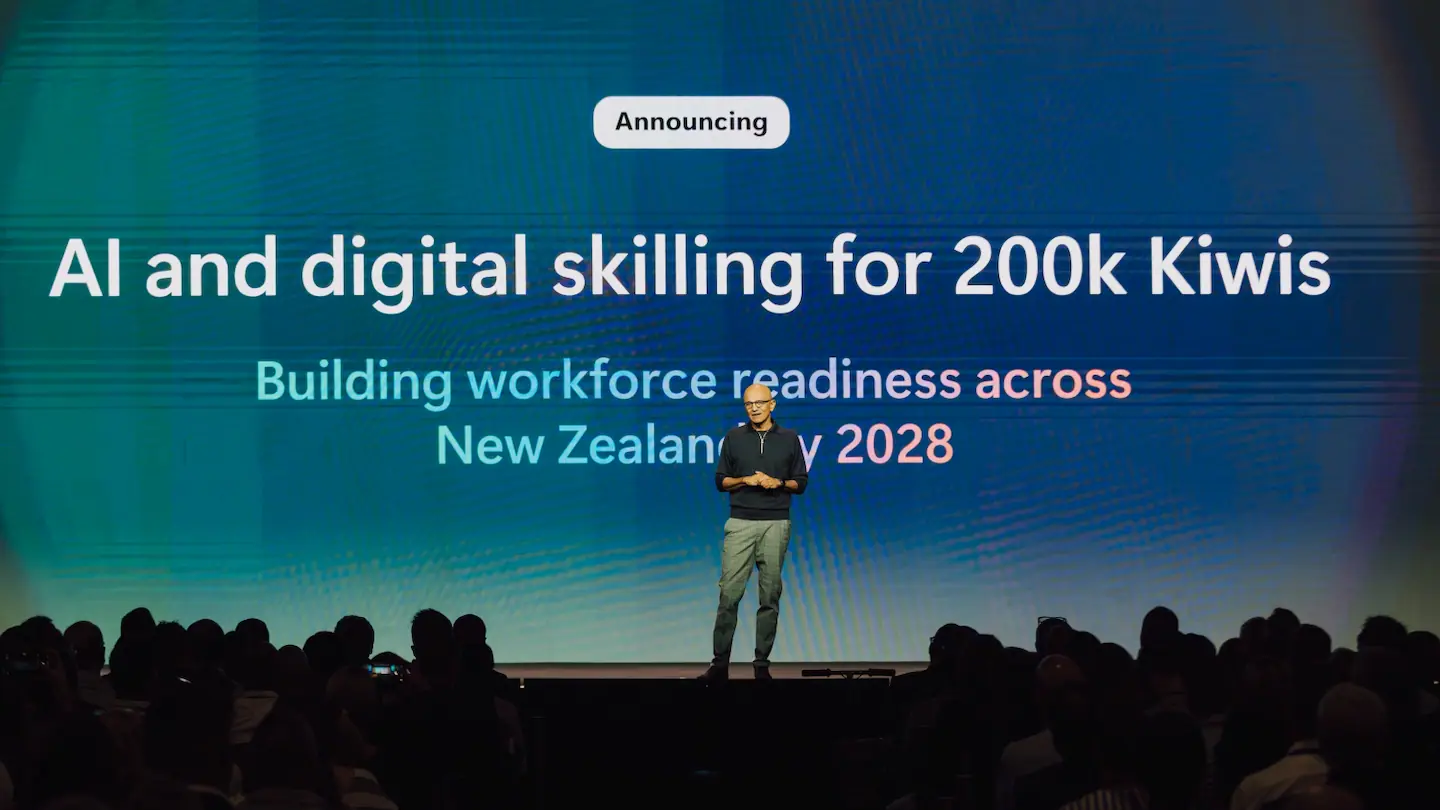
Microsoft chief executive Satya Nadella arrived in Auckland this week with a clear message: AI is a big part of the answer to New Zealand’s productivity problem, and Microsoft is the partner to deliver it.
The numbers rolled out at Microsoft's AI Tour stop in Auckland were grand in scale. A new EY‑Parthenon report estimates that Microsoft contributed $9.4 billion to NZ's economy in 2025, including $3.4b in productivity gains enabled by its technologies.
Earlier modelling from Accenture suggests that AI could unlock up to $102b in annual economic value by 2038.
Your eyes are probably glazing over with these estimates, last year's AWS fiasco over datacentres and dubious claims about economic impact still fresh in your mind.
But Microsoft didn’t stop there.
The case studies on display at Auckland’s gleaming new International Convention Centre on Tuesday were polished.
Westpac, Fonterra, Spark, Whakarongorau Aotearoa, Health NZ’s “BroPilot” and others are cutting costs, improving customer service, doing things faster and solving business problems with artificial intelligence, and increasingly the agentic AI that is now all the rage.
My sitdown with Satya
I had a 13.5-minute sit-down with Nadella, the only journalist interview on his whistlestop NZ visit before he heads to Australia. I wanted to explore that gap between Microsoft’s vision for AI and the reality inside most NZ organisations.
Why is our productivity limping along (just 0.3% growth in 2025) even though we have supposedly game-changing technologies available to us?
Nadella, dressed in a zip-up wool jumper and slacks, and fresh from his keynote address to a packed conference hall, was effusive, thoughtful, and on message.
He answered by reaching for a 1987 quote from Nobel Prize-winning economist Robert Solow: “You can see the computer age everywhere but in the productivity statistics”. He was pointing out a productivity paradox in the IT boom of the eighties.
It wasn’t until the early 2000s that the productivity boost from the personal computer revolution began to show up in statistics, Nadella pointed out.
“It took a little bit of time for the work, the workflows, and the work artifacts to change,” he said.
“You will, in time, start seeing the changes in productivity, and I think that it’s always been the case that the rate of diffusion of this tech and the way it shows up in productivity gains, there is a time lag, but there is no question that that happens.”
Microsoft’s pitch is that if businesses embrace its Copilot AI assistant and Copilot Cowork orchestration layer to coordinate AI agents across the organisation, productivity gains will start to flow.
Nadella concedes that diffusion is the bottleneck. He wants to move the conversation away from “worshipping of a couple of frontier labs” towards “a frontier ecosystem … where every country and every company feels like they have a stake in this system”.
That’s a more inclusive vision than the standard hyperscaler pitch.
But it also acknowledges that relying on a handful of showcase deployments and early‑adopter corporates won’t be enough to move a whole economy.
Avanade enters the fray
Jeyan Jeevaratnam is betting our mid-sized companies are poised to accelerate their adoption of AI. The CEO of Avanade for Australia and NZ this week soft-launched the NZ operation of the global IT services firm, a joint venture between Accenture and Microsoft that has operated since 2000.
Avanade will specialise here in Microsoft technologies, providing solutions architects to assist Accenture with projects in large organisations, and leading the charge itself into the mid-market, which is too small for Accenture to bother with.
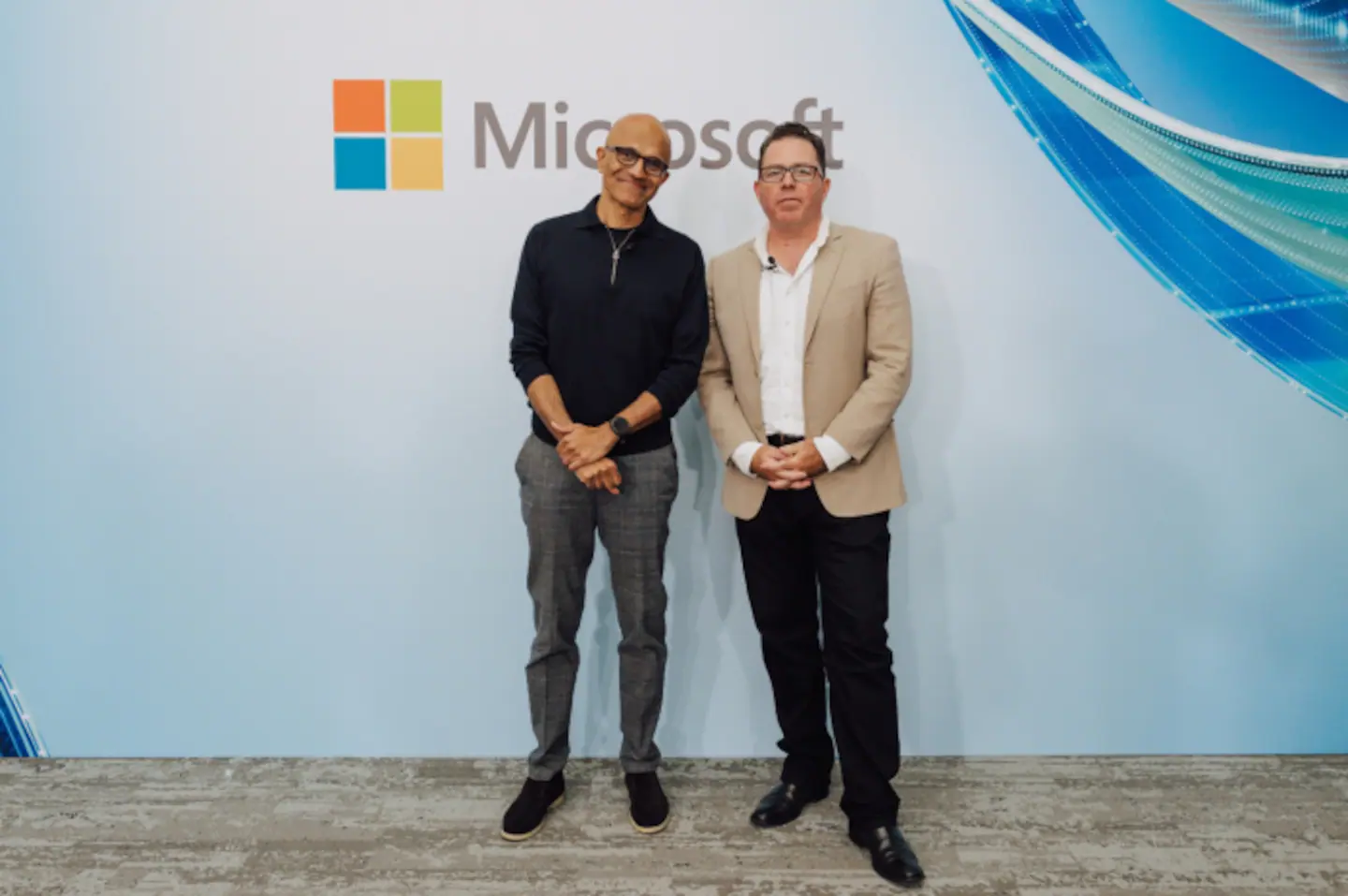
He aims to have Avanade up and running in July with 12-14 staff.
“True productivity is really when you’re trying to solve a problem and drive business outcomes,” Jeevaratnam told me.
“How do you take a bank, which may be 20% automated with their processes using robotic process automation, to 70% automation in three months and not three years? That’s where the agentic AI piece comes in,” he said.
Until recently, Jeevaratnam argues, many Kiwi firms weren’t in a position to deploy AI in meaningful ways because their data were unreliable or incomplete. But he feels they’ve turned a corner on that front, setting them up to enjoy the gains Microsoft’s spotlight case studies demonstrate.
“We’re here for the long term,” he told me. “We’re not here just to do a consulting gig for six months and walk away.”
AI skills push expanded
Microsoft seems to be positioning itself, in the absence of a national AI training strategy, as the country’s skilling partner of last resort. Nadella highlighted that the company has trained around 75,000 people here in AI skills and aims to reach 300,000 by 2028.
Here too, though, there’s a question of pace and relevance. For someone whose role is being automated away in a soft economy, the offer of micro‑credentials and Copilot training will sound more like a long‑term adjustment plan than a lifeline.
Nadella prefers to frame AI as a “task enhancer” rather than a job killer – a way to strip out the drudgery from 10‑step tasks so that your “individual contribution to the organisation has gone up”.
He points to software development as an early example in which, despite some displacement, “there are more software developers required” because there are more projects and a greater demand for higher‑level skills.
That assumes employers are willing to invest in people, not just software licences.
Which brings us back to Microsoft’s position in the NZ market. No other tech vendor is as deeply embedded here – from Office and Teams to Azure, Dynamics and now Copilot.
Redmond controls a huge chunk of the digital plumbing in large organisations and the public sector.
Microsoft’s new cloud computing region helps cement that dominance.
Nadella is right, the “tech intensity” he urged us to pursue on his last visit here six years ago, prior to the covid pandemic, still matters.
NZ does have genuine strengths to build on. We even have 441,000 registered users on Microsoft GitHub, the company’s software development platform.
“Both your cricket team and your Github community punch way above [their] weight,” Nadella told me.
But until the benefits of AI are felt beyond a narrow set of early adopters, Microsoft’s big productivity story will remain just that – a story.
The test for the next few years is whether the company most woven into our digital fabric can help close the gap between AI’s potential and NZ’s stubbornly flat productivity curve.
The tension is that Microsoft’s showcase customers are racing ahead while much of the economy is still kicking the tyres.