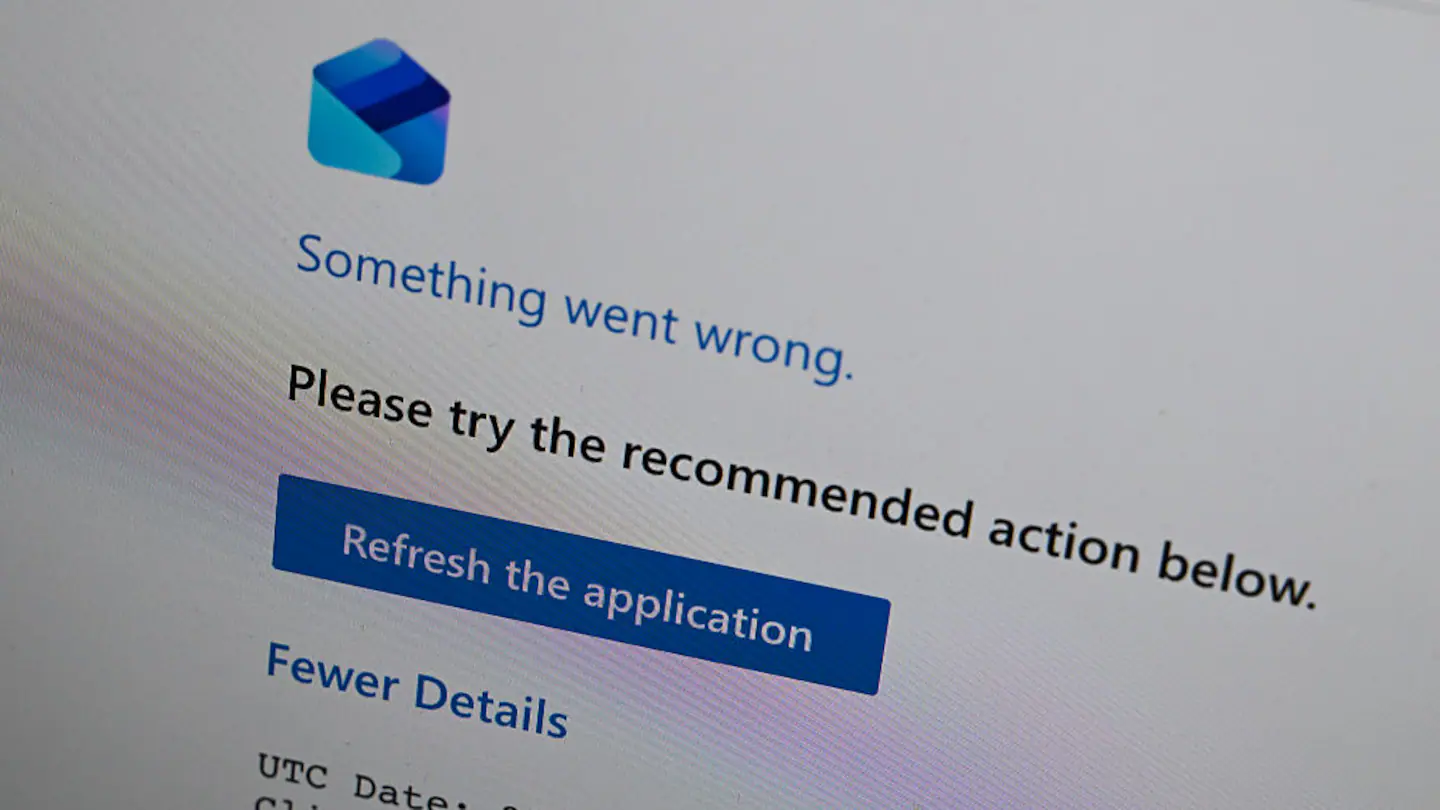
Last Friday, the country’s offices went dark as my friends and I, who operate outside the Microsoft ecosystem in Google Workspace, kept on merrily messaging and emailing each other.
For most of 24 hours, Outlook, Teams and Copilot were unreachable in 74 countries. At some point, as many as 430 million users were affected.
One US think tank put lost productivity around US$7 billion (NZ$12.7b) in the United States alone.
It reminded me of an interview I did with Microsoft national security experts Lewis Mills and Blake Herzinger, who appeared on The Business of Tech a couple of weeks back.
For much of the conversation, I felt we were talking past each other.
Lewis and Blake argued that hyperscale, multinational platforms like Microsoft’s Azure cloud give New Zealand digital resilience we can’t achieve on our own.
Cross-border fail
Sure, but I was arguing that our over-reliance on Microsoft is also seen as an increasing threat to our digital resilience, particularly as the Trump administration shows a willingness to use technology as a geopolitical weapon.
“We really emphasise the benefits of hyperscale … because it does give you that failover across borders and that type of national resilience that it’s difficult to generate with solely domestic infrastructure,” Herzinger, Microsoft Asia’s defence and national security government affairs lead, told me.
A couple of weeks later, Microsoft delivered an uncomfortable reminder of the flaw in that argument, given how much we’ve handed the plumbing of modern business to a handful of American tech giants.
Email, documents, identity, security, meetings and now AI all run through the same pipes.
After 21 hours of Microsoft 365 being down, businesses were facing tangible revenue and productivity losses, Craig Young, CEO of the Technology Users’ Association, said.
“However, standard cloud service agreements generally provide for service credits rather than compensation for lost business or staff time,” he pointed out ominously.
“Microsoft’s Service Level Agreement provides for different credit levels depending on the affected service and its measured availability.
“Credits are not automatic, and businesses need to establish their eligibility and submit a claim through the appropriate channel.”
We’ve been here before
Microsoft isn’t incompetent.
Even the best get it wrong. When they do, what cybersecurity experts call the “blast radius” is increasingly global because of the nature of cloud services.
In July 2024, a botched CrowdStrike update blue-screened millions of Windows machines.
Airlines, banks, hospitals and supermarkets ground to a halt.
That also happened locally on a Friday, just as many people were heading to the supermarket to pick up groceries on the way home from work.
They found blue-screened checkout terminals.
Friday’s mass outage wasn’t caused by hackers or rogue AI agents.
Microsoft says it was a fault “introduced during an earlier network capacity upgrade that surfaced following a recent network change”.
Someone changed something, and it broke everything.
The other problem: old stuff
The very next day, the US grounded every departing flight for more than four hours, the longest nationwide ground stop since 9/11.
Nearly 10,000 flights were cancelled. Flights bound for NZ were also delayed.
The US Transportation Secretary didn’t mince his words.
“We use 1980s little copper lines. It’s an old system that went down and went down everywhere. It got overloaded,” he said.
A contractor swapped copper cables for fibre.
In the space of two days, we saw both sides of the same coin.
Hyper-concentrated modern cloud on one side.
Neglected, decades-old critical infrastructure on the other.
Both failed and took millions of people down with them.
It’s not an American problem.
Plenty of our own critical systems, in health, local government, energy and transport, run on software and hardware that should have been retired years ago.
We just haven’t had our ground-stop moment yet.
Now add AI to the mix
Neither of those mega outages was a cyber attack. Next time we may not be so lucky.
Frontier AI models are getting frighteningly good at finding holes in software and websites.
The same capability that helps defenders patch faster lets attackers hunt for weaknesses at a scale and speed no human team can match.
Legacy systems riddled with unpatched flaws are sitting ducks.
Concentrated cloud platforms are the juiciest targets of all, because breaking one breaks thousands of customers at once.
Put those three trends together, concentration, old infrastructure and AI-supercharged attackers, and we can expect bigger, more frequent outages.
What’s the answer?
“If you want to spend, you know, 2% of GDP, you could build a completely domestic AI technology stack, but very few governments are going to be able to achieve that,” Herzinger rightly pointed out to me.
Stop hoping, start planning
The answer isn’t to ditch Microsoft or AWS or Google.
But the recent outages have reminded us to stop treating outages as freak events.
They’re a cost of doing business now.
What matters is how quickly you can get your systems back up after a digital disaster.
In the scramble to shift off legacy on-premises systems to the cloud, we’ve put too much faith in public cloud providers and done too little to hedge our bets.
We need to budget for a backup plan, and that gives us an opportunity to think more deeply about what digital resilience actually means to us.
It should mean diversity. Don’t run everything through one vendor.
If your email, files, chat and identity all sit with the same provider, you have a single point of failure, no matter how convenient it may be to manage.
Have a fallback for communications.
A second channel your staff and customers know about before the crisis, not one you scramble to set up during it.
Know which of your systems are old and critical. Then fund their replacement before they collapse on a Friday afternoon.
Budget for diversity
Test your plan.
A business continuity document gathering dust in SharePoint is useless when SharePoint is down.
Ask your suppliers hard questions.
Where’s my data?
What happens when your provider goes dark?
How long until I’m back?
Yes, diversity costs more. Running two of anything is less efficient than running one.
But ask anyone who spent last Friday unable to send an invoice, or Saturday morning sleeping on an airport floor, what efficiency was worth.
For the Government, there’s a bigger conversation to have about digital sovereignty, local capability and how much of our critical infrastructure we’re comfortable running on someone else’s servers, offshore, on someone else’s terms.