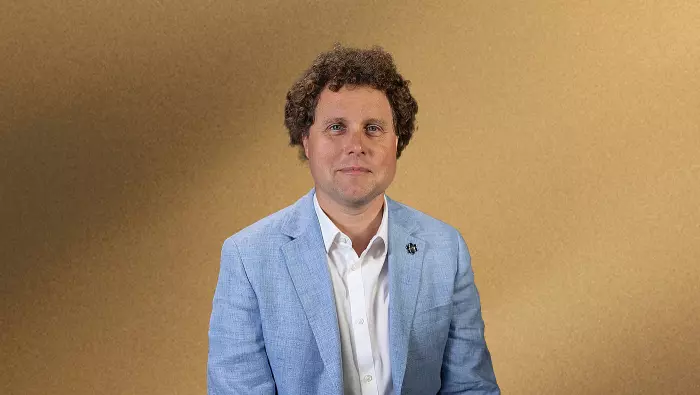
The BusinessDesk CEO Index, driven by Range Rover, has returned for its second year. Our newsroom and a panel of independent judges have hand-picked 24 New Zealand chief executives and business leaders making a real impact in their sectors and beyond. This profile features one of 2026’s finalists.
Peter Beck was never supposed to run a multibillion‑dollar space company from the bottom of the world.
A self‑taught engineer without a university degree or Nasa pedigree, he turned a childhood obsession with rockets into Rocket Lab, building a Nasdaq-listed business that has made New Zealand the world’s third‑largest launcher of payloads to orbit and which is now racing to become a fully integrated, end‑to‑end space company.
The traits that underpin that journey are as distinctive as Rocket Lab’s black‑carbon Electron rocket, a blend of paranoia and precision, audacity and discipline, and an almost punishing work ethic that sets the tone for everyone around him.
The paranoid perfectionist
Beck, a finalist in this year’s BusinessDesk CEO Index in the listed company category, was too busy to answer BusinessDesk’s questions for this profile, which is understandable.
He’s in the process of acquiring satellite operator Iridium in a deal valued at around US$8 billion (NZ$13.6b), the largest any NZ-founded company has ever undertaken.
Rocket Lab is preparing to build a new launch complex, this time in Alaska, to support a US$266 million deal with the US Space Force to fly up to 18 missile-defence missions.
Then there’s the ongoing work on Neutron, the reusable medium-lift rocket that is integral to Rocket Lab’s future plans to take on SpaceX with greater payload capacity and which may take flight later this year.
He’s got a bit on his plate.
Beck is probably NZ’s hardest-working CEO, and by many measures its most successful. He cheerfully describes himself as a “chronic workaholic” and “micromanager”, and goes further, calling paranoia one of his superpowers.
He’s the founder who lies awake at night running failure scenarios in his head.
That mindset drives an insistence on checking everything three or four times, because even a seemingly trivial decision can have catastrophic consequences on the launchpad.
Despite Rocket Lab’s industry-leading success rate, he hates launch day.
“All of these missions, you know, they're not for fun, they're really important stuff, and there's a lot riding on everyone,” he told me in November 2024 when I sat down with him for a series of interviews for the book The Launch of Rocket Lab, which charted the first 20 years of the company.
It was clear from those interviews, and from talking to Beck’s engineers, executives and financial backers, that Beck is a hands-on CEO. He doesn’t back the concept of the purely strategic CEO.
If there’s a grimy, difficult job to be done on the factory floor, like diving into a rubbish skip to retrieve a lost part, he’ll do it. His view is that you roll up your sleeves and be in there with everyone else.
That was true in the early days, but seems to remain largely true as the business has scaled to numerous countries, more than 2,000 employees and billions of dollars in contracts in its launch and satellite pipeline.
Many present and past employees describe Rocket Lab as an “intense” place to work.
It attracts people like Levi Fawcett, an engineer who worked on the Electron rocket’s guidance, navigation and control systems in the run-up to Electron’s maiden launch in 2017 before leaving the company in 2021 to found auto parts startup Partly.
“The thing that he is more intense on is when it comes to applying pressure on external parties or supply chain,” Fawcett says of Beck.
“He is unbelievably good at selling and removing blockers just across the board. He will go and create a bilateral treaty between the US and New Zealand just to unblock something.”
Lean, fast and fearless
Rocket Lab isn’t for everyone.
In 2021, BusinessDesk reported on former employees who described a “toxic culture of fear” at the company, which experienced HR growing pains as Electron launches ramped up.
As Beck himself admitted on a Blackbird Ventures podcast back in 2020, “I’m a walking HR disaster”.
Key engineers and mission control managers, many of whom have long tenures at Rocket Lab, recounted to me how they often had to work gruelling schedules.
Rocket launches don’t conform to office hours, and the company’s key pitch is that it can get payloads into space quickly, requiring staff to pull out all the stops.
That seems to have forged a unique type of resilience in those who hang around and share the camaraderie, the exhaustion and the thrill of having a front‑row seat to the transformation of space from a government‑dominated domain to a commercial infrastructure layer.
It’s not the norm for NZ companies but is common in frontier firms, OpenAI in artificial intelligence, or Tesla in electric vehicles, for instance.
The payoff for those who can go the distance is the opportunity to work on cutting-edge rocket and space technologies and share in the company’s financial success – Rocket Lab minted around 100 millionaires when it went public, and likely many more since, as the share price has risen.
When it comes down to it, Rocket Lab was built on constraint, and Beck turned that limitation into a philosophy.
The 3D-printed engines that power Electron are named after our famed physicist Sir Ernest Rutherford, who once uttered something about NZ along the lines of: “We’ve got no money, so we’ve got to think”.
Beck picked that line up and ran with it.
“We romantically fall in love at our firm with the loners with big visions, trying to do the audacious with a small amount of money,” says Vinod Khosla, the co-founder of Sun Microsystems and Silicon Valley venture capitalist whose firm Khosla Ventures gave Beck the capital injection that allowed Electron to get off the ground.
He describes Beck as “meticulous” when it comes to Rocket Lab’s engineering, but with the requisite boldness of vision and ability to overturn decades of space industry orthodoxy.
In Beck’s telling, being capital‑constrained forces engineers and executives to find smarter, more competitive solutions because “physics doesn’t care how much money you’ve got at the end of the day”.
'Absolutely unlimited vision'
In Beck’s view, to thrive – perhaps even to survive – in the new space age, companies will have to be fully integrated one‑stop shops rather than niche suppliers.
“What's made Sir Peter so successful is that he's totally focused,” says Auckland Mayor Wayne Brown, who has got to know Beck as part of Auckland Council’s efforts to bolster the city’s innovation ecosystem, which Rocket Lab is a key pillar of.
“If something is not helping the rocket go faster, then he doesn't do it. I totally admire what he's done,” adds Brown.
“The other thing is that he's had huge vision. Absolutely unlimited vision.”
Khosla admits that when he wrote Beck a cheque, he couldn’t assess the probability of Rocket Lab’s success.
“But it’s worth taking a bet on him and on this large vision,” he reasoned at the time.
Neutron is the next major test of Beck’s ability to execute on his vision. The team is not just scaling up Electron; it is rethinking the architecture in pursuit of a more efficient integrated launch platform.
Christian Davenport, a Washington Post reporter who covers the space beat, told me that the importance of Neutron’s success “can’t be overstated”.
He admits he’s not entirely sure what the “secret sauce” is that has allowed Rocket Lab to succeed where so many other space startups have failed.
“I think a lot of it has to do with Peter Beck and his leadership and the way that he's been able to be scrappy, to move fast, to see where the market is, but also where it's going, and to adapt to that.”
More information and articles on BusinessDesk’s CEO Index can be found here.