
TechNZ's new Tech & Innovation Manifesto 2026 reads less like a lobbying document and more like the national tech strategy ministers ponder but never deliver.
It starts with a familiar and grim diagnosis – lagging productivity, a projected labour shortfall of at least 250,000 people by 2045, and a growing infrastructure deficit, all while our best tech firms and talent drift offshore in search of capital.
It’s a situation that requires a coherent response, a compelling vision and strategy backed by concrete actions and priorities for investment. But the policy approaches from the various parties that held the upper hand in Parliament this century have been scattered, uncoordinated and weak.
The last Labour Government’s digital strategy was nebulous, its key initiatives a series of industry transformation plans that have since been defunded. The current coalition Government has enacted a major shake-up of the science system and favoured high-tech areas like space, quantum and high-temperature superconductors.
But rather than a collection of pet projects and shifting research funding from one leaky bucket to another, we need long-term goals and priorities that align Government spending with industrial development and education.
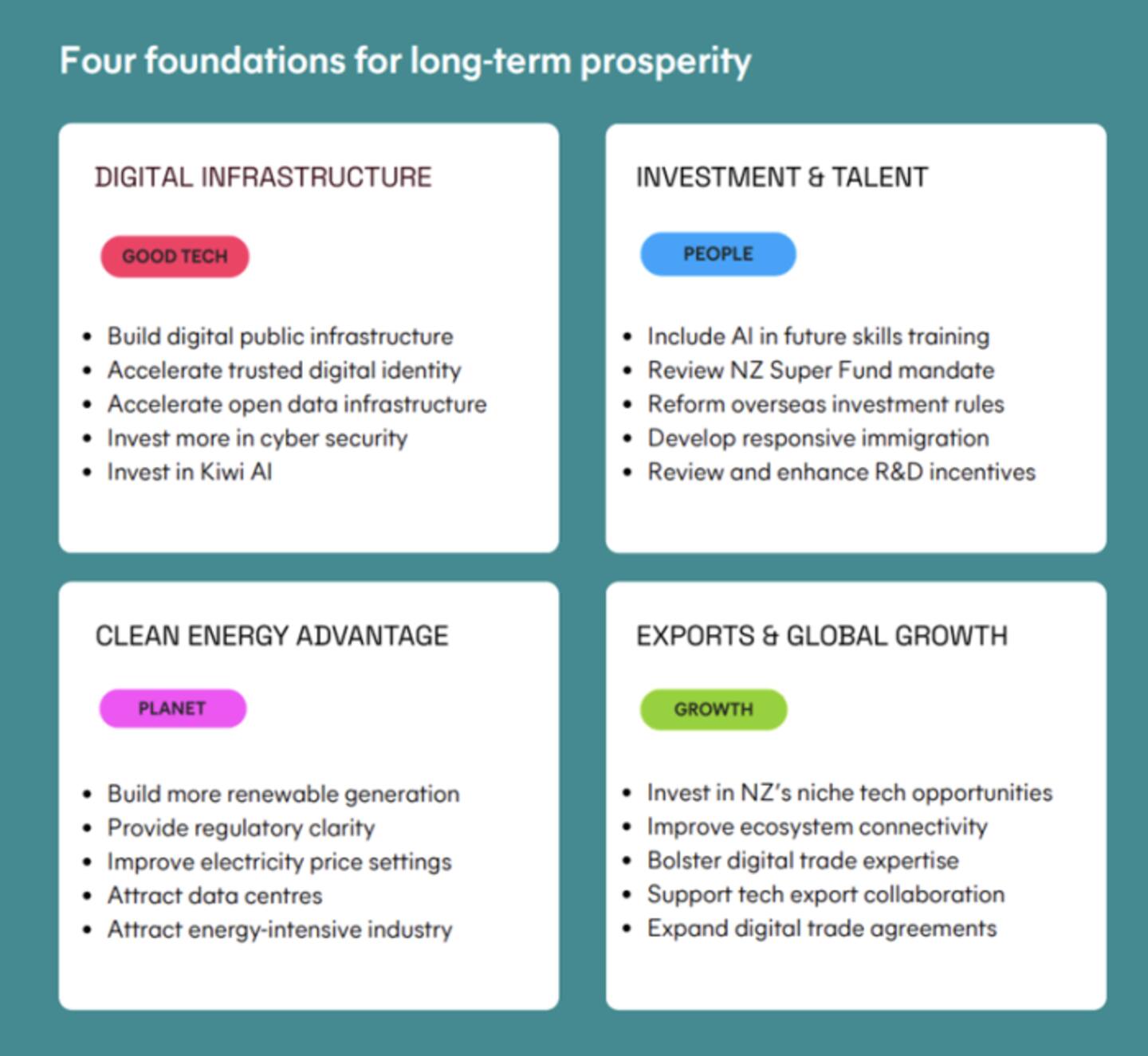
TechNZ has suggested some solid “foundations” – world‑class digital infrastructure, abundant clean energy, a reliable investment and talent ecosystem, and strong global connections for exports.
AI upskilling for all
The standout section is on AI. TechNZ points out that two‑thirds of New Zealand businesses are already using AI and almost all report significant efficiency gains, with minimal job losses so far.
The opportunity, it argues, is to harness AI to build a more innovative and inclusive country. But that only works if we invest in upskilling at scale.
It floats an ambitious but wholly necessary goal: “make every adult in NZ eligible to take free, globally benchmarked courses to gain practical AI skills for work”.
That sits alongside calls to invest in homegrown AI capabilities, local small language models, green energy to power AI infrastructure, and a legal framework for “agentic commerce” – AI agents buying and selling on our behalf.
By contrast, the Government has been inching forward: an AI strategy, some Budget money for training subsidies, a handful of responsible AI adoption schemes and low-key partnerships to boost AI literacy.
Useful, yes – but nowhere near the universal system‑level upskilling effort TechNZ is proposing.
Look offshore, and you see how ambitious other small nations have become.
Singapore's updated National AI Strategy 2.0 explicitly puts AI skills at the centre, with plans to triple its AI talent pool to 15,000 and train 100,000 workers to be "AI-bilingual" by 2029, invest billions in AI infrastructure, and significantly expand adult education so workers can reskill for AI‑augmented roles.
Denmark, meanwhile, has launched an AI Skills Pact aiming to strengthen AI skills for one million Danes by 2028, framed as a national project in responsible, human‑centred digital transformation.
Our efforts remain fragmented and modest in comparison – pockets of training funding, some tertiary AI courses, scattered industry‑led workshops and masterclasses.
If we’re serious about improving productivity, we need a universal, lifelong AI learning entitlement, tied to global benchmarks and accessible to everyone in work, not just early‑career graduates.
Tech policy as economic policy
The manifesto’s strength lies in treating tech policy as economic policy, not a side project. The tech sector, it points out, already contributes around $24 billion to GDP (8% of the economy), $11.4b in exports and supports more than 119,000 jobs, with exports growing five times faster than the broader economy.
It then links that to specific policy levers such as globally competitive R&D tax incentives, a revised NZ Super Fund mandate to back late‑stage local tech firms, targeted deep‑tech grant programmes modelled on Australia’s CUREator, and a national strategy for quantum technologies “as fundamental to our economy as AI”.
It calls for cross‑party agreements on the role of technology in fixing our demographic and productivity challenges, and for regulatory consistency that stops the “chop and change” every election cycle.
The international exemplars it cites – Singapore, Denmark, Switzerland – are all places that settled on a long‑term tech and innovation path and then stuck with it through multiple governments.
Why Wellington probably won’t bite
All of this gels with the advice of experts I've interviewed in recent months, such as innovation expert Mehran Gul, who joined me on The Business of Tech podcast to urge the Government to do more to keep our fast-growing tech companies NZ-owned.
“It's pretty standard now in a job interview at any level to not just be asked, like, do you know about AI?” LinkedIn executive Aneesh Raman told me last month.
“We're rapidly advancing to where you need a pretty basic but increasingly sophisticated understanding of the tools.”
But whether much of this will be picked up in the next term is an open question.
Shane Reti and Judith Collins, two of the more engaged senior figures in science, digital government and tech‑related portfolios, are retiring at the election, taking with them institutional memory and relationships with the sector.
That is a setback, given that tech has rarely had a permanent seat at the Cabinet table and that portfolios often go to ministers with limited background in digital policy. The manifesto calls for a “bipartisan national vision” on tech.
The more likely outcome is another reshuffle, another round of re‑briefing, particularly if the country opts for a Labour-led Government.
There is also a deeper cultural gap. TechNZ is arguing for a coherent technology‑driven growth agenda, akin to what other small advanced nations have pursued. Our political cycle still rewards incrementalism and short‑term fixes.
The manifesto’s call to treat clean energy as a strategic magnet for data centres and AI clusters, or to build national niche strengths in agritech and quantum, demands a level of coordination we’ve rarely seen outside primary sector policies or trade negotiations.
That doesn’t make the manifesto any less important. When we find ourselves still debating the basics of AI skills, digital identity and data infrastructure in a few years while peers race ahead, we won’t be able to claim we didn’t know what was required.