
Reading the Government’s new Science Investment Plan for the next decade, I kept getting a nagging sense of déjà vu. Then it hit me – it felt like reading SpaceX’s IPO prospectus.
That document was breathtaking in its audacity – a US$28 trillion (NZ$48.1t) total addressable market, CEO compensation tied to colonising Mars, and 38 pages of risk factors that read like a thriller novel.
The Science Investment Plan didn't have nearly as many images of space and high-tech gadgets, and the brokerage fees alone that the big banks charged for the SpaceX listing amount to our entire annual science budget.
But the plan, released last week by Science, Innovation and Technology Minister Penny Simmonds, is New Zealand’s version of that bet.
‘Rapidly developed and scaled offshore’
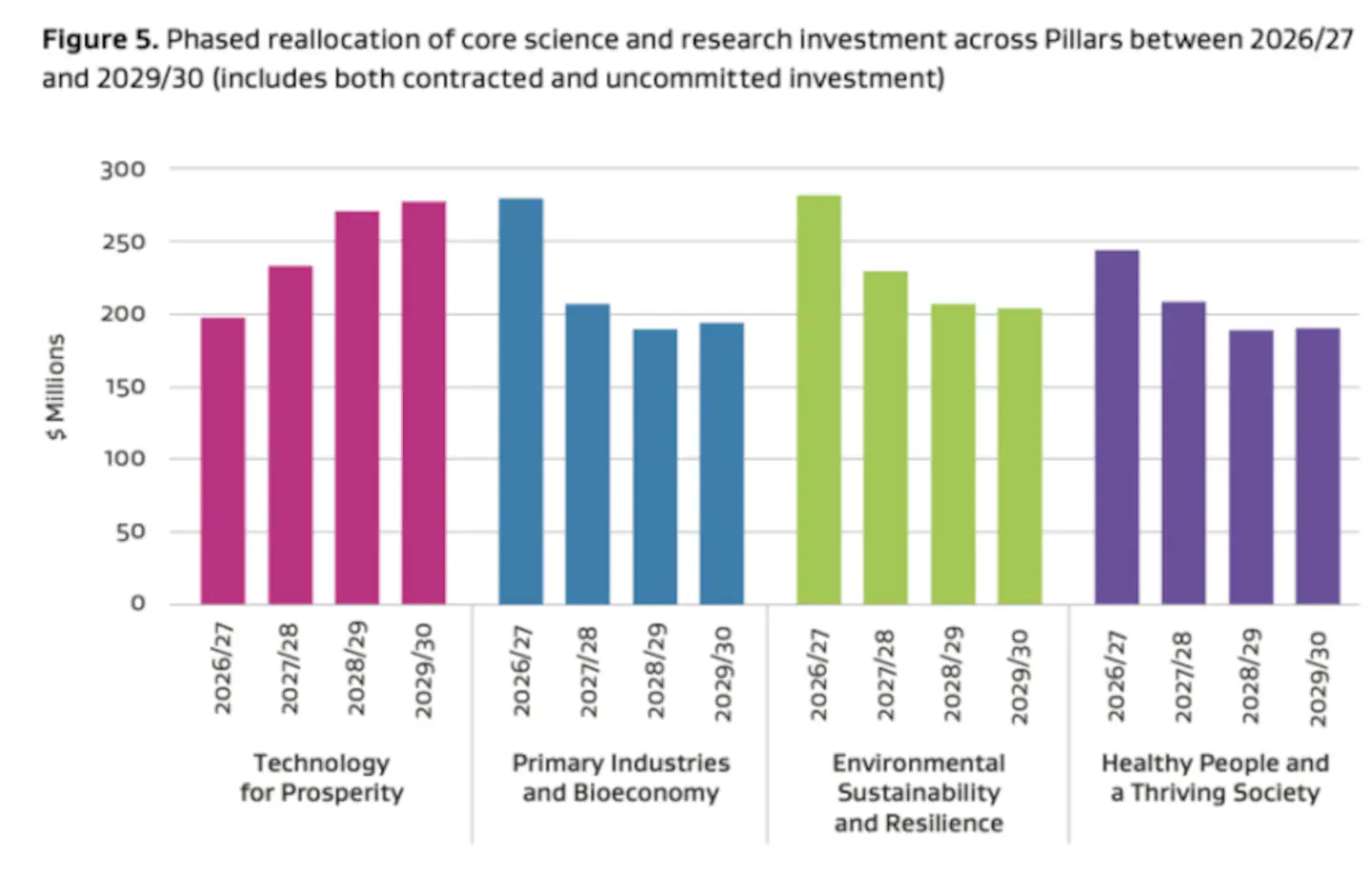
By 2029, a new “Technology for Prosperity” pillar – covering AI, quantum computing, synthetic biology, advanced materials, and space applications – will consume 32% of total science investment, up from 15% today.
That’s $278 million a year directed at technologies the plan’s own authors admit are “being rapidly developed and scaled offshore”. Not here. Offshore.
Say what you will about folding seven public science institutions into three, or about ditching the Marsden Fund and bundling the funding into the new body, Research Funding NZ, the heart of this plan unashamedly involves a pivot towards advanced technologies.
The big difference with SpaceX's moonshot is that Musk now has US$75 billion in fresh IPO capital, a US$2t company, and the most sophisticated aerospace operation on the planet behind him.
He can afford a moonshot. Can we?
Here is the critical catch virtually everyone in the science sector has pointed out. There is no new money. All changes are “funded through reallocation within existing baselines”.
This isn’t a science investment. It is a scientific redistribution from the things we’re actually good at to the things we hope to become good at.
Many scientists argued against this, but were told the status quo wasn’t working. Now, people in the sectors that are currently thriving are realising the implications of the funding reallocation.
Food HQ CEO Dr Victoria Hatton left Fieldays last week, buoyed by the news that food and fibre exports are projected to reach a record $64.3b this year. But she left the lush fields of Mystery Creek with "a harder question than I arrived with".
While the primary sector’s contribution to the economy was being celebrated, “we quietly cut $56 million … from the primary industries and bioeconomy research that invents the tools we were busy celebrating”.
"We are paying to help farmers adopt the science while defunding the science that comes next," she wrote on LinkedIn.
At Fieldays, Prime Minister Christopher Luxon announced a $143m productivity package for the agricultural sector to boost output from our farms and orchards.
"We want them to be producing more," he said.
But as Hatton pointed out, without serious and sustained investment in primary sector science, we risk simply becoming more productive at producing raw materials, for which we are ultimately price takers in a competitive global market.
“The functional ingredient. The verified provenance. The novel protein. The product designed from the customer backwards instead of the paddock forwards,” Hatton writes.
Those are the things that will move us beyond simply selling more milk powder, logs, and kiwifruit.
Starving the golden goose
Let’s be clear about what we’re defunding. New Zealand’s agricultural science is world-class. Our biosecurity systems, pasture genetics, and precision farming research are internationally recognised and commercially valuable.
Our climate, seismic, and environmental science punches well above its weight.
These aren’t legacy industries in graceful decline – they are living, export-generating, knowledge-intensive sectors. The cash will go towards efforts in AI, quantum, superconducting technologies, and maybe synthetic biology, if the biotech reforms can be resurrected.
The Government’s logic isn’t wrong. Advanced technologies underpin the next wave of productivity growth, and NZ genuinely needs to participate in it.
The Institute for Advanced Technology, which at this point looks more like a funding agency than a research institute, has made sensible early moves – backing superconducting magnet research at the Robinson Research Institute, investing in AI platforms, and launching a quantum technologies discovery phase.
There are valuable niches here in photonics, advanced sensing, and applied AI for agriculture and health.
NZ’s small scale and regulatory flexibility could genuinely attract global tech partnerships if we play it cleverly.
But here’s the problem. NZ’s total R&D investment sits at 1.55% of GDP, still well below the OECD average of 2.7%. We haven’t been able to convert our existing research strengths into commercial returns.
Now, before fixing that fundamental weakness and underinvestment, we’re pivoting to fields where we have minimal infrastructure, shallow talent pipelines, and competition from countries that spend 10 or 100 times more.
TOP’s alternative
With the general election less than six months away, only The Opportunity Party has floated any sort of policy around science funding, pledging to increase it to 2% of GDP "by boosting tax credits and properly funding core scientific research".
It would fund the increase by introducing a land value tax.
We’ll hear a lot about growing exports and raising wages during the election campaign, but sadly, little about the crucial role of world-class science and innovation in achieving them.
SpaceX can absorb years of losses because it can keep going to the market for capital. Millions will pay a premium to buy into Elon Musk’s vision of data centres in space and a colony on Mars.
It has a vertically integrated supply chain and a relentless execution machine to outlast the uncertainty.
NZ does not have that luxury. When we burn through the goodwill of our agricultural and environmental science communities, those researchers and their institutional knowledge don’t come back easily.
You can’t rebuild a 40-year biosecurity research programme in the time it takes to spin up a quantum computing platform.
You don’t fund a moonshot by cannibalising your launch pad.