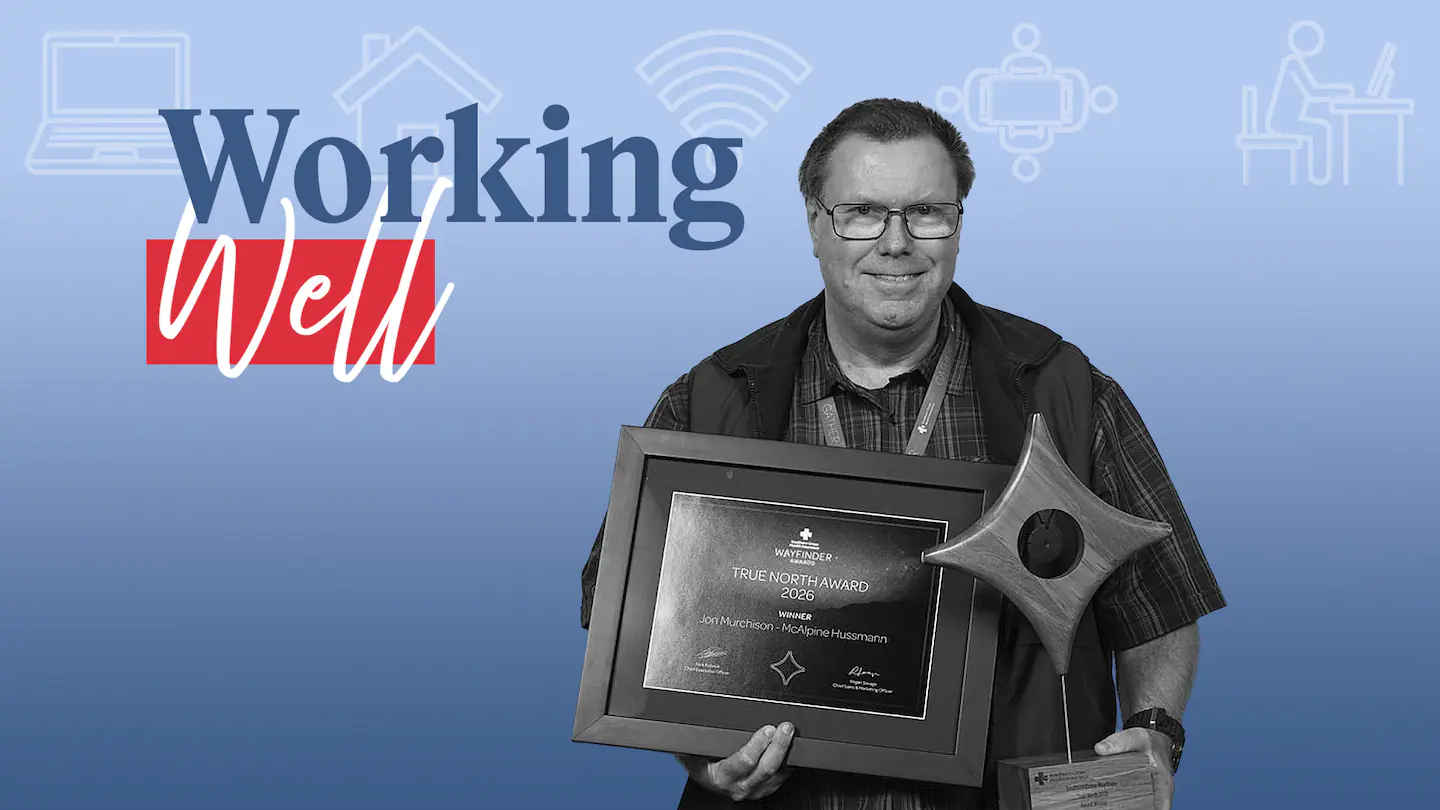
Jon Murchison at the Wayfinder Awards ceremony. Composite photo / Jacques Steenkamp, Supplied
Working Well is an ongoing series from BusinessDesk in partnership with Southern Cross Health Insurance, exploring the issues that shape employee health and wellbeing – and the practical solutions for happier, healthier workplaces.
At McAlpine Hussmann, one sign that its safety overhaul was working was a jump in how often things went wrong.
Or, more precisely, a jump in how many things workers were prepared to say had gone wrong.
The commercial refrigeration and air-conditioning company, which has a presence in cities around the country, had a handle on serious incidents involving its installers and technicians.
What it wasn’t hearing about were the close calls, the jobs where nobody got hurt, but a small change in circumstances could have sent someone to hospital.
Jon Murchison wanted to know about those, too.
Murchison, the company’s environment, health and safety manager for Australia and New Zealand, won the True North award earlier this month at the Southern Cross Health Insurance Wayfinder Awards.
The judges’ convenor, Regan Savage, said Murchison, who has spent most of his career focused on employee wellbeing and health and safety, with stints at Woolworths and NZ Post alongside nearly 15 years spent at McAlpine Hussmann, had “made turning up to work every day not just safer, but also into a community experience”.
The work behind it started with a serious question: what could kill someone doing this job?
For McAlpine Hussmann’s 250-strong workforce of technicians, the answers were obvious enough once you looked at where they worked.
They climb onto roofs and work off ladders. They deal with electricity, pressurised systems and refrigerants.
Some jobs involve heat or sparks and carry a fire risk.
Newer buildings can make equipment easier to reach, but a technician heading into an older site can face a daunting job.
Changing what people talk about
Knowing the risks was one thing. Getting experienced technicians to rethink the way they’d done a job for years was another.
Issuing gloves is easy.
Persuading someone who’s never cut their hand on the job that they need to wear them is harder.
McAlpine Hussmann stripped back its monthly toolbox talks.
Instead of trying to cover 20 or 30 topics, it kept coming back to the risks that could do the most harm and what workers could do about them.
It also asked its regions to nominate safety champions, people on the ground who could hear concerns from colleagues who might not want to take them to the boss.
“That’s where the company started hearing things it hadn’t heard before,” Murchison says.
The reporting numbers lend some weight to that.
Near-miss reports went from about 45 before the push began in 2021, to 220 in 2022, then 280 in 2023 and 292 in 2024.
The most recent full-year tally reached 435. The company was also getting 60 to 80 hazard reports a month, Murchison says.
A report from the job site
The technology facilitating the close call and hazard reporting was the Safety Hub, an online portal workers can use on site.
They can report an incident or a hazard, look up safety information or watch a video toolbox talk without waiting for the next meeting.
“If they want to report an incident, they can do that really simply and easily through the Safety Hub. Same with hazards, they can also access reference information,” Murchison says.
The app made it easier to speak up. But what made it worth speaking up was seeing what happened next.
Reports fed into conversations with customers about hazards on their sites, changes to how jobs were done, and decisions about training.
A close call in one branch could give another crew a heads-up before it faced the same problem.
McAlpine Hussmann’s managers also had to learn to read the numbers differently.
A spike in reports wasn’t necessarily a sign that work had become more dangerous.
It could mean people were finally telling the company about incidents that had always happened.
Murchison says more serious incidents have declined, though they haven’t disappeared.
The near-miss tally measures what workers report, not how often they nearly get hurt.
Beyond the incident form
Manual handling of parts and equipment remains the company’s biggest safety issue, Murchison says.
The work is physical, and experience doesn’t make anyone immune to the temptation to shift something heavy because it’ll only take a minute.
The company calls its approach “stop, think, act”: pause long enough to consider what could go wrong and what would make the job safer.
Managers also go out with crews to see how the work is done.
That gives them a chance to coach workers, recognise good practice, and see whether a procedure that makes sense on paper holds up on site.
The Safety Hub also carries wellbeing information.
The principle is the same: if someone feels comfortable raising a concern, whether it’s about a hazard or their wellbeing, the company has a better chance of acting early.
That’s the cultural shift that Murchison has overseen.
A technician doesn’t have to wait for an injury to make a problem worth mentioning, and the company doesn’t have to wait for an injury to find out it has one.
As McAlpine Hussmann addresses the causes of close calls and works to reduce hazards, the report numbers are expected to peak and start to decline.
“Creating that comfort to report … is just crucial,” Murchison says.
“Otherwise, you’re kind of blind, really.”
This is an editorial produced by our journalists. Southern Cross Health Insurance is a sponsor of the Working Well series but does not necessarily endorse these articles. It is not its opinion. Read more as the series progresses here.