
New Zealand does not have an AI enthusiasm problem. It has a capability problem.
That came through clearly in roundtable discussions I hosted in Auckland last week with chief information officers of mid-sized businesses and managed service providers looking after the IT needs of SMEs.
Plenty of interest exists in what artificial intelligence can do.
But between experimenting with chatbots for staff and customer use, and trusting AI with business operations, sits a gap that many firms lack the skills to bridge.
Much of it starts with data governance. What information does the business hold? Who can access it? Is it accurate? Which records should never leave the organisation? Deploying ready-built AI agents to automate tasks on a platform like Zendesk or Salesforce is a way to move into more impactful uses of AI.
But the sense I got talking to people on the coalface of deploying AI is that a host of issues challenge the typical SME, particularly those businesses that don’t have a dedicated IT department.
Then there’s the tokenomics of AI, making sure that you are getting a decent return on your investment and not blowing out your budget on a badly configured group of AI agents.
The nervousness I heard was practical, not philosophical. These businesses aren’t lacking imagination or an innovative spirit.
They are raising questions sensible businesses should ask before handing powerful software the keys.
Advice is not enough
The missing ingredient is confidence, built on skills and sound implementation.
A business struggling with basic data governance can’t simply bolt on AI governance. It needs help understanding how existing controls should extend to probabilistic systems that generate answers, draw conclusions and potentially take action.
That means deciding who checks outputs, approves actions and carries responsibility when something goes wrong.
We need to invest more as a nation in helping businesses build capability if we want to reap the productivity and GDP gains that supposedly will come with widespread uptake of AI.
The Government’s AI Advisory Pilot is a useful start. Eligible businesses can receive up to $15,000 in co-funding, split between developing a roadmap ($2500) and implementing it ($12,500).
The Government covers half the eligible cost, so the business has to spend $15,000 to get the full funding allocation, a meaningful chunk of money for a small business.
Crucially, implementation support can cover integration, testing, staff training and organisational change.
But it remains a pilot, funded to date at around $2.5 million. An expansion announced in September added another 120 places and extended it until June 30, 2027.
For participating companies, assistance could be substantial. For the economy plagued with lagging productivity growth, it is a very limited intervention.
Australia’s broader approach
Across the Tasman, the approach is more expansive.
Australia committed A$17m (NZ$20.9m) over four years to its AI Adopt programme, funding specialist centres that provide eligible businesses with free advice, training and practical support.
Depending on the centre, that includes consultations, demonstrations, adoption roadmaps, mentoring and guidance on responsible use.
The programme targets particular sectors prioritised for the National Reconstruction Fund, including agriculture, clean energy, and the medical sector, so it is not open to every Australian business.
Nor does it pay every AI implementation bill.
But it creates more entry points. A business can learn, test its assumptions and build capability before making a substantial financial commitment.
Australia also has its wider Digital Solutions programme, backed by A$25m over five years. It offers free group learning and subsidised individual advice on adopting digital tools.
Australia has given more heft to its efforts with the National AI Centre, which is tasked with driving AI adoption.
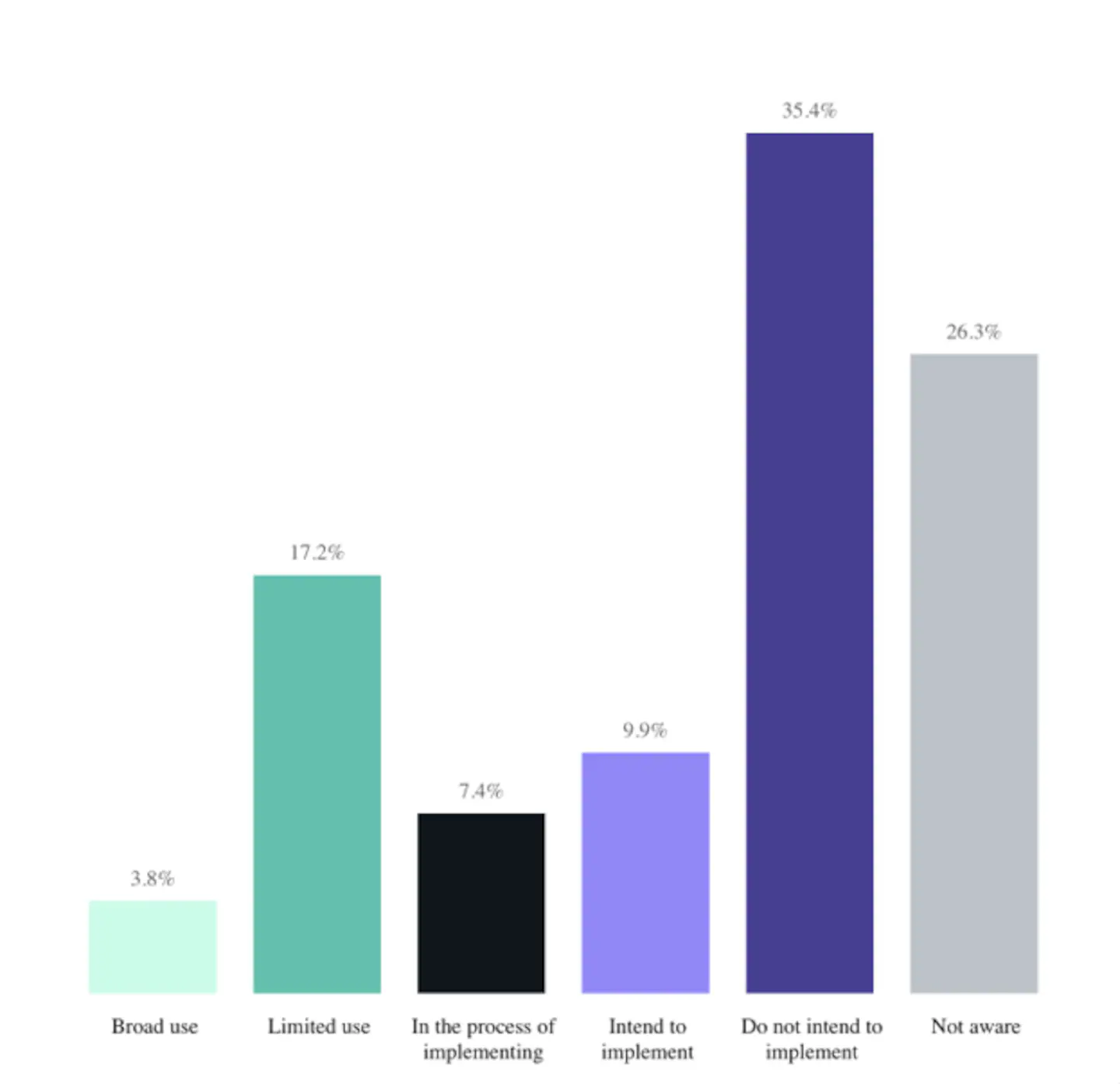
It runs a useful AI Adoption Tracker to track how small and mid-sized businesses are progressing with AI uptake. The latest snapshot suggests Australian businesses are still on the fence about investing in AI.
Surveys reveal similar ambivalence here. Overall, Australia’s national AI plan lists more than A$460m in existing AI and related initiatives.
In a few years’ time, we will learn whether the investments have paid off.
Promises need substance
The looming general election hasn’t set the stage for a debate on our national approach to AI in the way I’d hoped, but there has certainly been an uptick in AI-related policy announcements as we hurtle toward election day.
Labour proposes a $2m annual AI small-business fund, $3m a year for AI advisory funding, and an additional $4m a year for the Founder and Startup Support Programme.
Opportunity (TOP) has outlined a proposed tax credit for businesses covering up to 25% of technology-deployment costs, including AI, digital platforms, machinery and autonomous equipment.
This has a hefty annual price tag of $600m, part of a $1.3 billion package aimed at boosting research and development spending and growing the innovation economy.
That proposal is not one of TOP’s bottom-line policies. The National Party’s AI support for small businesses is a key pillar of its AI strategy.
National and its previous coalition partner ACT also tout the Investment Boost scheme, which allows businesses to claim an immediate 20% upfront tax deduction on qualifying assets.
That’s more likely to appeal to businesses employing AI in robotics and manufacturing systems, though software is treated as a capital asset.
A sustained programme of support
Neither a funding headline nor a tax incentive answers the questions raised around those Auckland tables.
Who helps a business clean up its data? Who explains the security implications of connecting an agent to customer records? Who trains staff to supervise it?
The existing pilot provides part of an answer. Consultants and AI experts can step in to help businesses with the rest. But the next government needs to turn limited support into a sustained programme.
Start with free introductory advice and practical training via the Regional Business Partner Network, which apparently co-funded 256 AI-related courses supporting 649 businesses last year.
A good start, but it’s time to increase that by 1000%. Then offer more co-funded implementation for businesses with credible projects.
Make data governance, cybersecurity and staff capability central themes to AI capability training.
Providing straightforward templates and independent guidance, rather than leaving every firm to reinvent the process, would speed adoption.
The CIOs and service providers I met were not asking the Government to choose everyone’s software.
They were describing a capability gap, and the sooner we close it, the sooner we’ll reap the benefits of having more AI-centric businesses.
Closing it would be a better election promise than telling companies, once again, to get cracking and embrace the future.