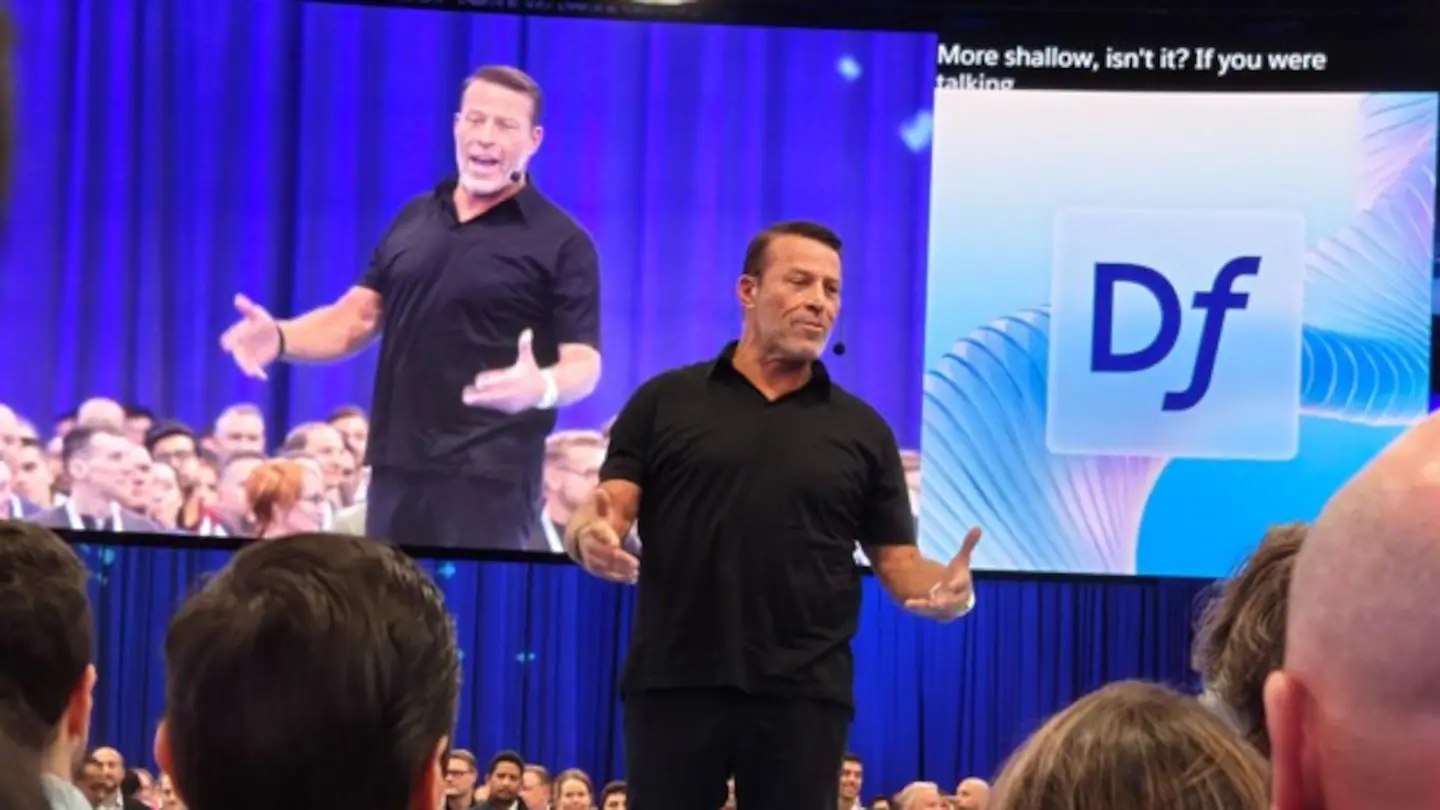
Tony Robbins reckons the perfect fix for burned-out executives is a good leap around the room, then an army of artificial intelligence agents.
Personally, I’d reverse the order. I’d steadfastly avoided the Californian self-help guru’s books and seminars for years, but a free ticket to one of his events during a tech conference in San Francisco saw me filing into the Moscone convention centre with 5000 other people to find out what the hype was all about.
Robbins has been in the self-improvement game, mentoring a roster of America’s top businesspeople, athletes and politicians, for more than 40 years.
He says his career has been spent trying to work out what makes people do what they do.
Here’s what a room of tired software salespeople and a few hungover journos got.
Your body is the remote control
Robbins opened by hauling everyone to their feet. His claim is that every emotional pattern begins in the body, so you shift your mood by shifting how you move.
“No movement is also known as death,” Robbins growled at us. Cheery stuff.
Then came the energy duel. Everyone paired up and tried to out-leap a stranger “like a little kid, not like a boring adult”, Robbins demanded.
Before long, thousands of tech geeks in chinos and check shirts, their lanyards flapping around, were jumping at each other.
It was all a bit cringeworthy, but Robbins is well-practised at getting an audience engaged and hearts pumping.
Energy is the whole game
Energy, he says, is the single most important factor in progress, in life and in business, and it has sagged since the covid years.
Exhausted, overwhelmed leaders think badly, relate badly and work badly. Low energy also drags your thoughts into negativity. His fix is not to think harder about it, but to move.
Anxiety comes from thinking about something over and over with no action, says the 66-year-old, who these days spends much of his time between lucrative corporate gigs relaxing at his Fiji resort, Namale.
Food gets a sideways swipe too.
Digestion burns more energy than almost anything. Keep the meals small, and cut the carbs, alcohol and junk food. Easier said than done, Tony.
Scale like it’s 1961
Robbins says 80% of achievement is psychological and 20% is strategy.
He offered a scaling formula built on JFK’s moonshot pledge that culminated in the successful Apollo 11 mission in 1969.
Set a seemingly impossible goal, make it a “must” rather than a “should”, and keep a tight timeline.
A 10-year goal lets you wake up tomorrow and do nothing. Asking what you must do this year is what sparks innovation.
He used it in 2014 to push his own food charity to deliver 100 million meals in a single year.
Now he’s scaling up with the 100 Billion Meals Challenge, attempting to feed the world’s hungry.
He’s given himself a 10-year deadline, but sets brutal annual goals to make sure he gets there.
The AI supercharge
Robbins is firmly in the AI (artificial intelligence) camp, and that’s where he pivoted to the inevitable sales pitch, spruiking his own agentic AI platform.
That’s when I zoned out.
But Robbins has a shrewd business mind and a knack for riding the latest trend.
He predicts more change in the next 36 months than in the past century – because of AI.
His advice is to run lots of small AI agents to handle your work and life admin, not one giant one.
If a big one breaks, you won’t know where.
His own agent studied his podcasts and read millions of comments before their first meeting, then asked to be installed in a robot.
He handed over his credit card details to the AI agent to handle the shopping, and it ended up buying Robbins a robot dog.
He then “terminated” it. No mention of a refund for the dog.
What to steal
At the two-hour mark, I was exhausted and stressed about missing my next meeting, but Robbins was pumped and in full flight.
The key takeaways: stand up between meetings and move around. Set a deadline that scares you.
Automate away your most boring tasks. And if a stranger challenges you to a leaping contest, flail your arms like a kid.
Steamy science
I usually skip the sauna at my gym because it’s always crowded with soggy bodies. It turns out there’s a good reason.
A new study from Finland, a land littered with saunas, adds to the evidence suggesting a 30-minute sauna session can do you a lot of good.
It can trigger a brief immune response that causes white blood cells to surge into your bloodstream.
They help identify infections and fight other potential threats.
There’s just one catch – you have to take a quick cold shower halfway through your sauna session, which could be a deal-breaker for some.
Recovering from a head knock
Wallace Sititi is just one in a long line of All Blacks who have had to deal with the after-effects of serious head knocks.
Exercise regimes have long been part of the treatment plan for elite athletes suffering from concussion.
Habit Health, which has physiotherapy and rehabilitation clinics around the country, has been testing the efficacy of its efforts to extend concussion rehab to everyday patients.
They may have suffered a fall or a head knock, like my friend Karen, who stood up in the kitchen and cracked her head on an open cupboard door.
Habit Health gives its concussion patients a cardiovascular exercise plan which is based on the heart rate at which concussion symptoms start to increase.
It’s usually a treadmill or exercise bike routine, but a graded walk along a flat route or local hills works too.
After working with 1100 patients, Habit Health’s discharge symptom scores fell from 16/64 historically to 13/64.
For Māori patients, they fell nine points, from 22/64 to 13/64, removing the previous gap between Māori and non-Māori outcomes.
Habit picked up a gong last week in the 2026 New Zealand Primary Healthcare Awards for its innovative programme.
When performance pay backfires
Performance pay is supposed to motivate your staff, not give them a reason to take to the picket line.
But that’s what happened at retailer Farmers, where most of Workers First Union’s 1200 members rejected an offer averaging about a 2.5% pay increase.
The basic pay increase was rejected, but the union says members also find the retailer’s performance-rating processes “unfair, subjective and upsetting”.
It complained that even outstanding performers were being offered increases below the rising cost of living.
Farmers is virtually the only major retailer still offering a performance-based pay scheme.
It has become a bitter source of resentment.