
We used to watch Middle Eastern conflicts play out like distant dramas.
Sure, there was the oil crisis of the 70s and the carless days many Kiwis remember well.
But it was the first Gulf War, beamed into our living rooms, thanks in part to the late, great New Zealand war correspondent Peter Arnett, broadcasting for CNN from the roof of the Al-Rashid Hotel in January 1991, that brought home how dependent our far-flung nation is on that part of the world.
A live variable
Today, news of every oil tanker diverted, every spike in Brent crude, is a reminder that our economy still runs on a fuel system that can be weaponised overnight.
Energy security is no longer an abstract concept that futurists like Dr Matt Boyd, whom I had on the Business of Tech podcast for a fascinating chat a couple of years back, discuss in depth at academic conferences.
It's a live variable in a volatile world. In that context, the NZ Cleantech Impact Report 2026, published last week, makes for both encouraging and concerning reading.
The report profiles 158 local companies offering sustainability‑related technologies and digs into commercial and impact data from 52 of them.
It finds a sector brimming with serious innovation. Our startups are working on technologies aimed at cutting industrial emissions, cleaning up hazardous waste, decarbonising transport and making our energy systems more efficient and resilient.
Look at the diversity of problems the report’s companies are attacking. Liquium is re‑engineering the catalysts at the heart of ammonia production – the world’s third most produced chemical and a huge energy user.
Their novel catalyst delivers more than double the ammonia synthesis rate of current commercial catalysts in early tests, promising lower energy demand and emissions from a process that underpins global fertiliser and, increasingly, future fuel markets.
In a world where gas pipelines and shipping routes are vulnerable, squeezing more useful output from every unit of energy boosts national security.
EV Maritime is electrifying ferries, replacing diesel‑burning commuter boats with high‑performance, zero‑emission vessels.
Two electric ferries in Auckland alone are expected to remove more than 20 million litres of diesel from harbour transport over 15 years, while cutting around 2,000 tonnes of CO₂ per vessel each year.
Neocrete, which I featured on the Business of Tech last year, is going after concrete – a material responsible for a big chunk of global industrial emissions – with an additive that allows far higher cement replacement in mixes, cutting carbon by more than 30% in a Brunei deployment while reducing costs and boosting durability.
Their tech is now being trialled across Asia, Europe, the Middle East and North America.
For NZ, scaling similar solutions at home is a way to decarbonise infrastructure without relying on offshore offsets or fragile fuel markets.
As impactful as forestry
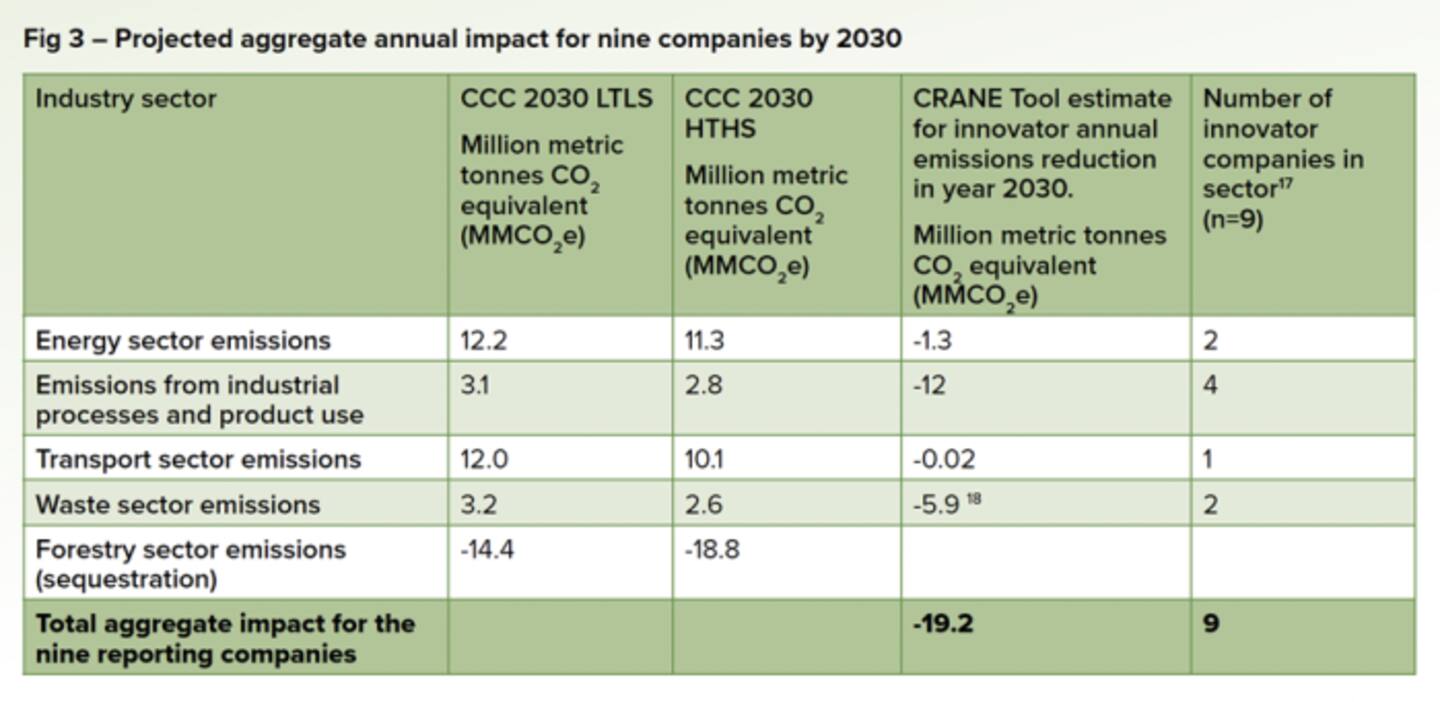
A subset of nine companies featured in the report claim they could collectively cut “global greenhouse gas emissions by 19.2 million tonnes a year by 2030, roughly the same as the carbon absorbed by New Zealand’s forests”.
That may sound far-fetched, but many of the carbon-reducing technologies are viable and proven. The inertia of industry and a lack of capital to scale up their deployment are holding them back.
As Dr Dave Rankin, Green Futures Group Leader at Lincoln Agritech, told the Science Media Centre last week, “an increasing attitude of climate denial or ‘kicking the can down the road’ with respect to emissions reductions”, here and abroad, is holding cleantech innovation back.
“This directly affects the cleantech industry since, without using carbon pricing to put a financial cost on carbon emissions, adoption of these new technologies is slower, more fragmented and often reliant on secondary benefits (like increased profitability due to lower energy use) rather than on well-priced emissions reduction alone,” he added.
As the Climate Change Commission signalled last week, the Emissions Trading Scheme, on its current path, "will struggle to provide an investment signal for emissions reductions by the mid-2030s".
The cleantech report authors identify a dual opportunity that a government of any hue should be particularly interested in. These ventures can deliver “enhanced energy security, supply chain resilience in the face of disruptions (eg, during a gas supply crunch)”, alongside emissions reductions and commercial returns.
There is no faster route to energy independence than reducing the amount of fossil energy we need in the first place.
While cleantech was the top‑performing sector for capital raising in 2025 compared with other NZ tech sectors, companies still raised only 21% of the capital they had aimed for in 2024.
Eleven firms that had planned to raise in 2025 ended up deferring their rounds by a year or more. That is not what urgency looks like. That is the sound of our founders riding the brakes while the world accelerates.
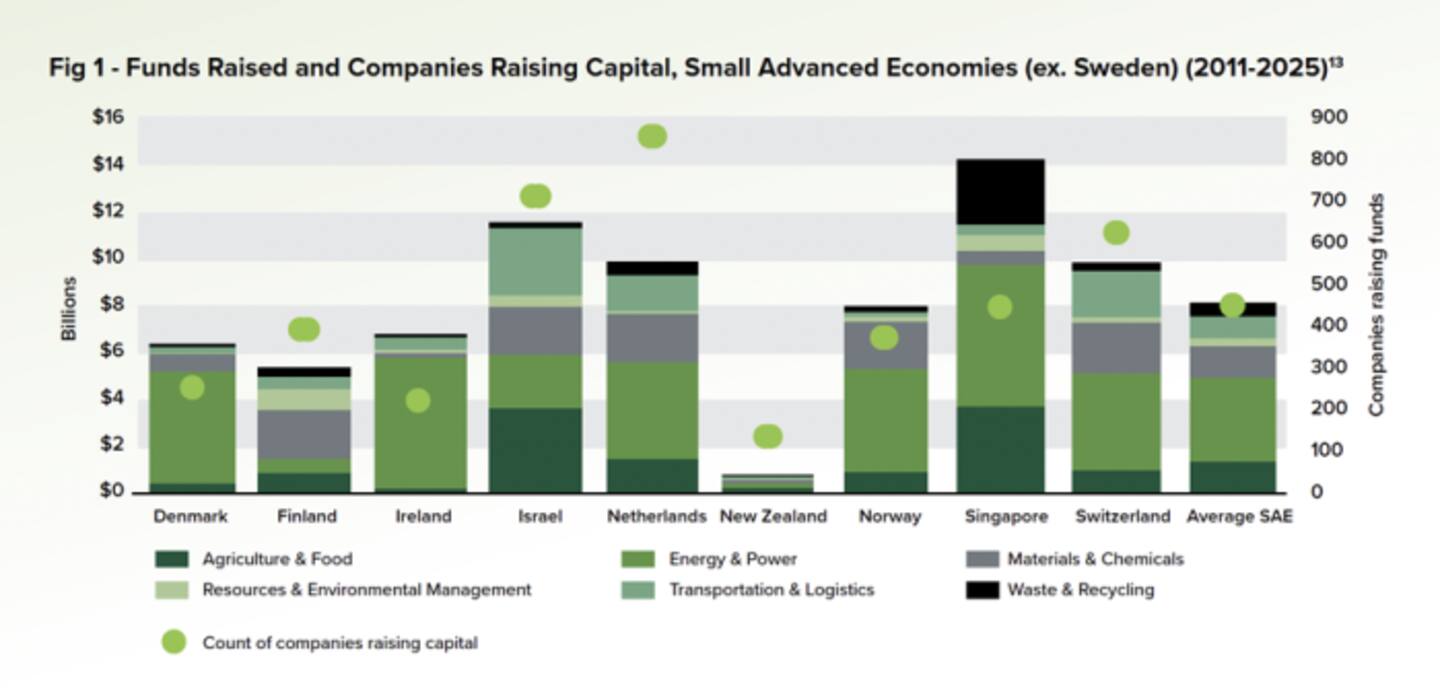
In total, 52 reporting companies raised $68.6 million in FY25 and $105.3m in FY26. On paper, that 53% increase looks healthy. In reality, it is underpowered. Other small advanced nations spend much more.
We are talking about capital‑intensive technologies that must traverse a brutal “valley of death” between prototype and commercial deployment, often requiring heavy hardware, industrial pilots, and international certification.
Capital speeds growth
The longer‑term data is even starker. A subset of companies surveyed in 2024 and 2026 had planned to raise $280.6m in FY25. They actually raised $29m, just 21% of their target. Some cut headcount, others shelved or slowed projects.
While they recalibrated, the climate clock and the geopolitical risk dial moved in the wrong direction.
Meanwhile, these firms are not small‑time lifestyle businesses. The report shows they employ a highly skilled workforce of around 943 FTEs across 82 companies, with average salaries in 2026 of around NZ$93,000 – above the national mean.
This is exactly the kind of talent base you’d want in a strategic sector, and it is being kept on a relatively short financial leash.
“In cleantech, capital does not just speed growth. It determines which technologies survive long enough to prove themselves,” Dr Rod McNaughton, Professor of Entrepreneurship at the University of Auckland Business School, said last week.
“The report underplays one important weakness,” he pointed out.
“New Zealand may be good at producing researchers, but we still have work to do in building the capabilities, incentives, and partnerships needed to turn strong science into new ventures.
"A promising pipeline is encouraging, but it may also conceal the ideas and technologies that never made it far enough to be seen.”
We should treat cleantech as critical infrastructure and a core plank of national security, offering greater investment, support, and coordination.
The war in Iran will pass through its grim phases, as every conflict does. But our ongoing fossil fuel dependency is an invitation to the next crisis.
For a small, trade‑exposed nation at the end of the world, betting on cleantech is not a virtue signal. It is self‑defence.