
Musings on a dog, dogs, and getting old.

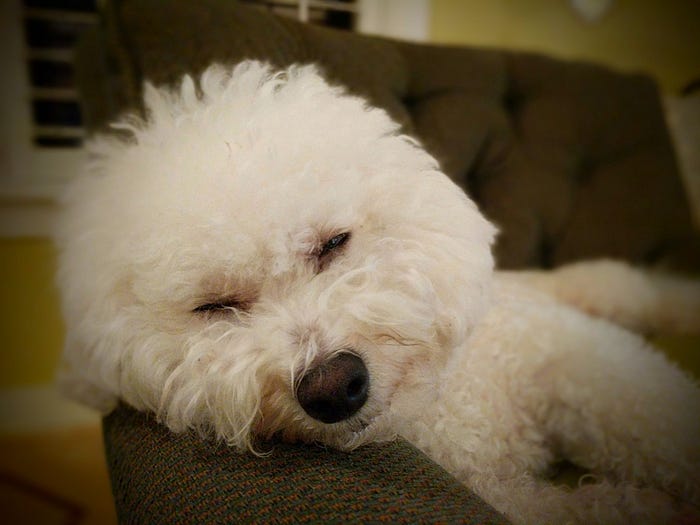
Photo by Author
Bob, our dog, died on August 28, 2025. He was 17 years old. Bob had been declining for a long time. He was blind. He was deaf. He couldn’t jump up on the bed, or the couch, or the ledge from which he used to supervise the neighborhood. None of those handicaps prevented him from being a good dog, but then he began having seizures. Terrible seizures in which he became disoriented and convulsive. Reluctantly, we called the vet. We paid her to come to our house, and she euthanized Bob on our living room couch.
It was sad.
Bob was a bichon frisé. My wife is skilled at interior design, so our home is both comfortable and aesthetically pleasing. Bob matched our decor.
When we were first considering a dog, my wife proposed a bichon. I scoffed. A little fluff ball. I was looking for a manly dog. Possibly a working dog (although I worked in a law office where there were never any tasks a dog, working or otherwise, was qualified to do). But being a good husband, I looked into what she had suggested, and it turned out that bichons make good pets. Smart, non-shedding, and hypoallergenic. The smart part was important to me because I would be the one in charge of training.
We bought Bob from a breeder. I told my wife to spend as much as she wanted because no matter how much we spent, the cost would be dwarfed by the expenses of ownership over the lifetime of the dog. When we are looking at that kind of money, I told her, we might as well get what we want at the beginning.
We have friends who get their dogs from the animal shelter. They get a dog as a favor to the dog. I don’t do that. I get a dog to enrich our lives. We try to give the dog a comfortable, healthy life, but it isn’t about the dog.
My sister-in-law always objected to Bob because he was a purebred. She pointed out repeatedly that inbreeding has made purebreds weak and subject to medical problems. She might be right, but when choosing a dog, I’m never in a situation where I can go out and steal a pup from a feral bitch who lives in the wild, free of selective breeding. I have to pick from what’s available.
I suppose I could seek a medium-sized, short-coated dog with erect ears, and a light brown coat, which is reputed to be what dogs would look like if humans hadn’t tinkered with them. Or if I couldn’t find one of those, I might have a breeder create one for me. But I don’t. I get a purebred for the predictability. With a recognized breed, I know how big the dog will get, how much exercise it will require, what its general temperament will be, and what health problems it will face.
Get Orrin Onken’s stories in your inbox
Join Medium for free to get updates from this writer.
It’s still a crap shoot. Like buying a car, you play the odds. A certain breed of dog or brand of car may have an excellent reputation, and yours still be a nightmare.
Bob turned out fine. By age 2, he could do a reliable off-lead heel and was trained not to cross a curb without permission from a human. In the early years I taught him a bunch of tricks, but it turns out that other than come, sit, heel and don’t go in the street, there wasn’t much I really wanted Bob to do. In middle age, when I asked him to do his tricks, he would still do them, but he rolled his eyes at me in a way that said, “Really, aren’t we a little old for this nonsense?”
Bob became well known in my community as the dog that didn’t walk on a lead. People knew his name who didn’t know mine. Strangers would come up to me and say, “Is that Bob? I’ve heard about him.”
One day, I was walking Bob and a police cruiser pulled up beside me. I thought I was finally going to get nailed for violating leash laws. The cop jumped out of the car, rushed up to me, and said, “That’s Bob, isn’t it. Can I pet him?”
I let the officer pet Bob.
Bob had the health problems common to bichons: skin issues, allergies, cataracts. We spent a lot on his grooming. We didn’t have to have him professionally groomed, but we liked Bob looking good. He lived a long time. Longer than any other dog I’ve had. With all his problems, he was still healthier than my sister-in-law’s animal shelter dog.
After Bob died, we threw away his beds, his food bowls, and his toys. We keep finding little reminders of him under furniture and in drawers. Coming home to the house without Bob to greet us feels lonely.
Eventually we will face the question whether to get another dog. We are old. The odds are that neither of us has another 17 years in us. If we get a puppy, which is preferable for me if I am going to train again, it means all the work and life constraints that go with raising a pup. When puppyhood ends, then training starts. Training a dog takes a commitment of time and effort that I’m not sure I am willing to make again.
Having a well-trained dog is a delight, and I am happy that Bob didn’t have to spend much of his life on a leash. But dog training takes place outdoors, and you can’t take days off. That makes it tough when the Oregon rains come, and we haven’t seen a dry day for weeks. I remember coming back from training sessions with both of us soaked to the skin. I’m not sure I can do that again.
We won’t decide about another dog for a while. It’s one of those things you wait on until the time is right. How will I know when the time is right? My wife says we will just know. She is always right about things like that.
Sign up here to receive our free weekly newsletter featuring the best of Crow’s Feet: Life As We Age.