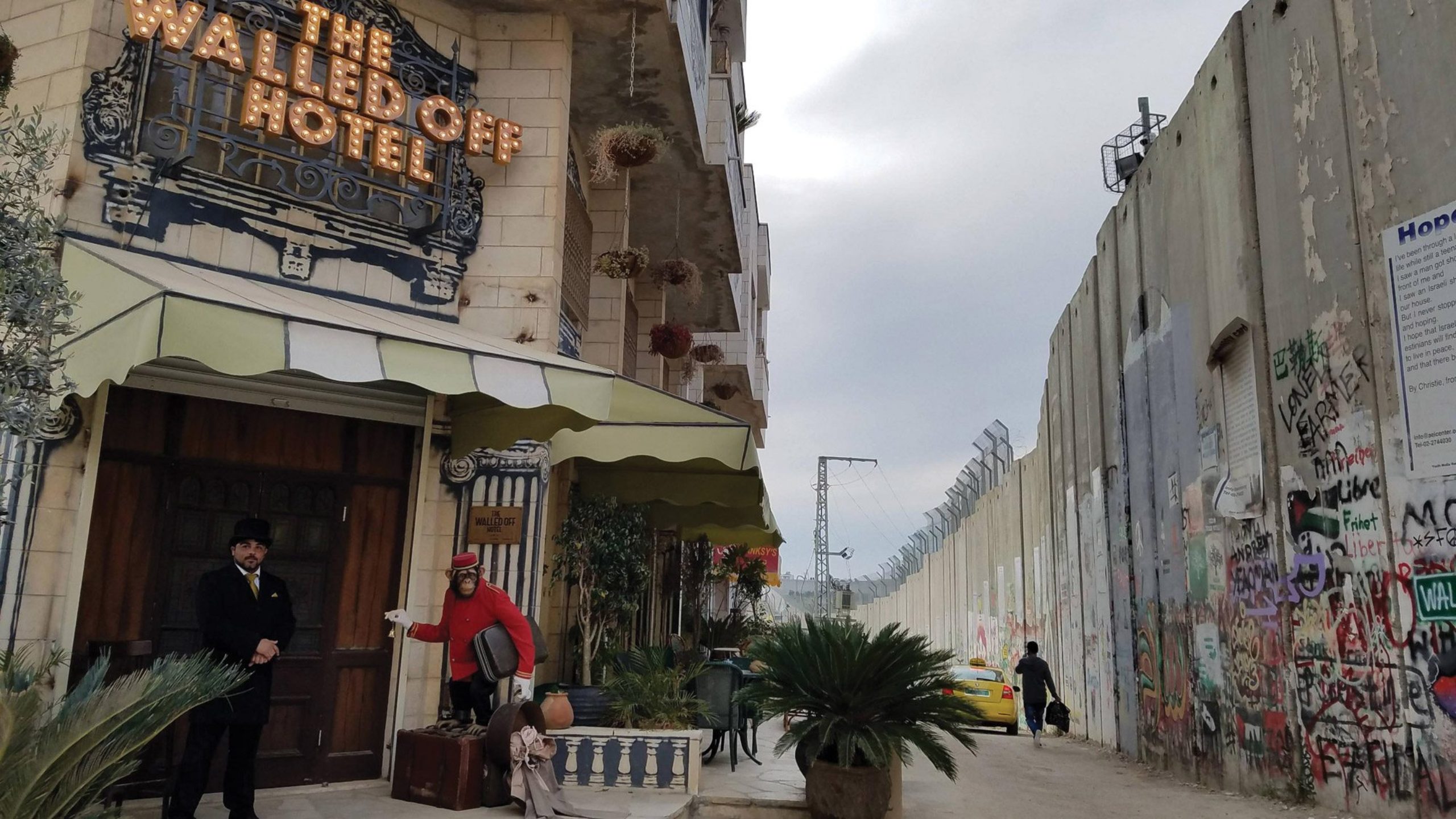
The bartender delivered my manhattan wearing a red vest and tie, an image—and drink—I wasn’t expecting to see when I crossed Israel’s “Green Line” into the Palestinian territories to research a school for fourth-generation refugees. But here I am, sitting in the lounge of a boutique hotel in the centre of Bethlehem’s concrete jungle, which is riddled with road blockades and rancid garbage.
The bartender also wasn’t expecting to find such a place. She was trained off-site and kept in the dark about its owners until her first day on the job. “We didn’t know what it was until the public did,” she told me. It wasn’t until staff stepped inside that they realized it, although the name outside, written in marquee lights, was also a dead giveaway: The Walled Off Hotel.
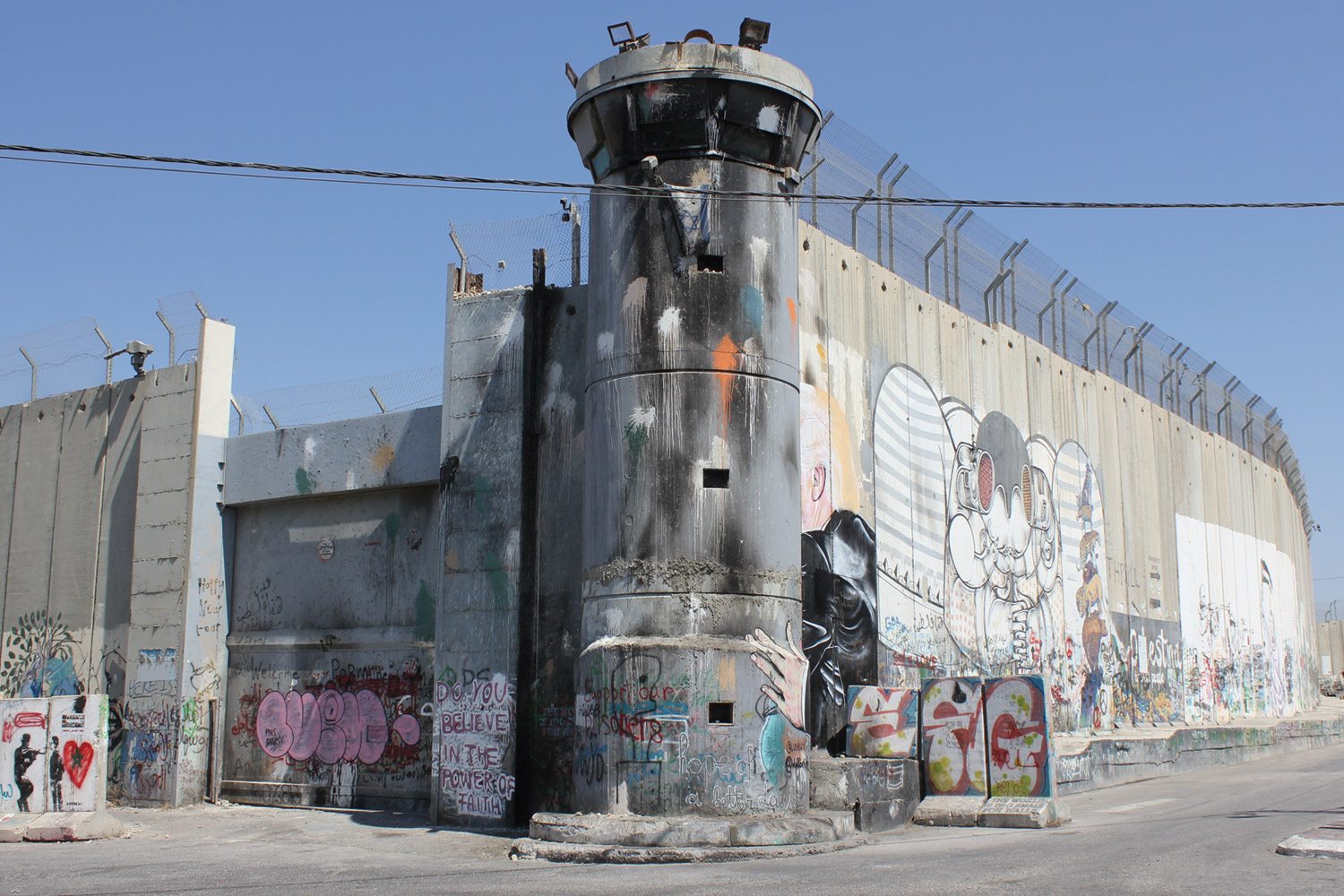
Adjacent to an Israeli military watchtower and an eight-metre-high cement wall that stretches 644 kilometres around (and sometimes through) the West Bank, the boutique hotel—complete with a top-hatted doorman and plastic “bell chimp” chained to the building—looks like someone had snuck a frame from a Wes Anderson movie into Black Hawk Down.
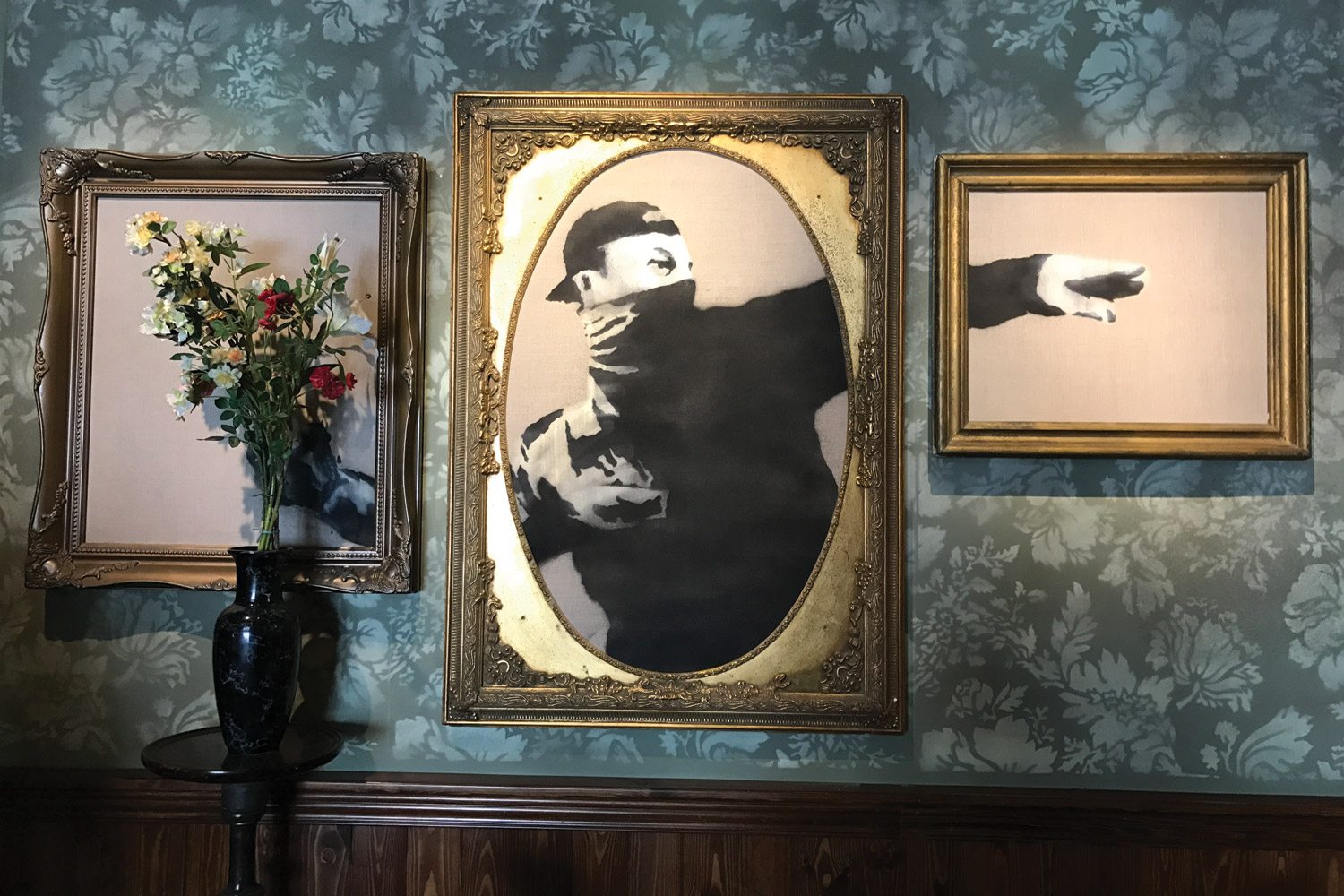
Inside the lobby and restaurant, a plush red leather booth sits under eight security cameras of various sizes pointed at would-be diners. A Hellenized bust of David has been dressed with cotton smoke fumes swimming out of an Israeli tear-gas canister, and a Palestinian flag crosses a beat-up one from Great Britain—the colonizer that cut up Palestine for a Jewish homeland after the Second World War. Any doubts in the staff’s minds about who was behind it vanished after seeing the three-panel painting replicating Rage, Flower Thrower, one of Banksy’s most famous paintings, which he left behind during one of his increasingly frequent trips to the Palestinian territories.
Something like this has been bubbling for a while. In 2005, Banksy painted nine optical illusions on The Wall—trompe-l’oeil scenes that imagine a sky-blue paradise on its other side. Over the years, he has added well-recognized stencils of a pigtailed girl frisking a soldier, a soldier checking a donkey’s travel documents and a bulletproof-vested dove just footsteps away from the new hotel. He has painted walls in the highly restricted and demolished Gaza Strip, too, which, in a 2015 faux-travel ad, he revealed he had accessed via a tunnel. Critics have speculated for years about whether he is “taking a side” in the occupation, or commenting broadly on war, but one of his recent murals leaves no room for speculation. In blood red, it reads: “If we wash our hands of the conflict between the powerful and the powerless, we side with the powerful—we don’t remain neutral.”
He really wants you to know this shit ain’t right.
Can we even be sure Banksy is a he, not a she or a they? Not Massive Attack’s Robert Del Naja? Palestinians don’t seem to care much about his identity, but they like the art. Taxi drivers offer informal tours of his murals. Gift shops selling Banksy’s works on key chains and mugs have opened with painted wooden signs. This must greatly amuse Banksy, who directed the documentary Exit Through the Gift Shop. There’s even another “Banksy Hotel,” a crude B&B whose owners tell a dubious story about receiving verbal permission from the artist himself while he worked on the side of a road. If Banksy isn’t the world’s most famous living artist, he’s at least Palestine’s.
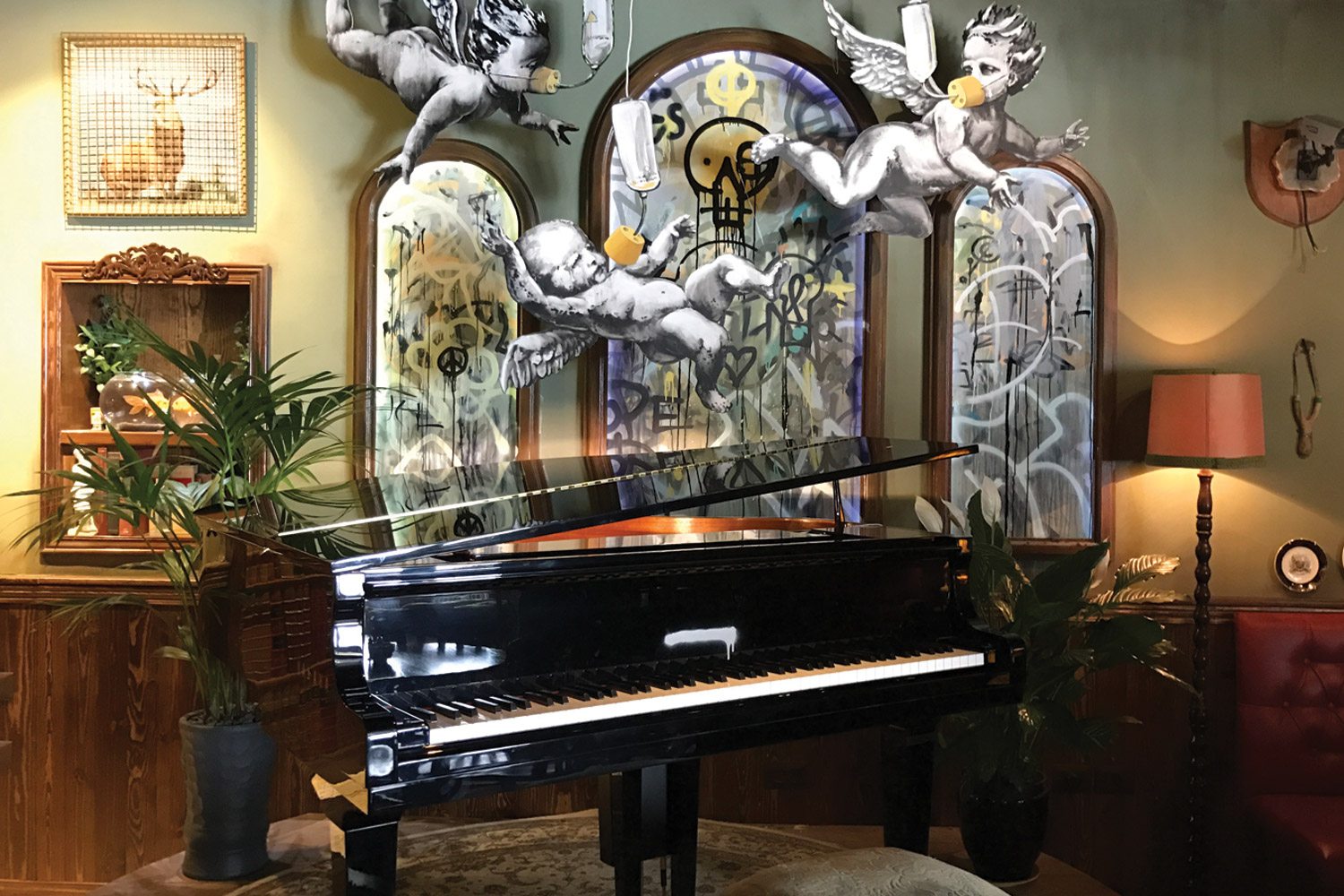
When I arrived at The Walled Off Hotel in August, five months after its opening, every bed was booked, from the $60 U.S. per night barrack bunks behind mosquito netting in the budget room to the $965 U.S. President’s Room, outfitted with Copacabana wallpaper, tiki bar and a plunge bath—“everything a corrupt head of state would need,” the website advertises.
Regardless of budget, I would have gotten the chance to sleep under an original Banksy piece—a mural of a Palestinian and an Israeli soldier pillow-fighting, perhaps.
Although the rooms get 25 minutes of direct sunlight daily, and the hotel’s slogan boasts “the worst view in the world,” The Walled Off Hotel can be a decadent experience. This has upset some people, labelling it a highly commercial squeeze of conflict tourism or, as some prefer to call it, “oppression tourism” (something Banksy’s art has mocked). It’s owned by a local businessman, and, sure, it’s creating good paying jobs, but should there even be a Drake Hotel or a Waldorf Astoria in a conflict zone?
Others have been critical of painting The Wall— beautifying it, in a way—because they’d rather you see it for what it is: an oppressive weapon, not a selfie backdrop. Because the art is in a conflict zone, and most often a commentary on it, praising it can feel like praising the conflict, too. Some artists simply won’t touch the occupation wall, a taboo that’s exasperated by the hotel’s sanctioned paint shop. Called “Wall Mart,” it rents out spray paint and stencils so you can put your own mark on the wall. Tourists are dissuaded from painting anything trifling—they want it to remain a commentary on occupation, even though the space outside the hotel is cluttered beyond comprehension.
The barrier began in 2000 after the Second Intifada (uprising) to prevent suicide bombers, according to the Israeli government. But open discussion of walling off the territories predates the 1993 Oslo Accords, which returned partial governance of the West Bank to Yasser Arafat’s Palestinian Authority. Predating all this, Palestinian street art has been a significant messaging tool. What covertly began in refugee camps is now out in the open, with many sophisticated large-scale murals signed by their creators and institutional collaborators. As a result, “bougie” magazines like Condé Nast Traveler and Travel + Leisure have hailed Bethlehem as one of the world’s best cities for street art.
A hotel designed by an anti-establishment artist is full of self-contradiction, a point that’s not lost on the contributing artists or the guests. But whatever argument wants to be made about The Walled Off Hotel—whether it’s part of the problem or the solution—it’s best not made until after you visit.
After paying for my cocktail (there’s a comprehensive mocktail list, as we are in the Muslim world, as well as high tea in the spirit of British colonialism), I ascended the stairs to a gallery of exclusively Palestinian art. Until then, the only art I’d seen in West Bank was on some cement or stone surface, and it was all politically charged: cheeky messages like “Make Hummus, Not War,” murals of Leila Khaled, a 1969 female hijacker who is a bona fide folk hero, or rawer stencils and posters of the faces of dead young men (“martyrs,” in local parlance). I was starting to wonder if Palestinian art could even be apolitical, but here I found beautiful impressionist and nature-inspired paintings, plus a social-realist masterpiece by famed Palestinian Sliman Mansour.
I loved these expressionist watercolour portraits of women by May Murad, a young painter in Gaza. I later emailed her to ask if commodifying the occupation wall with a hotel and graffiti bothered her. She said, “The Berlin Wall fell before it physically came down, when the first protester walked along it and wrote on it and when the first painter erased [the wall’s] stern face to give it a human dimension.”
Besides, she said, it meant more to her that she have an opportunity to exhibit in Christ’s recorded birthplace, a few kilometres from the Church of the Nativity, perhaps the only tourist trap in all of West Bank. The Walled Off Hotel is already Bethlehem’s number two, and it alone propelled West Bank to the top of the UN’s list of fastest-growing tourist destinations. “That the exhibition is located in a place visited by people from all countries further helps my message reach the world,” Murad told me. The opportunity is also greater than anything she could get at home in Gaza, where Hamas restricts free expression. “There are paintings I can’t even show in Gaza,” she said.
As for whether The Walled Off Hotel oversimplifies the 69-year-old conflict, or understates the suffering, the answer is found in the least photogenic room of the three-storey house. The nameless museum first struck me as more cheeky sarcasm because to enter I had to pass a wax British foreign secretary Arthur Balfour signing the declaration for a Jewish state a century ago this November, shortly before it was seized from Ottoman rule. Past the animatronic, a message board of everyday opinions from both sides of the conflict in English, Arabic and Hebrew suggested that I was in for some good old-fashioned “both sides-ism” that would end with “Keep the peace, brother.” But the exhibit resists false equivalencies. Instead, its objective is to share with you what life is like in the Palestinian territories.
There’s a shelf of rubber bullets, stun grenades, dog muzzles and other everyday weapons of the occupying forces managing check-stops and conducting raids. Other nooks are dedicated to government propaganda, resistance art and a comprehensive video showing the gains of Israeli territory since 1948. There are displays of refugees’ heirlooms passed down through generations, as well as a glass box of what’s been pulled from the ruins—children’s shoes and bags. I answered a ringing phone, and a throaty voice told me that I had five minutes to evacuate my home before the missile comes—translated from a real practice called “roof knocking,” which gets its name from the drone-operated “warning rockets” fired on the building that accompany the call. The most artistic and provocative deviation is an exhibit called A Tooth for a Tooth, showing a single human molar on one side of the Scales of Justice outweighing hundreds more on the other. According to an infographic nearby, during the last battle, in 2014, there were 2,203 casualties on one side, 73 on the other.
Though the museum places appropriate guilt on Britain and Palestine’s history of suicide bombers, I came out of it convinced that, at this point, the power for peace is primarily an Israeli responsibility. Banksy, in a rare statement to The New York Times, has said as much: “I don’t want to take sides. But when you see entire suburban neighbourhoods reduced to rubble with no hope of a future—what you’re really looking at is a vast outdoor recruitment centre for terrorists. And we should probably address this for all our sakes.”
In another offering sure to make people queasy, The Walled Off Hotel also provides tours of refugee camps twice a day. But it is far from the first entity to squeeze dollars out of the misery. Private groups will even take you to the hotly contested city Hebron to see the cage above the bazaar protecting shoppers from rocks and trash dropped by Jewish settlers above and then hand you over to another guide who has special permission to take you into the military-guarded ghost town in the process of becoming another illegal settlement. In fact, by the time I found out about The Walled Off Hotel’s guides, I’d already booked one through my hostel, Ibdaa Cultural Center, which sits at the foot of Dheisheh refugee camp, where I was researching a book about a Canadian social studies teacher I’m writing. He travels to places like this to better teach his students about them. The square-kilometre zone is inhabited by 15,000 refugees from four generations and is a hotbed for members and recruits of the Popular Front for the Liberation of Palestine, Leila Khaled’s secular political group.
My guide, Gehad Ramadan, happened to be The Walled Off Hotel’s doorman (making fine use of his nursing degree). As we climbed the skinny sloping streets, he recounted stories of being shot, arrested and detained for protesting both the Israeli forces and the Palestinian Authority—and sometimes for just breaking the occasional 24-hour curfew imposed by Israel. (The longest lasted 40 days.) “I was born here, raised here, and I’m determined not to die here,” he said.
Before I arrived at my hostel, I imagined the camp would be a clutter of tents and shanties, but after 69 years, Dheisheh is almost indistinguishable from the rest of Bethlehem. The first concrete wall went up in 1952, after a deadly winter killed refugees. The first private bathroom was erected in the 1970s, and, eventually, in 1995, the cage-linked fence around it came down and it essentially became a more densely populated subdivision. The street art here is mostly concerned with martyrs and the Palestinian right of return (UN resolution 194), although I couldn’t avert my eyes from the Xs over the Star of David or the mural of the leader of Hezbollah. But the walls only told one story; the ground tells another: rubber bullets and tear-gas canisters littered along the ledges of the building.
It’s here I realized one of the major purposes of street art, whether by Bansky or anyone else: Beyond expressing a message of resistance, hope, or despair, the art attracts visitors—those jetsetters reading Condé Nast Traveler, for instance—and then shows them the reality of living under an oppressive occupation. That’s the magic of street art: It turns the environment into context. It opens your eyes to the urban conditions, however oppressive or posh they may be.
The Walled Off Hotel works to the same effect. There will be skeptics—critics who argue it’s all preaching to the choir anyway—but shortly after I returned from Palestine, I learned that two friends, Andrea and Natasha Ross, had booked themselves a room at the hotel (after their Birthright trip, a free 10-day heritage trip offered to every Jew under 27 in the world). Of the 40 people on the trip, the twin sisters from Edmonton were the only ones to cross the Green Line into West Bank, although they didn’t know that that was even an option until news of Banksy’s hotel broke. Until then, the closest they got was a West Jerusalem viewpoint overlooking the territories.
Andrea and Natasha admitted to feeling self-conscious about their heritage (“I wasn’t going to broadcast the fact that we’re on Birthright,” said Natasha), and they worried that the hotel would be either exploitive of Palestinians or hostile to Jews. They also felt guilty sleeping under a potentially million-dollar work of art with their Canadian passports, while, at four in the morning, thousands of Palestinians lined up with their own papers at a nearby turnstile to get to their day jobs in Israel (although Andrea reckons the guilt was “kind of the point”). But, in the end, they never felt unsafe and got a chance to understand an unflattering part of their ethnic homeland they otherwise wouldn’t have. “The hotel is a gateway to going to West Bank,” said Natasha. “If it didn’t exist, honestly, we wouldn’t have gone.”