Most politicians wouldn't dare play up the idea that they were anointed by God to win an election. But that's what Trump is doing, and some of his supporters believe it
By Nicole Gaudiano
At a Donald Trump rally in New Hampshire, two of the former president’s supporters shared their prophecy about his reelection.
Tara Alves and Dorina Marisola Moriarty saw no need for Trump to participate in GOP presidential primary debates – not when he was already the winner and would become president again. “He’s anointed by G-O-D,” said Alves, a Massachusetts resident who attended the summer rally, told The Messenger
Her friend Marisola Moriarty added that the “divine courts of Heaven” had already decided the matter. “What God appoints, no man can flush,” she added.
Trump isn’t known as a church-going man. But the twice divorced former president, who faces 91 felony counts across four criminal cases, and who has been found liable for sexual abuse, has developed a loyal following over the past eight years among white evangelicals, who overwhelmingly voted for him in the last two presidential elections.
“The idea that he was specially sent, or anointed to be a kind of savior of Christian America is in the air in that fervent part of his religious base,” said David Gushee, a Christian ethics professor at Mercer University.
Most politicians of faith wouldn't dare play up the idea that they were anointed by God to win an election. This view is out of the mainstream and anathema to a lot of people of faith.
But Trump gets away with it because a significant chunk of his Evangelical supporters see him not as an ordinary political figure but as “something transcendent,” said Gushee.
- Prominent Iowa Evangelical Doesn’t Believe Positive Polls on Trump In His State
- Why Does DeSantis Keep Making ‘Politics 101’ Rookie Mistakes?
- ‘The Chosen’ Star Jonathan Roumie Reveals How Portraying Jesus Brought Him Closer to God (Exclusive)
- GOP Candidates Focus On Abortion To Court Evangelicals In Iowa
- Americans Hedge Their Bets on the Afterlife: More Believe in God than the Devil
- Pope Tells Young Transgender Person ‘God Loves Us Just as We Are’
Their zeal helps explain some of his curious moves recently on social media, touting an alignment with a higher authority. On Truth Social this week, Trump shared an image of his likeness kneeling and praying at a church pew. The image appeared fake. His right hand seemed to have six fingers.
That post followed his recent sharing of the bizarre video, “God Made Trump,” ahead of the caucuses. "And on June 14th, 1946, God looked down on his planned paradise and said 'I need a caretaker,' so God gave us Trump," the narrator says.
Before that, he shared a courtroom sketch of a brawny looking Jesus sitting by his side during his bank fraud trial in October.
In over-the-top ways, he’s been playing to Evangelical voters who helped him crush his GOP rivals in the Iowa caucuses – and who could be critical to his success in a general election against President Joe Biden.
A Trump spokesman did not respond to a request for comment. But Trump is clearly focused on this voting bloc. On the eve of the New Hampshire primary, Trump quoted a story about a Washington Post-Monmouth University poll of Granite State voters: “Trump has a 52-point lead among White evangelical Christians, but still has a 10-point lead among those who are not.”
Playing the role of persecuted, much like Jesus
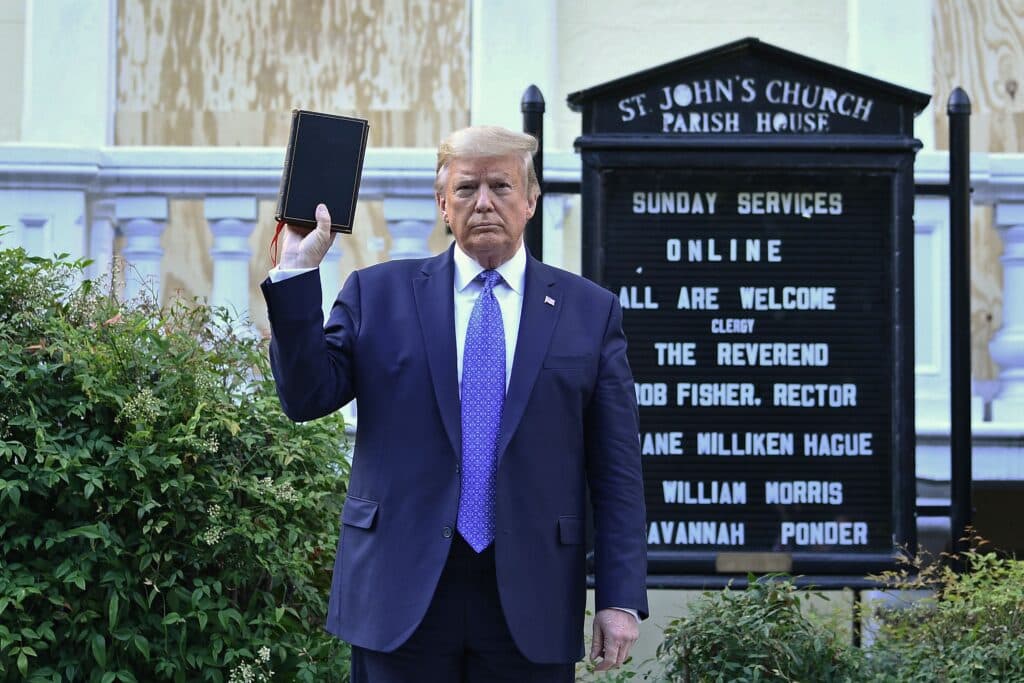
Trump’s outreach to these voters is nothing new. Memorably, after police used tear gas against peaceful protesters outside the White House in 2020, he hoisted a Bible as a photo op at St. John’s Episcopal Church, outraging religious leaders for using the Bible as a prop.
The “God Made Trump” video, created by the pro-Trump Dilley Meme Team, drew criticism, as well. Some Iowa pastors complained, one telling the Deseret News it was “absolutely sickening.” The anti-Trump Lincoln Project parodied the video with its own, “God Made a Dictator.” And Late-night host Jimmy Kimmel responded to the clip, “Even Jesus was like, ‘Jesus!’”
But while some in religious communities see such allusions as blasphemy, others among Trump’s die-hard, evangelical supporters may have a different view.
They see him as not only sent from God to “make America great again” for Christians but as someone who will defend Christians who believe they’re under attack by cultural elites and government, according to Gushee. He’s also aware that such images speak to the part of his base who sees him in religious terms.
“This embrace of a persecution narrative is emotionally very powerful for a lot of people,” said Gushee, author of "Defending Democracy from Its Christian Enemies.” “And Trump is brilliant at exploiting the sense of embattlement, of identifying with it, of claiming to be … the chief victim, and the chief defender of this population.”
Consider Trump’s statement following his federal indictment in June: “They're not coming after me. They're coming after you, and I'm just standing in their way.”
Trump is tapping into rhetoric that evokes a sense of persecution for Evangelical Christians as a way to mobilize voters, said Elizabeth Shakman Hurd, chair of Religious Studies and professor of Political Science at Northwestern University.
“It's an effective way of getting people on his side. ‘You should be scared, you need to be worried, you need to take my side, or you will be persecuted,’” she said. “He needs to have some kind of ground to get people to back him.”
She added he’s using “languages that resonate with themes that are familiar to his listeners and his prospective voters” that can act as a “really compelling call to action” during the election.
'He's doing this for us' -- Trump is being indicted 'for you'
Trump supporter Bethany Mambume explained on MSNBC how Trump’s line, “I’m being indicted for you,” speaks to her.
“My first thought went to, ‘Well, Jesus Christ died for my sins. Jesus died for me,’” she explained. “It connects in my brain that way. Like, OK, he’s doing this for us as a country to make the changes we need to make, and he’s the target where we don’t have to be.”
His arraignment during Holy Week in April, on charges that he hid hush money payments to an adult film actor and former Playboy model, also led to Jesus comparisons. “Jesus! Jesus was arrested and murdered,” said GOP Rep. Marjorie Taylor Greene of Georgia, who noted that Trump was joining “incredible people in history” with his arrest.
Most Republican voters (64%) consider Trump to be a person of faith and 47% said he is “religious,” but their least common reason for saying so was because he’s “actively engaged in religious and faith communities,” according to a national poll conducted by HarrisX for the Deseret News. Instead, more respondents pointed to his defense of people of faith (67%) or his support for policies focused on families (60%).
Before winning the Iowa caucuses by a 30-percentage-point margin, Trump announced more than 300 endorsements from faith leaders in all 99 Iowa counties. His campaign touted Trump’s record of nominating three Supreme Court justices who helped overturn Roe v. Wade, moving the U.S. embassy to Jerusalem, and his expansion of a policy to block U.S. aid to international groups that promote abortions.
“When he defeats Joe Biden in November, President Trump will once again restore biblical values to the White House, fight for religious freedom, protect America’s unborn, and support the family as the foundation of society,” said Brad Schroeder, senior pastor at Harvest Church of Huxley in Story County, in a statement shared by the campaign.
“Civil religion,” where God is deployed on behalf of a policy or politics, is not uncommon. Florida Gov. Ron DeSantis, who ended his presidential campaign on Sunday, used similar messaging in November ahead of his gubernatorial election. The ad posted on X by his wife Casey said that God made a “fighter” in DeSantis. It didn’t land well.
“I'm not sure that any other Republican politician can play this game the way that Trump can because he now has this cemented kind of Savior vision … vision of him that goes back eight years,” Gushee said. “I don't know that everybody can just do that.”
The Messenger's Stephanie Murray and Rebecca Morin contributed to this story.