A lot of people have their money working for them. The real question is how hard. That’s what GalaxyOne is built around.
If you make over $200K a year or over $300K a year combined, you probably qualify as an accredited investor. Galaxy Premium Yield pays 8.00% on cash, guaranteed by Galaxy Digital. Everyone on GalaxyOne earns 3.50% APY on GalaxyOne Cash, an FDIC-insured checking account power by Cross River bank.1
The best part is you can set that interest to auto-invest straight into your favorite stock, ETF, or crypto.2 You don’t have to think about it every month, and that’s why I love using GalaxyOne myself!
So if you also want your money working for you, it’s time to make a move.
Sign up and start earning today
Today’s letter features a guest post from Nick Fouriezos, a former Washington correspondent who leads launches for tech founders and investors. He’s been digging into a new AI hedge fund that’s betting against the obvious AI trade. I think you’ll learn a lot.
To investors,
There is a strange contradiction in markets right now.
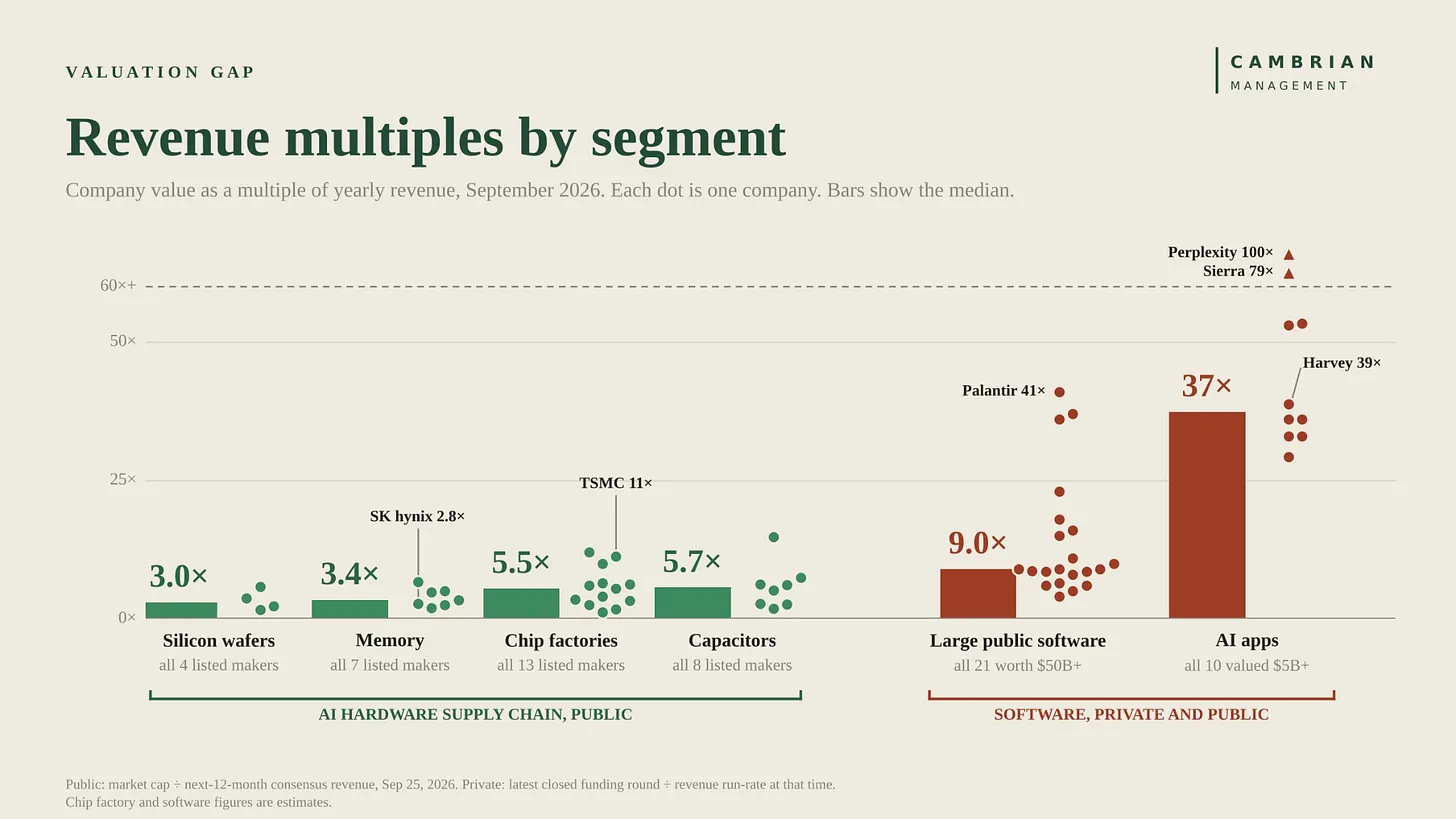
The AI boom has pushed frontier labs and private AI apps to sky-high valuations. AI labs trade at 15-30x their revenue run rate, while leading apps are valued at 25-40x revenue. Those premiums are understandable given their hyper-growth cycles.
But they also assume their moats hold, even as they look more fragile by the month.
Open-source models are closing the performance/affordability gap on frontier labs. And better AI keeps making the software giants easier to copy or build internally.
In contrast, a few hundred supply chain companies control the physical chokepoints that actually make all that AI run, from silicon wafers and memory firms to chip factories and capacitors.
Yet these oligopolies trade at just 1-5x revenue and 5-15x earnings … despite arguably holding a more durable moat for the AGI era.
That analysis is the core thesis behind Cambrian Management, a new $70M AI hedge fund that launched this week.
Its managing partner is Lonis Hamaili, with backers including Metaplanet, the Bitcoin treasury company, and Skype cofounder Jaan Tallinn.
First, improved models will destroy lab and software moats.
The first wave of the SaaSpocalypse has already hit.
In April, SaaS companies like Figma, Duolingo and Monday.com all fell more than 80% from their highs, and have only marginally recovered since. The next wave could easily come for the disruptors themselves.
Take Harvey, the legal AI startup just valued at $15.5 billion.
Its customers pay per seat, with unlimited use.
Harvey pays the AI labs per token. When its new AI agents took off, usage jumped twentyfold. By June, its gross margin had reportedly swung from about +50% to about −50%, according to Bloomberg.
Harvey fixed it by building its own model on a free Chinese open-source model, cutting costs by up to 90% on some tasks.
That should worry the frontier labs. Harvey now pays them only for its hardest work. And it isn’t alone: Decagon reportedly runs about 80% of customer queries on its own models.
Harvey isn’t out of the woods either.
Every Harvey deployment comes with a ‘legal engineer,’ a former practicing lawyer. It employs about 180 of them. That more hands-on model could eat into its margins and undercut the SaaS-like premiums it was built on.
Over time, many law firms can hire those people themselves and build in-house (as some are already). Cambrian is betting that will become even easier as we approach AGI.
Second, the physical infra will remain scarce
The AI supply chain has more than 100 layers, each taking decades of knowledge and relationships to build.
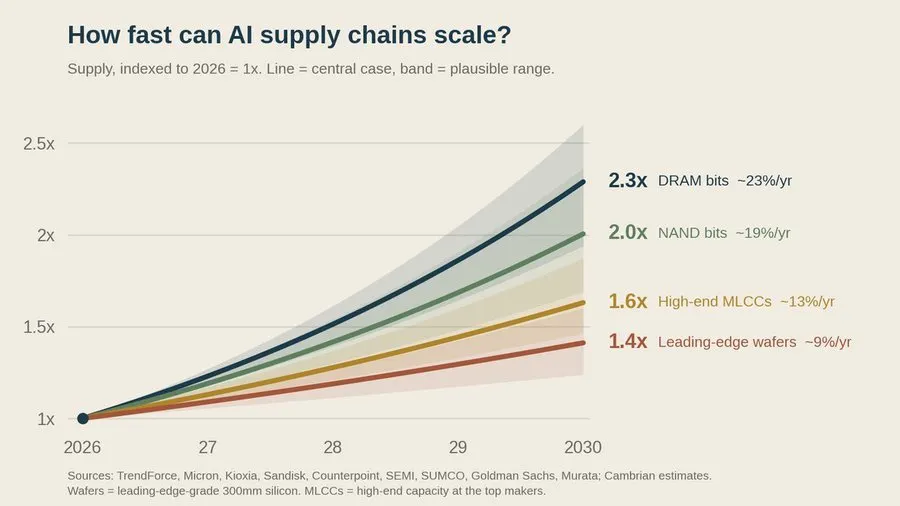
Even with Chinese output, Cambrian’s Lonis argues that key commodity supply will barely double by the end of the decade.
That shortage is showing up in prices. In August, the major Taiwanese wafer makers raised prices at least 10%, breaking a three-year freeze.
Memory chips are even tighter.
In June, Apple raised Mac and iPad prices, blaming the memory shortage in an unusually frank statement:
“We have never seen a component price increase this much, this quickly,” the company said.
Third, AI customers will outbid everyone else
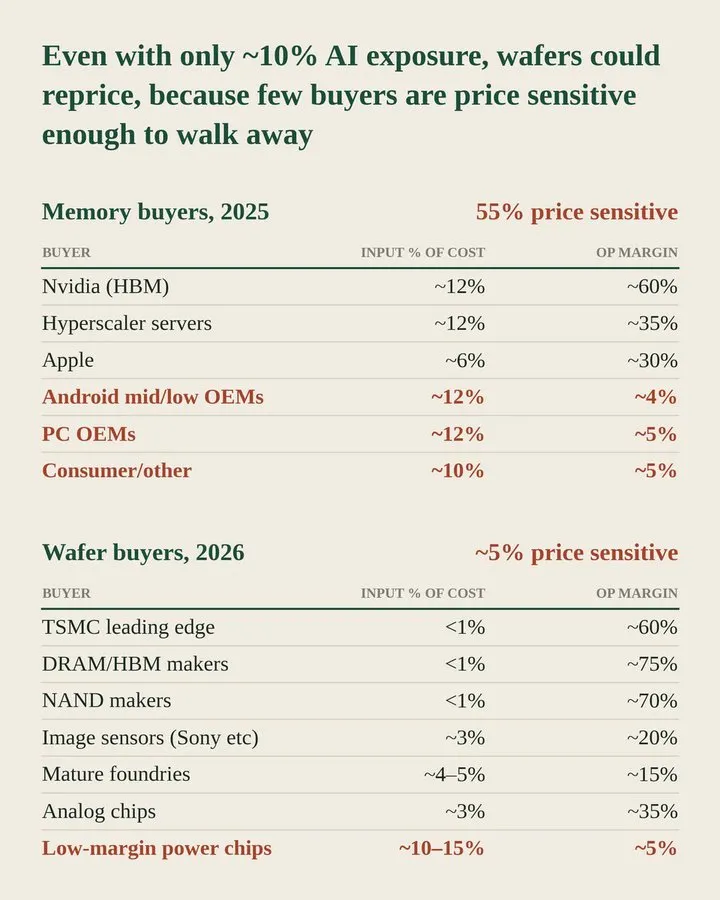
A supplier can only raise prices when its customers will pay.
Phone and PC makers fought every memory price increase, which is part of why memory prices didn’t rise until late 2025.
In their winner-takes-all race to AGI, the frontier labs and hyperscalers have already shown that price is no object.
They need the chips. That’s why Lonis tracks AI beta (the share of a supplier’s revenue that comes from AI) as a key indicator for supply chain companies being able to raise prices.
Fourth, the suppliers may be the safest AGI hedge
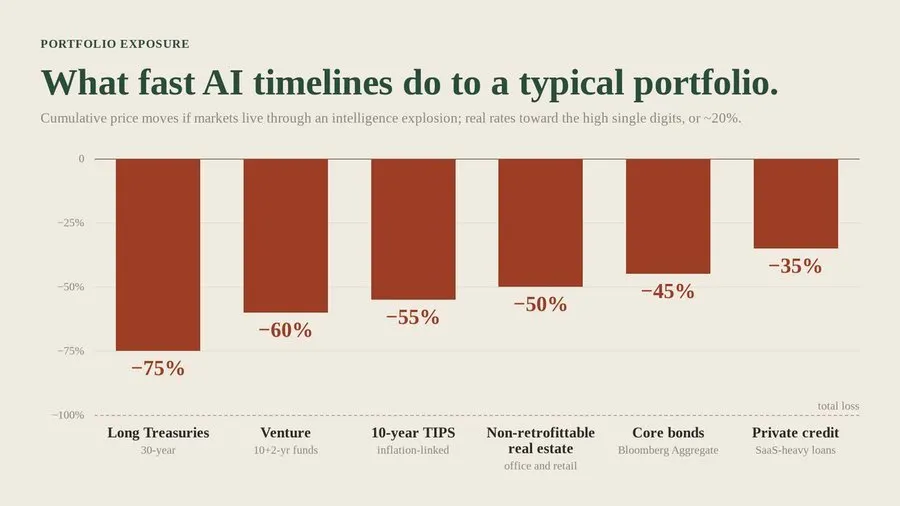
Traditional portfolios could be exposed if fast AI timelines “nuke” PE, VC, and RE in relative value, as Lonis argues in this chart:
Also, owning the supply chain only requires that the AI sector keeps growing.
Owning OpenAI or Anthropic requires that lab to keep its lead.
- Nick Fouriezos
🚨 Anthony Pompliano is hosting the ETF Investor Forum on November 3rd in NYC, bringing together 700+ investors, advisors, and ETF industry leaders to discuss where capital is flowing next.
The lineup includes Dan Ives, Jan van Eck (VanEck), Eric Balchunas (Bloomberg), Robbie Mitchnick (BlackRock), Matt Cole (Strive), Ankur Nagpal (USVC), and many more.
Pomp Letter readers get 50% off tickets with code POMPLETTER.
Get Your Tickets Here
GameStop CEO: The Machines Are Already Smarter Than Us
Ryan Cohen is the CEO and Chairman of GameStop and the co-founder of Chewy. This was recorded live at the Silvia Investor Summit in New York.
In this conversation, we break down how AI is changing work and hiring, his concerns about where humans fit in an automated future, and the rise of the retail investor. We also discuss Neuralink, how he talks to shareholders, his biggest failure, and the legacy he wants to leave.
Podcast Sponsors
Figure – True DeFi Democratized Prime yielding ~8.5% APY. They also have the lowest industry interest rates at 8.91% with 12 month terms! Take out a Crypto Backed Loan today. Figure Lending LLC dba Figure (NMLS 1717824)
Arch Public’s platform automates your trading strategy beyond DCA for equities, commodities, ETFs, and crypto. With advanced inputs that reflect your own intentions, Arch Public supports smarter entries, exits, and opportunities in volatile markets. Connect with their team, try the product for free, and see how agentic trading can work for you, with Arch Public!
Fitnexa is an AI-powered wellness technology brand. Its SomniPods 3 combine intelligent sleep technology with all-night comfort to support better rest and recovery. Use code POMP10 for 10% off.
Investor Health — Clinician-prescribed protocols for weight, metabolism, and longevity, shipped to your door in 48–72 hours. No office visits. InvestorHealth.com.3
GalaxyOne – Earn up to 8.00% yield4 on cash. Auto-Reinvest into stock and crypto.
Lava - The Lava Card allows you to earn up to 5% back in bitcoin every time you spend. There are no annual fees, no FX fees, and no gimmicks. You can also use Lava to borrow against your bitcoin at 6.5%, the industry’s lowest interest rate. Get started in just a few minutes at lava.xyz/pomp!
Simple Mining offers a premium white-glove Bitcoin mining service. Want to grow your Bitcoin stack? Visit https://www.simplemining.io/pomp
Uphold - Uphold is the all-in-one platform to trade, earn, stake, and swap across 300+ assets with real-time proof-of-reserves and any-to-any conversions. Manage your entire crypto portfolio in one place at www.uphold.com
🚨READER NOTE: If you want to sponsor The Pomp Letter, you can fill out this form and someone from our team will get in touch with you.
You are receiving The Pomp Letter because you either signed up or you attended one of the events that I spoke at. Feel free to unsubscribe if you aren’t finding this valuable. Nothing in this email is intended to serve as financial advice. Do your own research.