To investors,
Asia’s AI trade is unwinding. South Korea’s KOSPI is more than 40% below its June peak after last week’s “Black Thursday,” and China’s stock market just posted 11 straight red weeks despite 4.5% GDP growth. The short answer for investors: this is fear about AI spending and higher Treasury yields, and governments are already stepping in. Here are five charts that explain it.
Each Friday, the Pomp Letter publishes five charts that helped us make sense of the world this week. We hope these will bring you clarity.
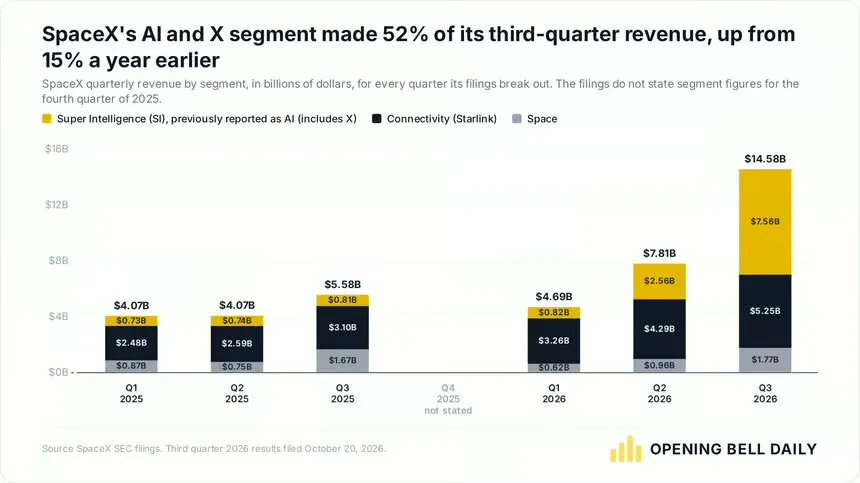
1. SpaceX Now Gets Most of Its Revenue From AI and X
(Phil Rosen, Opening Bell Daily)
SpaceX’s AI and X revenue grew more than ninefold in a year, from $810 million to $7.56 billion. Over the same stretch, the rocket business grew 6%.
Most of that AI money isn’t coming from chatbots. It’s coming from renting out computing power to other companies.
Our friend and colleague Phil Rosen said it best: “Investors who bought SpaceX for rockets and Starlink now own a stock that gets more than half its quarterly sales from AI and X. Unreal.”
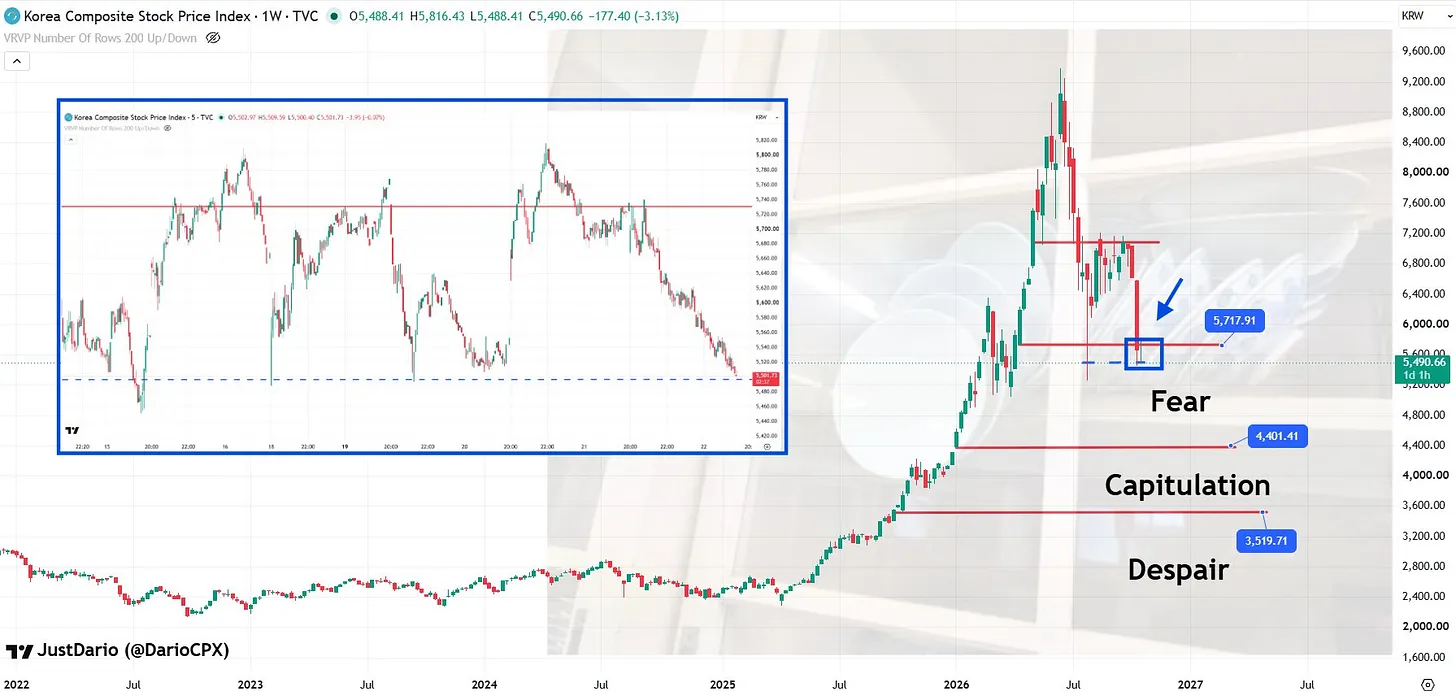
2. Korea’s Black Thursday: Why the KOSPI Is Down 40%
(Dario Catodici, JustDario.com)
Last week, South Korea’s KOSPI plunged nearly 8%, a session local press called “Black Thursday.”
The biggest winners of the AI boom fell hardest. Samsung sank 9.5%, and SK Hynix fell more than 11%. The KOSPI is now more than 40% below its June peak.
That’s close to the average drop in Korea’s seven previous market crises, including the 1997 Asian financial crisis and 2008, according to Daishin Securities.
The trigger was fresh doubt about AI spending, along with rising Treasury yields that make safer bonds look more attractive.
“Ultimately, the AI revolution will be judged not just by how much computing power we build, but by how profitably we use it,” Manish Singh of Crossbridge Capital told Bloomberg.
AI’s future is one of nearly unlimited productivity potential. Its present though is one of high debt-servicing costs.
On Thursday, Hong Kong-based analyst Dario Catodici warned the KOSPI was “on the verge of crashing hard again, 3rd time this week,” with “a high chance that tomorrow will be Black Friday in Korea if a miracle does not strike.”
He was close. On Friday, the KOSPI fell as much as 4.1%, then reversed to close up 0.3%. SK Hynix, one of the hardest-hit names, finished up nearly 5%.
No miracle needed, at least not this week.
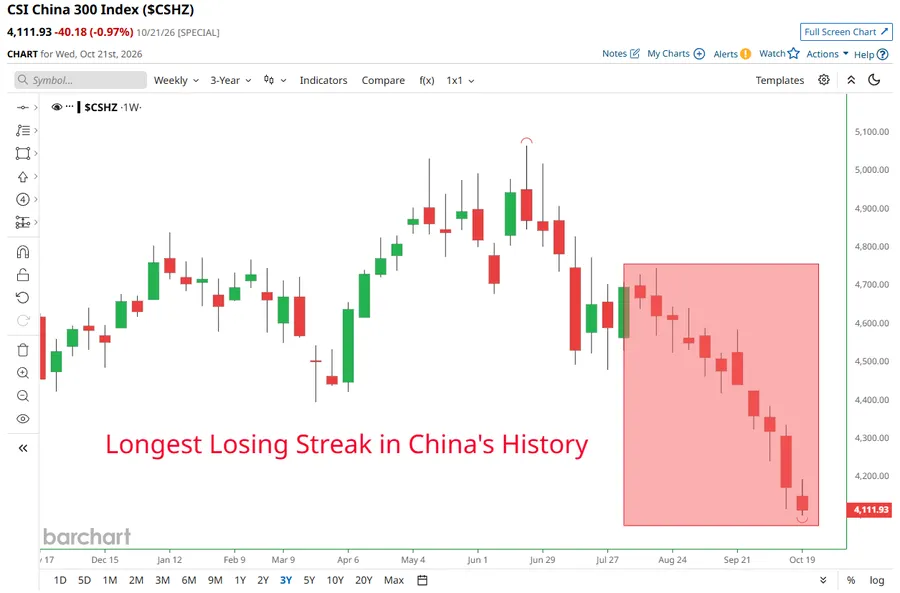
3. China’s Stock Market Has Its Worst Losing Streak on Record
(Barchart)
It’s not just Korea. China’s economy just beat expectations, growing 4.5% last quarter.
Yet its stock market is having its worst run on record, with 11 straight red weeks.
Another sign that traditional economic indicators say little about how markets will perform.
The chip and AI stocks that powered China’s spring rally are now leading the drop.
China’s tech-heavy STAR 50 is down about 40% since June 30, and chip stocks are down 45% this year.
This is what an AI trade unwinding looks like.
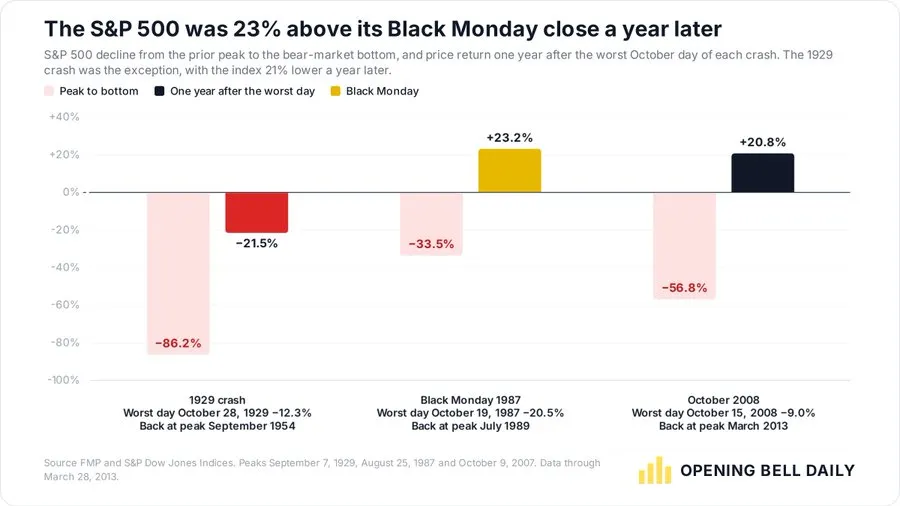
4. Governments Now Step In at the First Sign of Trouble
(Phil Rosen, Opening Bell Daily)
Beijing isn’t waiting to find out how bad it gets. State-backed funds are buying stock ETFs at the fastest pace since July.
It’s the same government playbook that Pomp highlighted at the Silvia Investor Summit two weeks ago, where he said he doesn’t expect another 18-month recession in his lifetime.
At the first warning sign, governments step in. History shows why. Black Monday turned 39 this week. On Oct. 19, 1987, the S&P 500 fell 20.5% in a single day.
The Fed promised to flood the system with cash, and a year later the index was up 23%.
After the October 2008 crash, Washington stepped in again. Stocks were up 21% a year later.
5. Crypto Hacks Are Cybersecurity’s Canary
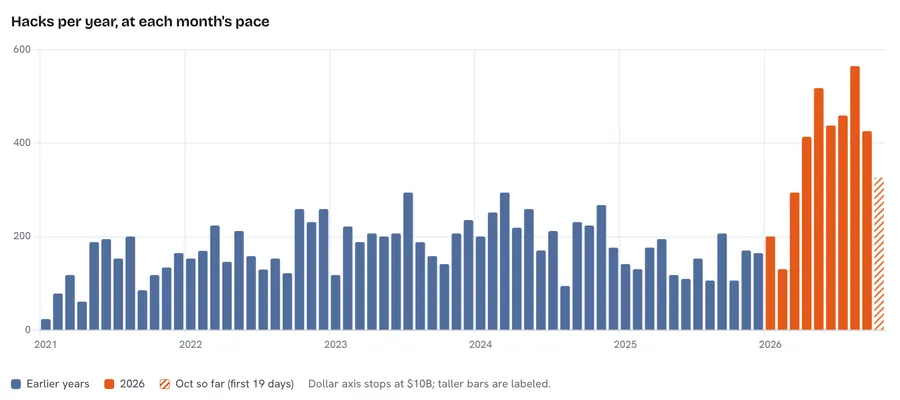
With the help of AI, hackers are having their best year ever, at least by volume.
Crypto hacks in 2026 are running at more than double their usual pace … serving as a glimpse for what the general web can soon expect.
“Onchain hacks are a canary for what will happen in the rest of web security, because onchain is the first and easiest place to monetize cyberattacks,” says Haseeb Qureshi, managing partner at Dragonfly.
The big protocols have hardened their defenses, many with AI tools of their own, leading hackers to find more vulnerable targets
“The dollar value of hacks has gone down, while the number has gone up—a mass looting of small, poorly maintained protocols,” Quereshi adds.