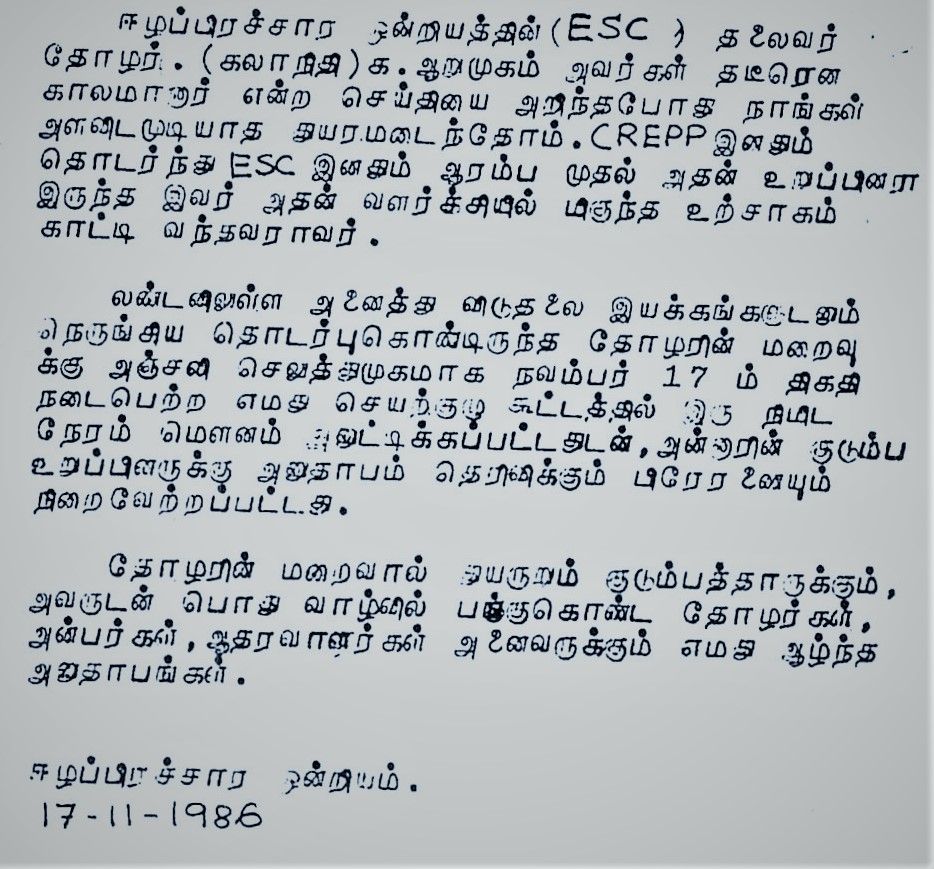
It was sometime in 1981. I was talking to a friend in my home in Colombo. My friend was a Tamil who was working abroad as a Vice President of a large multi-national corporation and he was in Sri Lanka on a short visit. He said: "You know, in Dr.Arumugam, we have a future Prime Minister of Eelam - he is one of those few Tamils who can help to bring many of us together." I had not met with Aru at that time. But I did meet with him in the years that followed and I believe that I came to know him and also understand him. I also came to understand something of that which my friend had said in Colombo in 1981. Last week when I heard that Aru had passed away, my immediate feeling was one of having suffered a personal loss. It was a feeling that comes from the passing away of a human with whom one has shared not only many thoughts but also many feelings and experiences. Each one of us is a composite of matter, life and mind and to the extent that we integrate all these elements into a larger whole, we move towards becoming whole and therefore holy - and to that extent, we are more evolved. Aru was one of those more evolved humans. He was more internally integrated than many and it was this which was often reflected outwardly as his 'integrity'. There were many occasions when I did not agree with his conclusions - but there was never a moment when I doubted his integrity. To him, as for Mao Tse Tung, theory was the most practical of things. And a theory divorced from practise was not for him. He had the capacity to laugh openly and I enjoyed laughing with him. He had a clear mind and he was equally at home with Karl Marx and with Aurobindo. And the philosophy of Saiva Siddhanta was not unknown to him. He cared for people and I know that he has helped many in unobtrusive ways and without expectation of any return. Aru, in his own life, gave content to Lord Krishna's injunction to Arujna on the battlefield of Kurushetra: "To action you have a right - but not to the fruits thereof.". My wife as well as my son, who is in his twenties, enjoyed his company as much as I did, but not always for the same reason. Aru was not only a personal friend - he was a family friend. The largeness of a human is often showed by his capacity to relate to a wide spectrum of people, of different ages, coming from different backgrounds and with different aspirations. The friends that Aru has left behind reflects the largeness of the man. It is related in the Mahabaratha, that when Tharmar, the eldest of the Pandavas, was questioned as to what was the most surprising thing in the world, he replied: "The most surprising in the world is that man knows he must die, but he lives as if he will never die." Aurobindo, for whom Aru had an enduring affection, commented many thousands of years later that this feeling that impels a man to live as if he will never die, was but a shadow of his true immortality - an immortality which we may glimpse from time to time in our moments of inner quiet and peace, when our chattering mind is silent. Aru was a good and honourable man in a world where goodness and honour are not always easy to find. In his death, the Tamil people have lost an untiring and steadfast fighter for justice, his family a caring husband and father, and many of us, a friend to whom we could turn to. |

Some Tributes .... When the phrase the 'abundance of the heart) was first coined, it is likely that the author had visualised rare people like Dr Arumugam who has been suddenly snatched from our midst on the morning of 9th October 1986. His large heartedness was legendary, his keenness to help transcended all barriers. His enormous fund of goodwill was never exhausted. The endearing terms in which he was referred to - Aru and Doc Aru - reflected the warm affection which bound him to his friends and associates. After a brilliant career at St John's College, Jaffna, where he won several prizes, he entered the University of Ceylon, where he passed out with a first class in Civil Engineering and went on to a research scholarship in the United Kingdom. On his return to Sri Lanka after obtaining his doctorate, he joined the Civil Engineering Faculty of the University of Ceylon before coming over to England. Aru was a classic example of a generation of Tamil academics, whose brilliant services were lost to Sri Lanka as a result of their being treated as "second-class citizens" in the land of their birth. On this fateful day, Aru was walking along the corridor of the City University, (where he was a Senior Lecturer in Civil Engineering) to his lecture hall, when he collapsed and never regained consciousness. His sudden demise has been a rude shock to the members of his family, colleagues and numerous friends and associates. It was only the previous evening that he had taken part in the vigil organised by the Eelam Solidarity Campaign (of which he was Chairman) opposite the United Nations Refugee Rehabilitation office in London. Aru has left a void in the Tamil expatriate scene, which it would be difficult, nay impossible, to fill. It is tragic that he has passed away at time of great crisis for the Tamil community. He spearheaded the campaign of the expatriate Tamil community in the United Kingdom for the rightful place of the Tamil people in the body politic of Sri Lanka. Even before the terrible anti-Tamil violence of 1977, Aru had initiated through the Pothukai Trust, a broad plan to assist the deprived sections within the Tamil community by raising their standard of living. The events of 1977 which displaced thousands of Tamils convinced him that the tasks ahead required wider support from the expatriate community and that is how the Standing Committee of Tamil Speaking People - SCOT - came to be inaugurated in that year. He was its first President and throughout the nine years since then, has been its main guiding force. SCOT today is a leading Tamil organisation in the UK with strong links with relief agencies and expatriate communities outside the UK. It was largely his vision, his deep concern for the less privileged sections of our community, his insistence on credibility and accountability that have put SCOT in a position to channel support of those outside Sri Lanka, who are concerned with the sufferings of the Tamils of that country. Aru along with his wife Lingeswari and daughter Ponni formed a closely knit family. His loss must be a great blow to them. They might derive some consolation from the fact that their great grief is one that is shared by many hundreds, and perhaps that thought might sustain them in the days to come. While we miss him and grieve for what we cannot but feel was his premature death, we are thankful that we had the privilege of knowing and being served by someone who was a giant among men. but endowed with an abundance of humility. A great tree has been felled by the remorseless forces of nature. Those of us whom he left behind have a duty by him and the great vision for the future which he represented - to translate that vision into a reality. May the great soul rest in peace." |

"An outstanding academic, full of warmth and generosity..." - Prof. P. O. Wolf, Department of Civil Engineering, City University, London, October 1986 He had been an outstanding postgraduate research student at Imperial College in the early I950's and has been described by one senior academic as the most brilliant and most efficient doctoral candidate known to him over a period of 37 years. Aru brought to The City University an unbounded enthusiasm for his speciality, Fluid Mechanics, an enthusiasm which he passed on to his colleagues and the many undergraduate and postgraduate students with whom he worked. In addition to his teaching and research Aru was a member of the Board of Studies in Civil Engineering, Senior Tutor for research and he was also responsible for initiating a Master's degree course in Water Resources Engineering in collaboration with Queen Mary College, University of London. Apart from his departmental responsibilities, Aru had also served the University as a whole as a member of Senate and was, for a time, treasurer of the local branch of the Association of University Teachers and an active member of the local committee. He was a citizen with a great sense of responsibility and his concern for the problems in Sri Lanka was apparent to all who knew him well. Aru had a great love of books and of knowledge and truth. He enjoyed discussion on many subjects always demonstrating his clear understanding of the problems involved. Some of his colleagues and postgraduate students will remember him also for his culinary skills for he introduced them to the delights of Sri Lankan cuisine at the parties that he organised for them. Above all Aru will be remembered with affection for his personal warmth and generosity, for his willingness to give support to all who sought his help and for his joviality at all times. He will be sadly missed both as a friend. and as a colleague by all who knew him at the City University and in his field of work outside." |

"Unassuming, simple and humble..." - P.Rajanayagam, Editor, Tamil Times, October 1986 Although Dr. Arumugam played an invaluable role in the work of the expatriate Tamil community in focusing attention on the trials and tribulations to which this community has been subjected in Sri Lanka, he eschewed narrow nationalism and ethnic chauvinism. He was passionately committed to the liberation of the Tamil people of Sri Lanka from majority domination and oppression, but he never condoned the excesses committed in the name of liberation. Even in the context of the almost unbridgeable gulf that had developed between the Sinhalese and Tamil communities of Sri Lanka in recent years, his contact with all the positive and progressive sections in Sri Lanka never ceased. Dr. Arumugam's premature demise is a great loss to the City University where he taught for over 20 years, to his family and above all to the Tamil people of Sri Lanka for whose liberation he was actively engaged at the time of his death." |
A Dictionary of Ceylon Tamils - Dr.K.Arumugam 1925-1986, B.Sc (Cey)., PhD(Lond) Senior Lecturer, City University, London He then proceeded on scholarship to Imperial College, London, for post graduate work, in the early 1950's. He got his Doctorate in Civil Engineering. His favourite subject was Fluid Mechanics. Returning to Sri Lanka he was for a short time with the University of Ceylon. In 1966 he accepted a Lecturer's post in the Faculty of Civil Engineering at the City University, London. Later, he was appointed a Senior Lecturer there. Besides his work in lecturing and research, he was a Member of the Board of Studies Civil Engineering and a Member of the Senate of the University. He initiated a new course in Water Resources Engineering at the University. His work has been much appreciated and highly commended. Dr. Arumugam was a popular member of the Tamil community in London. He was one of the prime movers in the founding of the "Standing Committee Of the Tamils", known also as "S.C.O.T" organisation, established for the welfare of the Tamils. He was its first President in 1977 and continued to function as a leading figure even afterwards, till his demise. On 9th October 1986, while walking along the corridors of the University, he collapsed from a heart attack and passed away. His sudden demise was a great loss to the Tamil community in Great Britain." |

Eelam Solidarity Campaign. November 1986 |