Design by Verywell Health; Getty Images
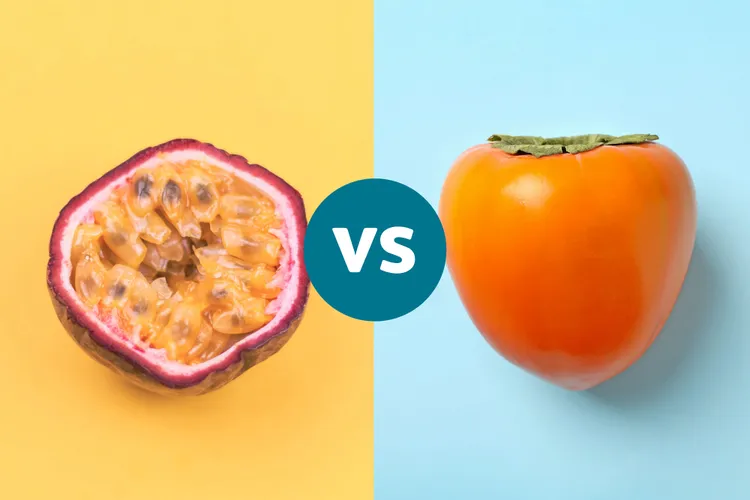
Both passion fruit and persimmon offer a wide variety of nutrients, including vitamins, minerals, and dietary fiber, making them a solid choice for an easy, healthy snack. But if you’re wondering which of the two is better for blood sugar stability, passion fruit is the clear winner.
How Passion Fruit and Persimmon Can Affect Blood Sugar
Because passion fruit contains a high amount of soluble and insoluble dietary fiber, it’s a good choice for those who are trying to manage their blood sugar and follow a low-carb diet.1 Persimmon, on the other hand, contains less fiber and more sugar, so it’s more likely to cause moderate blood sugar spikes.2
Passion fruit also has a lower glycemic index (GI) and glycemic load (GL) than persimmon.21 Glycemic index refers to how fast a food that contains carbohydrates raises blood sugar levels, while glycemic load measures how fast a carbohydrate raises blood sugar and the total amount of carbohydrates per serving. Passion fruit’s GI and GL are low, while persimmon’s are moderate. This means persimmon is more likely to cause a faster and higher blood sugar spike than passion fruit.
Research shows that the pulp and seeds in passion fruit, which are rich in dietary fiber, help to slow digestion and the absorption of glucose.3 Preliminary research has also found that bioactive compounds found in passion fruit seeds, leaves, and peel may support glycemic control in people with diabetes.4
One scientific review presented preliminary evidence that compounds in persimmons may help regulate glucose metabolism—how your body processes sugar—though there is currently no evidence that eating persimmons lowers blood sugar in people with diabetes. 5
| Nutrition Facts: Passion Fruit Vs. Persimmons | ||
|---|---|---|
| | Passion Fruit (per 100 g)6 | Persimmon (per 100 g)7 |
| Fibre | 10.4 g | 3.6 g |
| Carbohydrates | 23.4 g | 18.59 g |
| Total Sugar | 11.2 g | 12.5 g |
| Glycemic Index | 30 | 50 |
| Glycemic Load | 4 | 9 |
Can You Still Enjoy Both While Managing Blood Sugar?
Because of its high fiber content and low GI and GL, passion fruit is highly recommended as part of a healthy diet for those with diabetes or anyone trying to manage their blood sugar.
Persimmons, on the other hand, may be less ideal for those managing their blood sugar. But you can always pair them with other sources of fiber, healthy fats, and protein to help slow digestion and mitigate a blood sugar spike.8
Here are some foods you can pair with the fruit to reduce the blood sugar impacts:
- Nuts or seeds: Eating a persimmon alongside nuts or seeds, such as almonds or pumpkin seeds, can help blunt a blood sugar spike because the fiber and healthy fats in these foods slow digestion and glucose absorption.
- Greek yogurt: Adding a source of lean protein, such as Greek yogurt, alongside fruit can slow digestion and minimize blood sugar spikes.
- Cheese: The fat and protein in cheese help to slow digestion and reduce blood sugar spikes, making it a good pairing choice for persimmons.
The Bottom Line
If you’re trying to follow a diet that focuses on blood-sugar-friendly foods, passion fruit is a better option than persimmon because of its high fiber content, low GI, and low GL. In general, foods with less sugar and higher fiber are better for those trying to manage their blood sugar.
Persimmons can still be a part of your diet if you’re worried about your blood sugar, but you’ll want to pair them with other foods that are rich in fiber, healthy fats, and/or protein rather than eating them on their own.