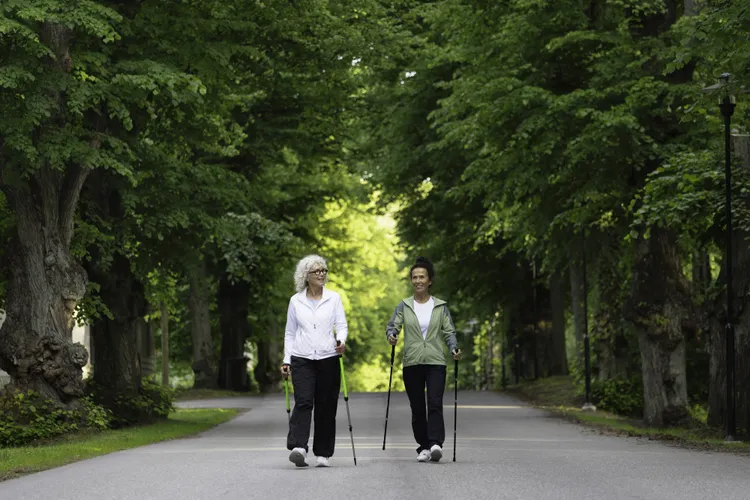
Walking is widely considered one of the best exercises you can do for your health. It’s beneficial for your heart, muscles, and joints, and it’s also free and accessible. But is walking alone enough exercise to keep the average person healthy and fit?
We asked Kai-Yu Ho, DPT, PhD, the interim chair and an associate professor of physical therapy at the University of Nevada, Las Vegas, to find out.
*This interview has been edited and condensed for length and clarity.
Q: If you walk regularly but don’t do any other exercise, is that enough to keep you in good health?
Ho: Walking is great exercise for the general public, but I wouldn’t say it’s enough on its own.
Walking is great for cardiopulmonary endurance. You get moderate-intensity cardio, it helps with the basic range of motion in your joints, and it requires whole-body coordination. Walking is an essential skill, especially when you are outdoors and have to navigate your environment. It is very good for the brain. It’s also free and doesn’t require a gym membership or any equipment.
For individuals with Parkinson’s, someone who’s had a stroke, or an individual with a cardiac condition, walking is particularly good to slowly regain strength, relearn motor skills, and regain range of motion. For people with osteoarthritis, walking is also beneficial because it helps lubricate the joints.
Walking is definitely very good, but it’s not everything. Especially if you are older, you also need to be doing some kind of resistance training and stretching.
Q: Why is strength training necessary?
Ho: For older adults, and older women in particular, the chance of bone mineral density loss is significant. Walking can provide some stress on your bones to keep them strong, but it is not sufficient to prevent osteoporosis. Strength training is essential to prevent both muscle volume loss and bone density loss.
Ideally, you want to be doing some kind of strength training two or three times per week. That might look like doing exercises with weight machines, free weights, resistance bands, or your own body weight.
Start with 10 reps per exercise. You’ll know the resistance is enough to get some benefit when the last few repetitions feel challenging. If it’s too easy and you feel like you could do 50 reps, then there isn’t enough resistance. As you get stronger, you can increase the number of reps or the amount of resistance.
Q: Why is stretching important?
Ho: Walking doesn’t require much flexibility, so we also recommend some stretching. You need to have enough muscle or tendon flexibility so you don’t get hurt when you reach for something or bend over. The body can become very stiff without stretching, and that can result in injury. So ideally you’d do some stretching before and after you walk.
Q: How much should you walk?
For most people, I would recommend at least 30 minutes, three to five times per week. If you have pain, you can start off with shorter walks more frequently, like a few 10-minute walks in one day.
Once you feel more comfortable and your body feels better, you can increase it to 30 minutes per session per day, and keep increasing from there.